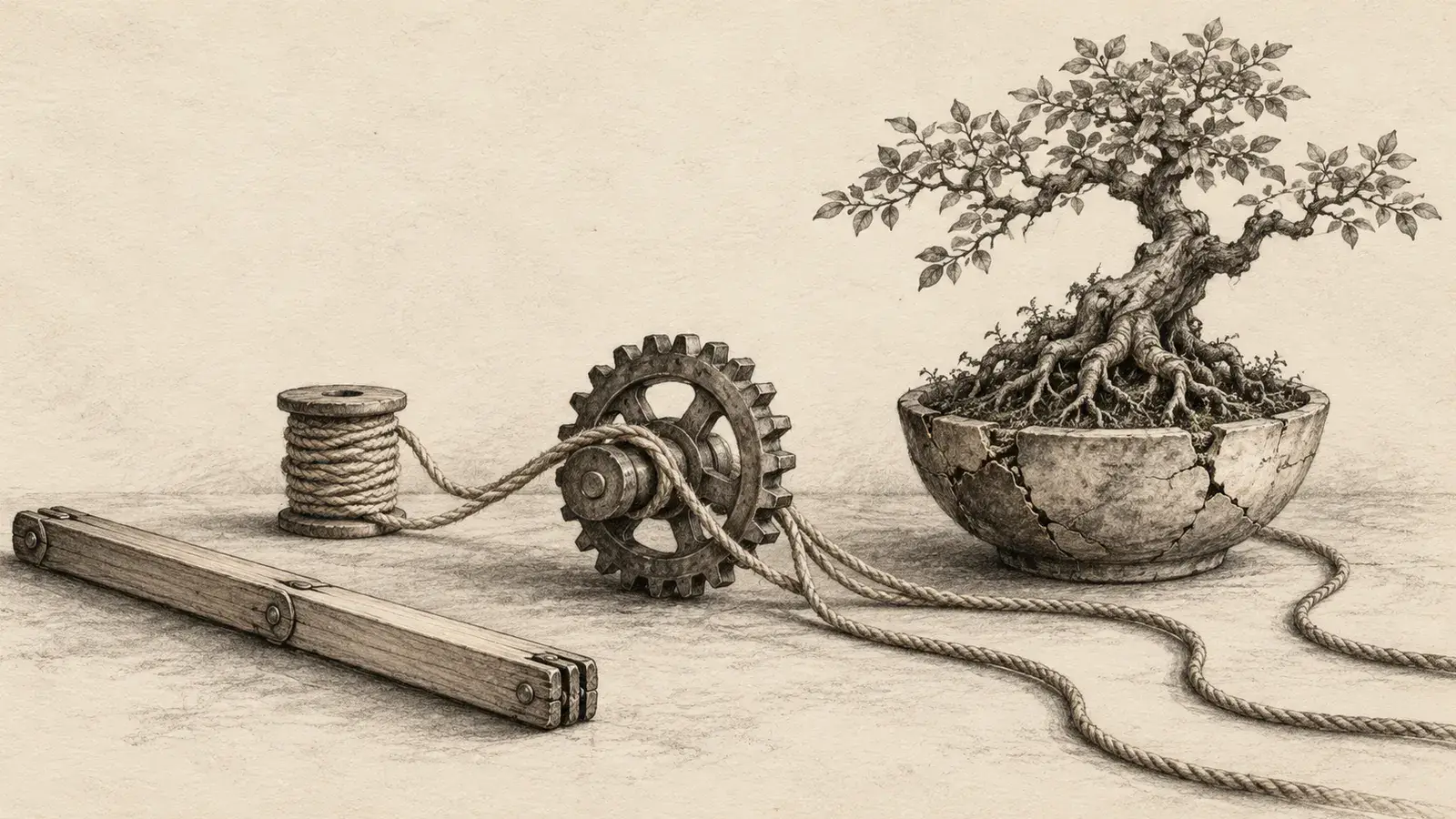
Nate Hagens opens the first installment of a four-part series titled “How to Think About the Future”. As he explains, The Great Simplification covers many fields — energy, geopolitics, ecology, economics, mental health, food, governance, plastics, nuclear power, meaning and community — and almost every episode draws predictable comments. Some ask why he hosts nuclear experts when nuclear power is “too slow and expensive”, others why he discusses plastics and toxic substances when the economy is going to collapse, while others insist that renewables cannot replace fossil hydrocarbons at today's scale or that climate is not even among the top ten risks. Hagens says he reads the comments and takes them seriously because they reveal something deeper: everyone has settled on a particular version of the future and judges everything else against it.
If someone has decided that economic collapse is imminent, discussions about long-term ecological restoration seem like a luxury. If they have decided that artificial intelligence will change everything, soil biology seems quaint. If they are convinced that global warming is a hoax, climate episodes seem like a waste of time. He recognizes the same impulse in himself, though less so now: we function more efficiently when we have just one story in our heads, because we know what to pay attention to and what to ignore, saving cognitive effort.
After more than twenty years of observation, Hagens has concluded that neither he nor the commenters know which future is coming. His baseline assessment, based on trends in energy, debt, ecology and geopolitics, is that the global economy will probably hit a wall in the relatively near future, and that there is a significant chance that one of the next two recessions will turn into a deep economic downturn, with chaos and restructuring in debt and currency markets. But he holds this view with humility: first, he could be wrong; second, even if the general direction is right, the way it unfolds creates branching paths he cannot predict. The same economic wall could lead to managed simplification, an authoritarian concentration of power, chaos or a hundred things in between.
Keeping all these possibilities open is, he admits, difficult both temperamentally and emotionally, and sometimes exhausting. He reads studies and invites guests from such different fields because he believes the only authentic response is to see the situation as clearly as possible and then find a way to act, even if only with a general sense of direction. Scenario thinking is his way of remaining functional in the face of information that would otherwise be paralyzing. That is why he continues to hold discussions about nuclear power, plastics, artificial intelligence, renewable technologies, governance and mental health: each topic concerns a possible future, and we do not know which one we will live in. The viewer who says nuclear power is irrelevant may be right, as may the one who focuses on soil ecology or artificial intelligence. Each holds a piece of the picture, but the picture is bigger than anyone can see alone.
In this series, Hagens wants to do something different: instead of declaring which future is coming, he asks how we think about the future when many futures are still possible in early 2026, and how we plan and act when we truly cannot predict. The first part concerns how we hold the future in our minds. The second will present four simple scenario grids covering economic direction, power and distribution, geopolitics and Earth systems. The third will combine subquadrants from these grids into composite worlds, because real futures arrive as combinations rather than individual variables. The fourth will address shortfall risk and responses that hold up across many scenarios.
The first problem he raises is that most people treat future challenges as independent problems in separate boxes: climate here, politics there, technology elsewhere. In reality, he says, these are coupled systems that interact and reinforce one another. Energy affects geopolitics, geopolitics affects supply chains, supply chains affect inflation, inflation affects political legitimacy, legitimacy affects the policies that are possible, and policies affect ecological pressure. The cycle comes full circle as ecological pressure affects energy, food and water. As an example, he cites the situation in the Strait of Hormuz: what he considers an ill-advised military decision in late February escalated within weeks into an energy crisis and is expected soon to lead to a fertilizer shortage and then a threat to food security, with potential challenges to political legitimacy and, in his view, an increased likelihood of financial and monetary restructuring.
If risks are correlated and systems are coupled, we cannot plan for one challenge at a time; we have to think in combinations. Complex systems, he adds, do not move smoothly but in starts and stops; sometimes decades happen within weeks. There are periods of stability, and then something breaks, stalls or tumbles. Ecologists see stability and abrupt phase changes. Another characteristic is path dependence: once you set out on a path, the cost of changing course rises. Decisions accumulate, infrastructure is built for a particular energy system, political alliances solidify, and economic structures create interests that defend themselves. The future is therefore shaped partly by choices that have already been locked in, even if they did not seem like choices at the time.
Complex systems also cross thresholds: you apply pressure gradually, nothing seems to change, and suddenly everything changes at once. This is how ice sheets and soils work. The problem is that we usually do not see thresholds and tipping points before we cross them. That is why analysts and consultants who extrapolate recent trends linearly are caught off guard: they assume a linear relationship between cause and effect, while the most critical systems are nonlinear, with thresholds and feedback loops. According to Hagens, what matters is less the current trend lines than the conditions under which a system could jump from one regime to another. A better question than “what is the most likely outcome?” is “what different regimes could the system enter, and what would trigger each transition?”
This brings the deeper problem into view: most of us have been trained to hold just one story in our heads. We often disagree about facts, but at a deeper level we disagree about what kind of thing the future is. Most narratives are not competing, he says, but incomplete; people are looking at different levels of the same system or different time horizons. Prediction works for narrowly defined, short-term, well-understood systems, such as tomorrow's weather, but not for complex, long-term, coupled systems where surprises dominate. Human civilization and the biosphere in April 2026 form the most complex and surprise-prone system we have ever tried to think about. A scenario, by contrast, is a coherent microcosm: a set of conditions that lets us ask what would be scarce, what would be abundant, what would be rewarded, which institutions would survive, which failures would be difficult to reverse and what everyday life would look like.
The shift Hagens calls for is from prediction to scenario thinking: from trying to be right about the future to being prepared for many versions of it and contributing to the better ones. He acknowledges that this is harder than it sounds. Our nervous systems want certainty because keeping many possibilities open is metabolically costly and cognitively difficult; the mind seeks resolution so it can stop expending energy. Careers and identities also become tied to narratives: someone who has built their professional life around green growth, techno-optimism, peak oil or collapse may feel that admitting other possible futures threatens their identity. People defend their versions of the future as they defend their families, while institutions also reward confident stories: no one gets funding by saying “I'm not sure which of the six futures is coming”.
Hagens notes that single-narrative thinking has deep roots. For most of human history, almost everyone grew up within a single story about where they came from, where they were headed and their place in the world. He does not say this to attack religion — some of the people he respects most are religious, and some of the most grounded responses come from religious communities — but to show that single-narrative thinking is the human animal's default. Beneath the trends and data lie deep stories: that progress is the natural pattern of human experience, that humans are separate from nature, that more things mean a better life. These stories shape what we consider possible more than the data themselves.
He then introduces a concept he learned long ago while managing portfolios at Salomon Brothers: shortfall risk. In complex systems, he says, the greatest risk is rarely the average outcome; it is a shortfall, when something important falls below a threshold and does not recover, at least not easily. This applies to the reliability of the food system, grid stability, access to clean water, social trust, the capacity of governments, topsoil, pollinators, the nuclear taboo and democratic institutions. These are hard to build, accumulate slowly and, once they fall below a certain level, do not recover on a timescale that matters to the people living through it. Lost soil would take centuries to restore, a depleted aquifer may never refill on a human timescale, and if social trust breaks down past a certain point, coordination can become almost impossible for a generation. The asymmetry is fundamental: money and comfort can be regained; other losses are effectively permanent.
The series, he says, will not try to choose the right future but to broaden our perception so that we can see more than one possible world at a time and become harder to surprise. He also wants us to identify what is coupled, which shortfalls and irreversible losses we cannot afford to experience, and to build resilience that carries across many futures — something like managing a portfolio rather than betting on a single outcome. In closing, he shares that he hears more and more people feeling overwhelmed: they know the future will be different from the past but cannot get their heads around it. The dominant cultural narratives are powerful — either everything will be fine thanks to technology or everything will collapse. He considers neither useful nor likely to be accurate, and believes both lead to inaction. Scenario thinking is an antidote: it says “I don't know which future is coming, but I can prepare for and contribute across a range of futures, build capabilities that carry over, and start locally today”.
The first part closes with what Hagens calls a bird's-eye view: the future as a landscape of interacting conditions rather than a data point, as a challenge of navigation rather than a single story. The aim is to perceive the landscape of possible futures clearly enough to act within it with our eyes open. The second part, he announces, will make the discussion of scenarios more concrete.

Comments