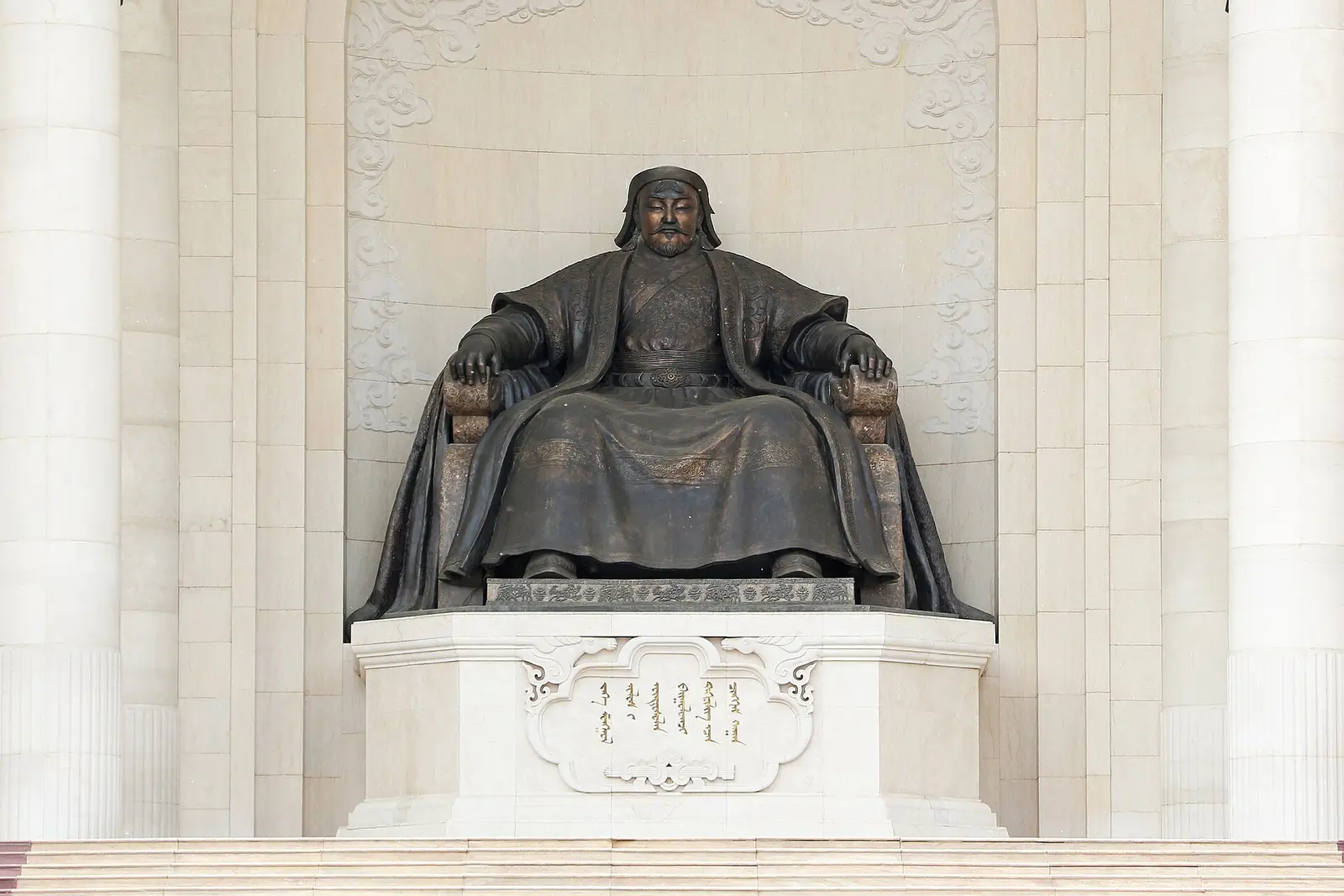
Jack Weatherford, an anthropologist and historian specializing in Genghis Khan and the Mongol Empire, talks to Lex Fridman in an extensive discussion covering the great conqueror's life, his military innovations and his enduring legacy. Weatherford, the author of Genghis Khan and the Making of the Modern World, describes how a child who lost everything managed to unite the steppe tribes and create an empire that changed the course of human history.
Genghis Khan's story, Weatherford points out, begins with his parents' meeting rather than his birth: his father, Yesugei, abducted his mother, Hoelun, from her first husband. The child born from this abduction was named Temujin—“iron man”—after a Tatar warrior his father had just killed. After Yesugei died of poisoning, the tribe abandoned his widow and her children on the steppe to die during the winter. His mother, however, saved them all by digging for roots and fishing.
Temujin experienced repeated abandonment and humiliation: he was forgotten when a camp moved, and was captured and held in a wooden yoke, from which he escaped by striking his guard; he also killed his half-brother Bekhter at a young age. Weatherford argues that these experiences taught him that he could not trust even his own family, which later shaped his approach to power: promotion would be based on merit rather than blood.
The most decisive moment of his life, according to Weatherford, was the abduction of his wife Borte by the Merkit tribe a few months after their marriage. Temujin decided that “life is not worth living without Borte” and organized his first military campaign to free her, forming an alliance with Wang Khan and his childhood friend Jamukha. The operation succeeded, and Borte returned pregnant—the child, Jochi, was probably her abductor's, but Genghis Khan acknowledged him as his own and defended him until the end of his life.
His relationship with Jamukha, his “anda”—a brother beyond friendship—was the most important of his adult life after Borte. The two men swore eternal loyalty as children, but parted when Borte urged Temujin to become independent. Jamukha was eventually captured by his own men and handed over to Genghis Khan, who executed the traitors and also Jamukha himself, at his own request, without spilling blood. Jamukha asked to be buried in a high place so that he could become a “guardian” of his people.
Weatherford describes Genghis Khan as a military genius who never fought for honor but for victory. The Mongol army, despite numbering only 100,000 men—all horsemen—conquered China, Russia, Persia and Central Asia thanks to its organization into decimal units, complete self-sufficiency (each soldier brought five horses, a needle and thread, and dried dairy products) and innovative tactics such as feigned retreat. Genghis Khan was also exceptionally receptive to new technologies, such as catapults on ships and cannons combining Chinese gunpowder with European metallurgy.
The historian stresses that Genghis Khan introduced religious freedom as an individual right—something unprecedented in history. He did more than allow institutions to operate: he declared that every person had the right to choose their religion. He also exempted religious institutions, doctors and teachers from taxes. He remained an animist throughout his life, worshipping Mount Burkhan Khaldun and later the eternal blue sky, Tenger.
The Mongol Empire created a unified trade network that permanently connected East and West. Merchants were protected, taxed once and able to travel safely throughout the empire. Exchanges involved goods as well as ideas, technologies, mathematics (such as zero from the Muslim world), sciences and agricultural products. Weatherford notes that since Genghis Khan's time, there has never been a year without contact between East and West.
His grandson, Kublai Khan, completed the conquest of China in 1279, uniting northern and southern China, Tibet, Manchuria and Korea. Conquering southern China required radical innovations: the Mongols, who scorned ships as “women's carts,” were forced to develop a navy with ship-mounted catapults to break through cities' defenses from the river side. The Song dynasty ended with the drowning of a seven-year-old emperor and his parrot when his prime minister threw him into the sea so that “the country would not be dishonored.”
Weatherford does not avoid the issue of brutality: the Mongol Empire is estimated to have caused around 40 million deaths, 10% of the world's population at the time. However, he refuses to judge Genghis Khan differently from other conquerors, including those involved in modern wars. He mentions the dropping of atomic bombs on Hiroshima and Nagasaki and the wars in Vietnam, Iraq and Afghanistan, saying that “if we can tolerate what the Americans did, we can tolerate what the Mongols did.” He points out that the US dropped more bombs on Cambodia than on Germany during World War II.
Weatherford argues that Genghis Khan's legacy lives on: protection for diplomats, religious freedom, meritocracy, and the abolition of the abduction and sale of women. Thomas Jefferson, he says, was inspired by Genghis Khan's ideas on religious freedom. Genghis Khan himself forbade anyone from painting his portrait or building anything in his honor—the first portrait was made 51 years after his death. He was buried in an unknown, unremarkable grave, saying, “Let my body go, let my nation live.”
At the end of the discussion, Lex Fridman shares personal reflections on Gaza, stating that what is happening there is an atrocity and that the Israeli government bears direct responsibility. He says that more than 60,000 people have been killed, including at least 17,000 children, and calls for an end to the violence, stressing that “the death of a child is a tragedy, regardless of their skin color, their religion or the patch of land they call home.” He quotes Martin Luther King: “The arc of the moral universe is long, but it bends toward justice.”
The discussion ends with Weatherford talking about his wife, who died after years with multiple sclerosis. He describes how she encouraged him to write, telling him, “This illness will take my life, but it is taking yours too—you must write.” He says he always wrote “for her,” as though telling her the story on the radio. This personal note brings a human dimension to the discussion: history includes not only conquests and empires, but also the people who inspire us to keep going.
Comments