James Holland, a British historian specializing in World War II and co-host of the podcast “We Have Ways of Making You Talk,” describes the conflict as the greatest catastrophe in modern history: more than 60 million dead from more than 60 countries, destroyed cities, altered borders and millions displaced. For him, what makes the war unique is that it was truly global—fought in deserts, in the Arctic, on oceans, in jungles, on beaches, in the air and on the Russian steppes.
Holland stresses that he is drawn to the human drama. He mentions Sam Bradshaw, a British tank crewman from Liverpool who went away for four years, was wounded twice, returned home and felt so disconnected from normal life that he enlisted again and ended up near Belsen. Holland says this alienation from home and the need to see what Nazism meant was a profoundly human experience for many veterans. He also tells the story of one of Bradshaw’s comrades who received a “Dear John” letter, suffered a psychological breakdown and was killed in the next battle, something Bradshaw considered almost a self-fulfilling prophecy.
The historian explains that Nazi ideology was founded on an “us versus them” outlook. Hitler saw the world in black and white: either a Thousand-Year Reich or Armageddon. At its core were Lebensraum, or “living space,” and the so-called Hunger Plan: German economists such as Georg Thomas and Hermann Backe calculated that the occupation of Ukraine and the Soviet Union would cause “countless millions” to die of starvation, not as collateral damage but as deliberate policy.
Holland argues that Operation Barbarossa, the German invasion of the Soviet Union in June 1941, was doomed from the outset at an operational level. The Germans had about 2,000 different types of vehicles, little motorization relative to the size of the front, and fewer aircraft than they had in 1940. Railway tracks had a different gauge from the German network, and German trains needed more frequent replenishment of water and coal. The initial advances were impressive, but the wear was enormous: the 16th Panzer Division, for example, was reduced to 16 tanks out of 180.
According to Holland, much of the initial German success was due to Soviet inadequacy. Stalin’s purges had decimated the leadership of the Red Army: about 22,500 officers were executed or imprisoned, including three of the five marshals. Stalin initially refused to allow a retreat from Kyiv, resulting in about 700,000 men being taken prisoner. Georgy Zhukov warned him, but Stalin temporarily dismissed him.
Holland argues that Hitler was not a military genius. The plan for the invasion of France came from Erich von Manstein and its execution from Heinz Guderian. The real “genius,” he says, was Joseph Goebbels in propaganda. Germany had the densest radio network in Europe: in 1939, 70% of households had a radio, while the cheap “people’s receiver” made it a mass medium. The Nazi machine endlessly repeated the same message: Germany is great, Judeo-Bolshevism is a threat, Hitler is the savior.
Regarding the debate that casts Winston Churchill as the war’s “chief villain,” Holland disagrees. He recalls that the decision over Poland was made by Neville Chamberlain’s government, when Churchill was out of government. Hitler would have invaded the Soviet Union and France anyway, he argues, and if he had not been stopped, he would have become stronger and more voracious. He acknowledges that the Allies made mistakes and that the moral questions surrounding bombing are serious, but insists that the war against Nazism was justified.
Holland describes the war as a battle of factories. In 1940, Britain produced 496 Hurricane and Spitfire fighters compared with 240 German fighters; in total, it produced 132,500 aircraft, while the United States produced 315,000. Allied superiority rested on more effective training, crew rotation and mass production. The Sherman tank, although inferior to the Tiger in armor and gun power, was reliable, easy to maintain and produced in 49,000 units compared with 1,347 Tigers.
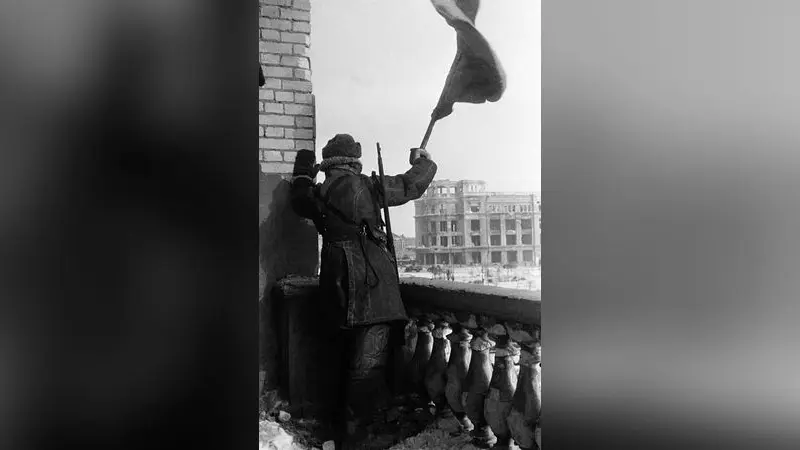
On Stalingrad, Holland explains that the destruction of the 6th Army was due primarily to encirclement made possible by American motorization, rather than street fighting. In 1942, instead of attacking Moscow, Hitler directed his forces toward the oilfields of the Caucasus, without any plan for how to transport or refine the oil. Holland says nobody was asking “and then what?” Meanwhile, Luftwaffe losses in the Mediterranean between June and October 1943 were much greater than on the Eastern Front.
Holland describes Normandy as the high point of the Allied coalition. On D-Day, 6,939 ships took part, including 1,213 warships, along with 12,500 aircraft and 155,000 men within 24 hours. He stresses that two-thirds of the aircraft and soldiers were British or from Britain’s possessions, and that the Canadians suffered the heaviest proportional losses. Success rested on total air superiority, secured by the P-51 Mustang with its Rolls-Royce Merlin engine, and on the war’s largest minesweeping operation, with not a single ship lost to a mine during the landing.
The historian believes that Hitler’s end in the bunker is faithfully portrayed in the film “Downfall,” although Goebbels took cyanide and did not shoot himself.
What shocks him is how quickly a democratic and civilized Germany slipped into the barbarity of the Holocaust. Holland stresses that half of the six million Jews were murdered by bullets to the back of the head and that gas chambers were devised only when the executioners could no longer psychologically endure the method.
Finally, Holland warns that economic crises bring political unrest and that complacency is dangerous. Freedoms in the West are not guaranteed, he says, and peace is fragile. He sees a source of hope in the fact that the overwhelming majority of people want to live peacefully and that the human capacity for new solutions is unlimited.




Comments