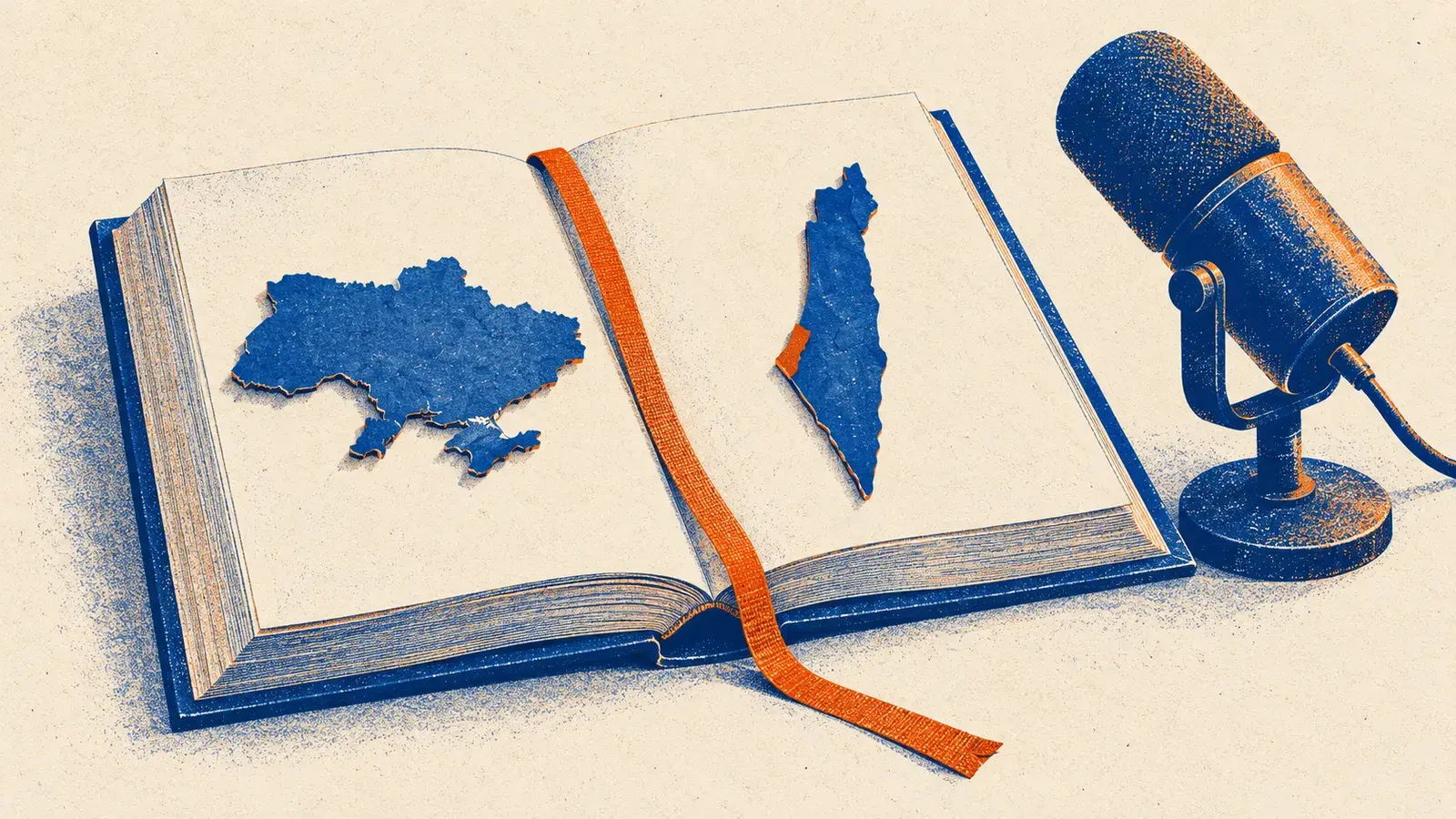
Douglas Murray, author of “On Democracies and Death Cults,” talks with Lex Fridman about two wars: Russia’s invasion of Ukraine and Hamas’s attack on Israel on October 7, 2023. In the discussion, he describes what he saw firsthand on the front lines, explains why he considers Hamas a “death cult” and argues for remembering the obvious facts, such as who attacked first.
On Ukraine, Murray says his visits showed him something much clearer than the political noise: people defending their homes and families. He was with the Ukrainian armed forces when they retook Kherson and returned recently, watching the tension between Trump and Zelenskyy from a trench on the front line. He found that the initial optimism about recapturing all the territory, even Crimea, had given way to exhaustion, without changing the soldiers’ fundamental commitment to their work.
He considers the Trump–Zelenskyy meeting at the White House premature. The minerals deal was putting pressure on the Ukrainians, Zelenskyy was visibly exhausted and the atmosphere was poisoned by questions Murray describes as disrespectful, such as the one about his clothes. He notes that Zelenskyy missed the opportunity to thank the US at the start and that his English did not help him; nevertheless, Murray understands the confusion of a leader who hears from Washington that Ukraine started the war, while he himself comes from the “country at war.”
Murray leaves no room for doubt about Putin: he describes him as a bloody dictator, a kleptocrat and someone responsible for murders abroad, including those involving polonium and nerve agents in Britain. He considers Russian elections unfree and sees the 2022 invasion as part of an attempt to reconstitute the Soviet Union. The Baltic states, he says, are not pretending to be afraid; and if there is a ceasefire, Putin will probably try again, as he did in Georgia in 2008.
Murray is critical of “realist” interpretations in the vein of John Mearsheimer, which he considers rehashed theories of spheres of influence. He acknowledges that the West did not always treat Russia well after 1989, but this does not justify the invasion. He also rejects the idea that economic investment is enough to deter a deranged leader, citing Norman Angell, who believed before World War I that the economic cost would prevent war. For Murray, what matters is remembering the basic fact: the war began because Putin invaded.
On peace in Ukraine, Murray expects that territory in the east will have to be ceded and that the country will need to rearm during any ceasefire. But he stresses that these territories are not abstract maps: they include hundreds of thousands of Ukrainian citizens. He describes children hiding from the Russian authorities, schools of Russian indoctrination and around 20,000 children who, he says, were abducted. He also considers it naive to think that American miners or business interests will serve as a buffer to deter aggression: people believed the same about Hong Kong.
In the second part, Murray analyzes October 7. Hamas, he says, launched a brigade-level attack, broke through the security fence and attacked the softest targets—kibbutzim, towns and the Nova party—killing, raping and abducting people. Hezbollah was planning a similar attack from the north, and Iran knew about the plan. Israel’s failure was, in his view, one of the greatest since the state’s founding: the prevailing “conception” was that Hamas had grown comfortable with corruption; at the same time, there were multiple operational failures and confusion, with terrorists disguised as Israeli soldiers and police officers.
Murray insists that Hamas does not hide its intentions. Its charter calls for Israel’s destruction and quotes a hadith about the end times. He mentions Yahya Sinwar, who told a dentist while in prison that he would attack when Israel became weak. He recalls that the victims included people who dreamed of peace, such as activist Vivian Silver, who transported children from Gaza to Israeli hospitals and was burned alive in her home. For him, Hamas embodies a true “death cult.”
On Israel’s response, Murray says the two objectives were to bring the hostages home and destroy Hamas. He argues that Israel initially showed restraint and that fighting in Gaza is extremely difficult because Hamas uses hospitals, schools and mosques as bases and builds tunnels for weapons and hostages, rather than to protect civilians. He rejects the term “collective punishment” and recalls that Gaza’s population almost doubled after Israel’s withdrawal in 2005, something he says is inconsistent with genocide.
Murray links Hamas to corruption: its leaders died as billionaires, while money from Qatar, America and Europe went toward weapons, tunnels and indoctrination. He believes Gaza’s residents bear responsibility because they elected Hamas in 2006, which killed its Fatah opponents in 2007 and spent 18 years radicalizing children. He cites recordings and videos from October 7 in which abductions are celebrated, as well as accounts from hostages who said they found no trace of human kindness. For him, this is not simply desperation; it is evil.
On Benjamin Netanyahu, Murray notes that October 7 happened on his watch and that the judicial reforms divided the country before the attack. However, he defends Netanyahu’s overall record: he sees him as a leader who regarded protecting the only Jewish state as his mission, warned about Iran and managed to significantly weaken Hamas and Hezbollah. He adds that no Israeli political leader would have responded substantially differently to such an atrocity.
Murray sees a resurgence of antisemitism behind the worldwide hatred of Netanyahu and Israel. He quotes Vasily Grossman: “Tell me what you accuse the Jews of, and I will tell you what you are guilty of.” He explains that many in the West, burdened by narratives of colonialism and genocide, project their guilt onto Israel. He recalls that after October 7 there were no demonstrations against Hamas, but there were demonstrations against Israel, and that the antisemitic narrative serves as an easy explanation for every problem.
In his book, Murray links Iran to the “death cults.” He describes Ayatollah Khomeini’s flight from Paris to Tehran in 1979 and the suppression of the Green Revolution, when students were tortured and raped to terrorize society. He mentions Oriana Fallaci’s exchange with Khomeini, who insisted that his movement was guided by love, and the slogan “Viva la Muerte” used by students in Unamuno’s time. For Murray, today’s equivalents are those who say, “We love death more than you love life.”
Despite the dark subject matter, Murray closes with hope: he is encouraged by bright young people, such as the students in Kyiv, and by the clarity that comes with being close to death. He says that in war you see the best and worst of people side by side, and that this intensity is worth recording. He advises Fridman to hold on to his own compass, quoting Churchill: the only shield is conscience and the sincerity of one’s actions.



Comments