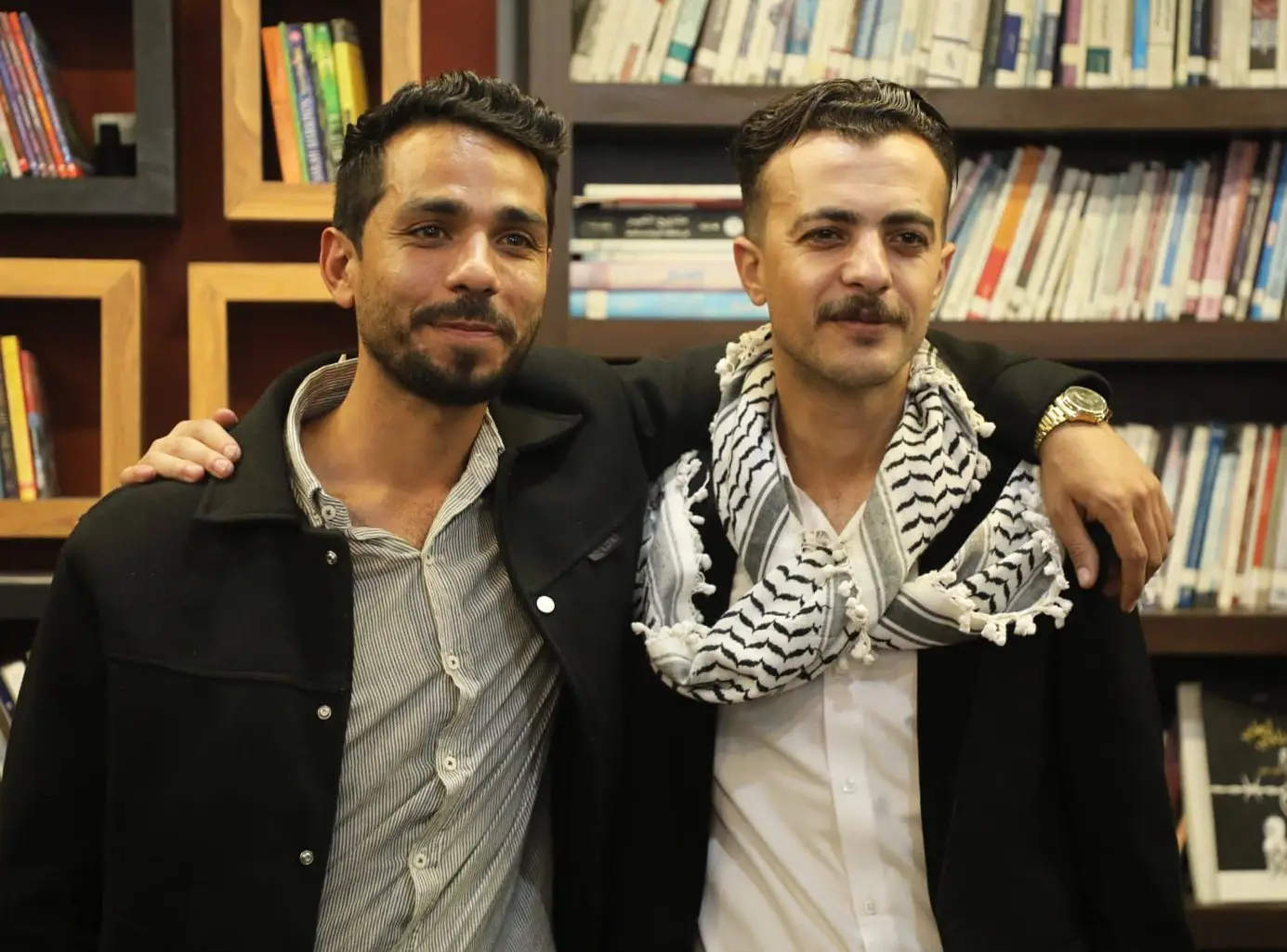
More than a year ago, a donkey-drawn cart made its way through piles of rubble in Gaza. Three young people brushed ash from burned book covers and loaded whatever volumes had survived, trying to protect them from bombardment and from neighbors who burned them for cooking because the blockade had made cooking gas scarce.
Omar Hamad, 30, a pharmacy graduate, along with Hussam Hamad, 42, and Ibrahim al-Masri, 31, have helped collect and preserve more than 5,500 books since 2025. Their effort grew into an unexpected library in the Gaza Strip, the Phoenix Library, which opened on April 21. The books were gathered by every means available: recovered from the rubble, bought or reprinted.
Israeli bombardment has buried Gaza beneath 61.5 million tonnes of rubble, equivalent to more than 169 kilograms per square meter. Beneath that mass lie libraries, personal collections and major institutional archives. Omar Hamad says the library's name speaks for itself: “The Phoenix, rising from the ashes.” Their work is part of a broader community movement to rescue books and public libraries from the destruction of war.
At least 87 libraries in Gaza have been damaged or destroyed since October 2023. Gaza's Central Archives, containing 150 years of historical documents, were flattened by airstrikes in November 2023. In May 2024, the Al-Aqsa University library was burned by Israeli soldiers, according to the report. Ahlam al-Sha’er, director of libraries and cultural heritage at Gaza's Ministry of Culture, says Gaza had more than 200 million books before the war.
Omar Hamad was displaced ten times from Beit Hanoun. Each time, he loaded his books at the front of the truck, among luggage and food, leaving his family puzzled. The rescue effort began in January 2025, when Pulitzer Prize-winning Palestinian poet Mosab Abu Toha asked for the books from his personal library in Beit Lahia to be retrieved. At a shelter for displaced people, the team found people burning books from the Islamic University of Gaza library, one of the Strip's largest academic libraries, for heating and cooking. Omar Hamad bought whatever he could, especially from children selling books for one shekel per kilogram, less than 30 cents.
The price of cooking gas in Gaza had risen by 4,000% compared with before the war and by 600% compared with the period of the so-called ceasefire, according to a March 2025 OCHA report. To house the Phoenix Library, the three men rented a 180-square-meter apartment in central Gaza and built double sliding shelves to save space. They recovered some books in digital form and reprinted them at five times the cost. Since last December, the team has been raising money through the Chuffed platform and has raised more than $100,000 for rent, generator-powered electricity, water and equipment.
Al-Masri, an English literature graduate, shows books pierced by bullets, burned around the edges and torn, with visible pride. Among those recovered from the rubble are volumes more than a hundred years old: a fifth edition of “Kalila and Dimna,” a Bible and Ibn Khaldun's “Muqaddimah.” The library is organized into sections: Islamic jurisprudence and history, Palestinian studies, world literature featuring Nobel laureates, Russian and English classics, Palestinian and Arab prose, political books and academic texts. A quarter of the collection is for children. “Knowledge is the most important weapon against the occupation,” says Hussam Hamad, who makes no secret of his concern that the war could resume.
The Omari Mosque library, Gaza's oldest, was bombed on December 8, 2023. Much of its collection of around 20,000 rare books was reduced to ashes, including manuscripts from the Mamluk period through the late Ottoman period, some 700 years old. The mosque itself is a historic monument: it was a Byzantine church in the 5th century, a mosque in the 7th, a Crusader church in the 11th and a mosque again in the 13th. Al-Sha’er describes such losses as “cultural erasure.” Examples include Abdel Latif Abu Hashim's personal library of 14,000 books and the National Book House in Gaza, with 5,000 titles by Gazan authors that had no copies outside the area.
Haneen al-Omsi, 33, coordinates the Eyes on Heritage team, which began working at the Omari Mosque library in January 2025. She says what they are doing is not restoration but “triage.” The team includes five young women from different fields and is supported by doctors, nurses, engineers, teachers and homemakers. They use whatever materials are available, even alcohol and traditional surgical tools that are difficult to find. From the collection, they found only 3,000 damaged books, and even partial conservation is barely possible. Of the 228 rare manuscripts, 147 were found, while 81 remain missing.
Al-Omsi's own home was destroyed while she was displaced, but she did not visit it until two weeks after returning to Gaza City, a period during which she devoted herself entirely to the library. Al-Sha’er considers the community efforts commendable but says they are not enough. The consequences, she stresses, extend decades into the future, and she calls on UNESCO to treat Gaza's libraries as a priority before what remains is lost. Meanwhile, writers from Gaza continue to request national deposit numbers for new books and publications; writing continues amid the rubble.
Comments