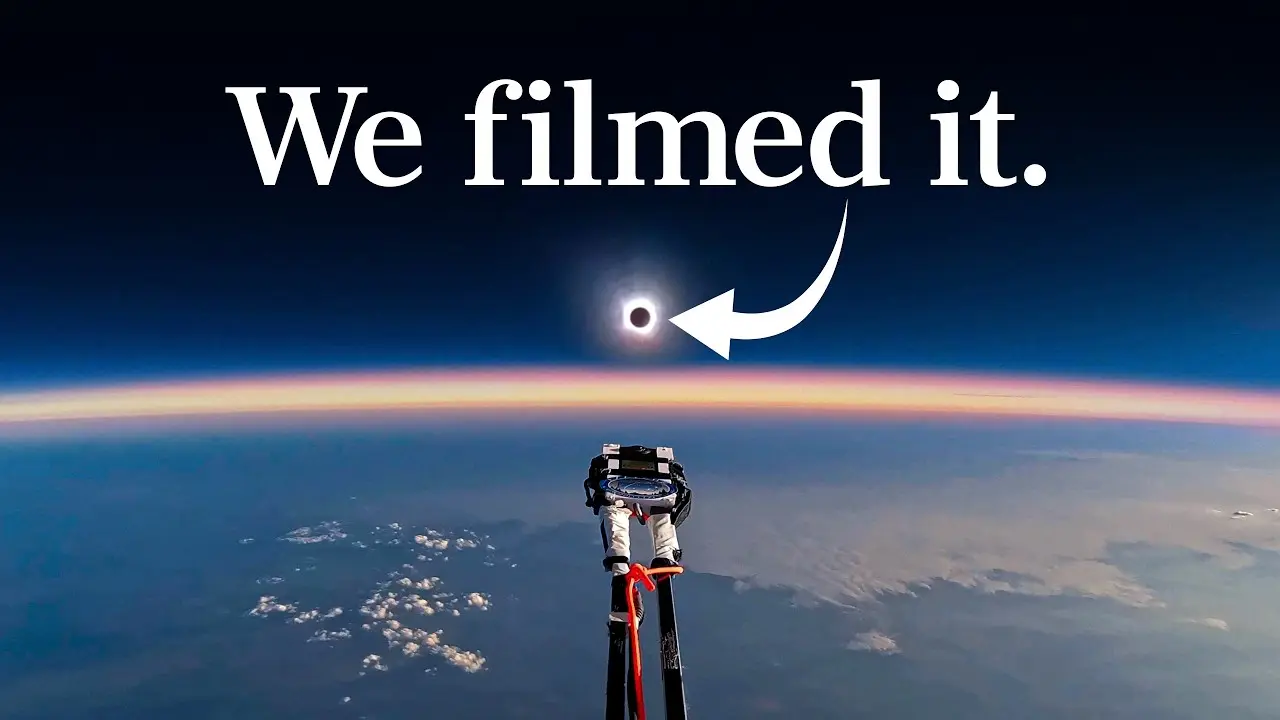
In a few seconds, Spain was about to see its first total solar eclipse in more than 100 years. The Veritasium team was in Burgos, at the center of the Moon's shadow, to work with NASA and film the eclipse from the edge of space. As the presenter explains, he initially thought there were already good videos about eclipses, but some questions remained unanswered: why the northern hemisphere sees more total eclipses, why the Sun turns white only during totality and what causes the mysterious “shadow snakes” on the ground.
Angela Des Jardins, the project leader, says this was her fourth eclipse and third total eclipse, while some people on the team had seen eight or even twelve. A random point on Earth sees a total eclipse about every 300 years, but when all total eclipses from 2000 BC to AD 3000 are mapped, the northern hemisphere gets about 15% more. The reason is that the Moon's orbit is elliptical and its apparent area can change by up to 30% in a month, while Earth also orbits the Sun in an ellipse.
Because the Sun's apparent area is about 7% smaller in July than in January, total eclipses are more likely around July, when the northern hemisphere tilts toward the Sun. The southern hemisphere sees more annular eclipses, with a ring of light around the Moon, because the Sun is closer during its summer. This pattern will reverse in about 9,500 years, as Earth's axis precesses and its elliptical orbit slowly shifts around the Sun.
In eclipse statistics, there is never a year without a solar eclipse: there are at least two and at most five. The Moon's orbit is tilted about five degrees relative to the Earth–Sun plane, so the new moon usually passes at the wrong height to cast a shadow. However, there are two nodes where the orbit crosses the plane, and “eclipse seasons” last about 34 days. Because a new moon occurs every 29.5 days, every eclipse season must contain at least one new moon, and therefore one eclipse.
If the new moon falls near the middle of the season, it usually produces a total or annular eclipse, while partial eclipses occur toward the edges and can produce two eclipses per season. Because eclipse seasons shift within the calendar year, there can be as many as five solar eclipses in one year. Another finding that excited the team is that every solar eclipse is accompanied by a lunar eclipse two weeks before or after, because Earth is then between the Sun and the Moon.
But why does the Sun appear white only during totality? In time-lapse footage, the partial phases look yellowish, but the explanation is simpler than one might imagine: cameras use filters, usually reddish or orange, because the light is so intense. During totality, however, the Sun is dim enough to look at without a filter, and we then see its true white color. As the team says, the yellow color is an artifact of the filter, rather than a property of the Sun.
NASA took part with the student ballooning team from Montana State University, as part of the Nationwide Eclipse Ballooning Project. They had teams in Reykjavik and Spain, and launched instrument-equipped balloons carrying cameras as their payload. For counterweights, they used improvised solutions such as water bottles filled with stones, and sent signed NASA stickers to the edge of space. The launch was carried out with close attention to the wind, so the balloon would not hit a nearby church, and was successful.
Meanwhile, about 3,000 kilometers away, NASA used an aircraft derived from a 70-year-old Cold War bomber to chase totality. On the ground, the maximum duration of totality was 2 minutes and 18 seconds, while the jet, traveling at 460 miles per hour, could stay within the shadow for about 3 minutes. The record still belongs to Concorde, which flew at Mach 2 in 1973 and remained in totality for 74 minutes. The jet's aim was not just more time, but also stability for sensitive instruments studying the corona.
The study of eclipses has a long history: during the total eclipse of August 18, 1868, French astronomer Jules Janssen traveled to India to examine prominences, the arcs of gas at the Sun's edge. By placing a slit in front of a prism, he split the light and found five bright lines, one of which did not correspond to any known element. Two months later, England's Norman Lockyer saw the same line and named the new element helium, after the Sun. Another unexplained line was found in the hotter corona and was thought for 70 years to belong to an element called “coronium,” until it was shown in 1939 to be iron so hot that it had lost 13 electrons.
The video also shows how pinhole projection works: a piece of cardboard with a triangular opening held close to the ground produces a triangular patch of light, but when moved far enough away, it produces a circle, because it is then projecting the luminous object itself. During the eclipse, all the gaps between tree leaves produce small crescents, facing the opposite direction to the crescent in the sky, because the light crosses at the opening. Cameras work the same way and invert the image.
Just before totality, the team held up a white sheet to spot the “shadow snakes,” long moving shadows that appear only seconds beforehand. According to Angela, their cause remains an open question. The leading theory is that narrow beams of light are refracted by layers of air with different temperatures and densities, just as stars twinkle. However, during an eclipse in Burgos in 1905, an army engineer went up in a hydrogen balloon and saw the shadows all around him, but not on the white sheets he had laid out. Another explanation is that the Moon's own terrain creates multiple point sources of light that interact and amplify the effect.
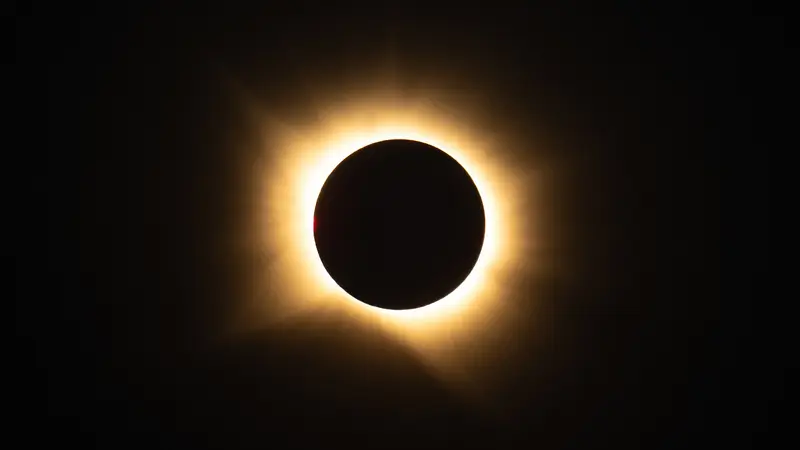
In the final seconds before totality, Baily's beads appear, isolated points of light along the Moon's edge. Fifteen seconds before totality, the team put on their special glasses. When totality arrived, they saw the corona, a bright prominence on the left side and a 360-degree sunset around the horizon. The reaction was intense: the presenter describes the sight as overwhelming and says he has never felt such excitement about a natural phenomenon. The next day, they located the balloon in a farmer's field, recovered the cameras and watched footage of the shadow retreating from an altitude of about 30 kilometers.



Comments