Janna Levin, a theoretical physicist and cosmologist, talks with Lex Fridman about some of the universe’s most extreme objects. Levin specializes in black holes, the cosmology of extra dimensions, the topology of the universe and gravitational waves, and has written books such as Black Hole Blues about LIGO’s detection of gravitational waves. The discussion explores both the physical concepts and the human stories behind the discoveries.
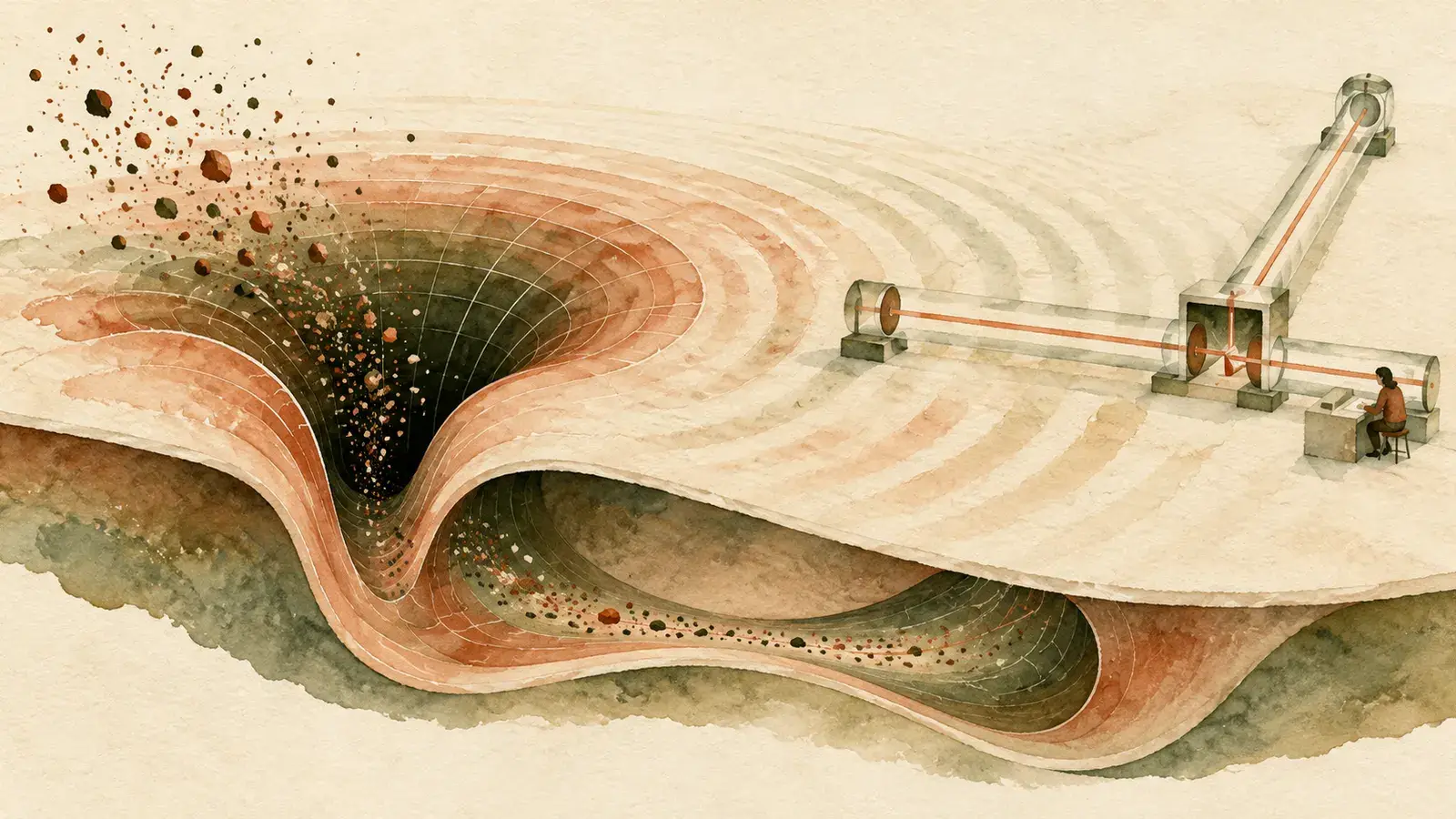
Levin explains that a black hole is not a dense object, but the event horizon: a surface in spacetime beyond which not even light can escape. The idea began in 1915 with Karl Schwarzschild, who solved Einstein’s equations in the trenches of World War I, as a pure thought experiment. In 1939, J. Robert Oppenheimer and his student showed that very massive stars can collapse into a black hole, leaving behind only their gravitational pull — like the Cheshire Cat disappearing and leaving only its smile.
If someone falls into a black hole, from their own perspective they cross the horizon without drama, because there is nothing material there. But space and time exchange roles: the singularity is not a point in space but an event in their future, and they cannot avoid it. To an outside observer, their friend appears to slow down indefinitely and hover at the horizon, while the person inside the black hole sees the galaxy’s entire evolution as a bright flash before death. The larger the black hole, the less noticeable the curvature at the horizon.

One of the great mysteries is the information paradox. Stephen Hawking added a little quantum mechanics to the vacuum around the horizon and showed that a black hole emits thermal radiation and evaporates. This radiation carries no information about what fell inside, which violates unitarity, a sacred principle of quantum mechanics. If information is lost, either general relativity or quantum mechanics needs to be revised.
Levin says she believes unitarity will be preserved, and that the black hole is the arena where we can test a future quantum theory of gravity. Among the proposed solutions, string theory’s fuzzballs suggest that a black hole has no interior; “soft hair” attempts to store information on the horizon; and firewalls would destroy anyone attempting to cross it. Levin finds Juan Maldacena and Leonard Susskind’s ER=EPR proposal more promising, linking quantum entanglement to wormholes. This suggests that the horizon may be “stitched” from quantum wormholes and that gravity may not be fundamental, but emerge from quantum mechanics.
Levin also discusses extra dimensions. They may be curled up on a small scale, or we may be stuck on a three-dimensional membrane within a space with more dimensions.
The evidence for dark matter is compelling: in colliding galaxy clusters, the distribution of mass revealed by gravitational lensing separates from the luminous matter. Dark energy is harder to explain, with an unusual pressure and energy value that do not fit what we know; it may be connected to extra dimensions or the vacuum, but no one has found a solution that satisfies everyone.
Most of the discussion concerns gravitational waves and LIGO. When two black holes orbit each other and merge, they produce ripples in the geometry of spacetime itself, rather than light. The energy released follows E=mc², reducing the mass of the final object. These waves are more like sound than an image: if you were close enough, they could compress and stretch your eardrum even in a vacuum. LIGO required fifty years and sensitivity to changes smaller than one ten-thousandth of a proton over a length of four kilometers; the first detection took place on September 14, 2015, when a wave that began its journey 1.5 billion years earlier passed first through Louisiana and then through Washington state.
The discussion also touches on the history of nuclear physics. Oppenheimer, a central figure in the Manhattan Project, wrote his theoretical work on stellar collapse on the same day the Nazis invaded Poland. Levin emphasizes how agnostic science is: the same physics that explains why stars shine also led to the nuclear weapon. Lise Meitner first demonstrated fission, and Werner Heisenberg remained in Germany; Levin believes he did not deliberately derail the German program. She also notes that many scientists fled to the United States, explaining the disproportionate concentration of Nobel Prizes there, and warns that this freedom of thought must be preserved.
In her book A Madman Dreams of Turing Machines, Levin connects Kurt Gödel and Alan Turing. Gödel proved that there are true mathematical statements that can never be proved; Turing started from there, considered noncomputable numbers and arrived at the idea of a universal machine, or the computer. Turing helped break the German Enigma code, but was later prosecuted for being gay, subjected to chemical castration and probably died by suicide after eating a poisoned apple. Gödel, deeply suspicious, died of starvation. Levin does not idealize madness, but sees how the same traits that led to creation also led to destruction.
The discussion turns to the question of life. Levin believes that life on Earth began almost immediately, but multicellularity took a very long time, possibly for reasons related to energy. There are now more exoplanets than stars in the Milky Way, so it is difficult to imagine that life does not exist elsewhere. However, aliens may not resemble us or use technology; they may be solitary, without a centralized brain, like jellyfish. She thinks of life as the movement of electrons and the organization of entropy, and argues that we must open our imaginations much wider about what might be alive.
Levin is the head of science at Pioneer Works, a cultural space in Brooklyn founded by artist Dustin Yellin with Gabriel Florenz. The old iron factory was transformed into a place where art and science coexist, with events, Broadcast magazine and artists working alongside scientists. For her, science is part of culture, rather than “popularization” or “education”; just as an artist exhibits their work, a scientist brings back to the world what they saw from the summit.
At her appearances, she often wears jumpsuits by designer Andrea Lauer.
Levin mainly reads fiction. She singles out Never Let Me Go by Kazuo Ishiguro, Time’s Arrow by Martin Amis and The Road by Cormac McCarthy, in which science structures a world so that a deeply human story can be told. She also mentions George Orwell’s Animal Farm, which shows how a simple surreal fable can shape culture. This combination of abstraction and emotion is her favorite territory.
At the end, when asked what she would ask an all-knowing oracle, she hesitates to say “quantum gravity,” because mystery is part of the scientific outlook. If she learned that gravity emerges, new questions would immediately arise. She acknowledges that the entire history of the universe, even the Nobel Prizes and the proofs, will one day be erased, but this can be poetic: we build something in the sand and then a wave washes it away. What matters is leaving something positive in the near future and designing something beautiful while it lasts.


Comments