In this Stanford lecture, Robert Sapolsky begins with cellular automata: elementary binary units and local rules for the next generation produce complex patterns. But, as he points out, most such systems stop, "hit a wall" and die out. Only a small subset of initial states leads to a few mature, stereotyped shapes. This demonstrates convergence: different starting points end up in the same patterns, while small initial differences can lead to dramatic divergence—the butterfly effect.
Sapolsky describes how changing only the spacing between the initial boxes in a cellular automaton radically changes the outcome: with one space, the system remains static and lifeless; with two or three, it dies out; while with four, a dynamic, asymmetrical pattern suddenly appears and remains asymmetrical forever. The same happens with slight asymmetry in the initial state: asymmetrical beginnings tend to produce more dynamic systems than symmetrical ones. The central lesson is that the initial state does not allow us to predict the mature form. We have to work through the entire process step by step.
These principles appear in nature: seashells and turtle shells follow patterns similar to those of cellular automata. Sapolsky mentions plants on Mount Kenya and in the Andes that, although taxonomically unrelated, have converged on the same strange shapes because they survive in similar environments near the equator and at high altitudes. The same can be seen in desert animals or in forms of legged locomotion: there are only a few possible solutions, so different starting points converge on a limited number of forms.
Sapolsky refers sarcastically to Stephen Wolfram's book "A New Kind of Science," which argues that much of nature's complexity is encoded by a few simple local rules. He then turns to the "grandmother neuron" problem: there are not enough neurons for each one to encode a single piece of knowledge. The solution is neural networks, where each neuron sits at the intersection of many inputs. His example involving paintings by Gauguin, Van Gogh and Monet shows how a neuron in the middle recognizes Impressionists in general, while those at the edges recognize specific artists.
The network concept explains the "tip of the tongue" phenomenon: to remember Toulouse-Lautrec, many inputs are activated—an Impressionist, painted dancers, was not Degas, an art teacher, a pun—until the name emerges. Neurons in the association cortex are multimodal, meaning they respond to many stimuli, rather than being "grandmother neurons." Sapolsky mentions Karl Lashley, who could not locate individual memory "engrams," and clinical examples from Alzheimer's disease: the memory is not lost, but the network weakens and needs stronger priming for retrieval.
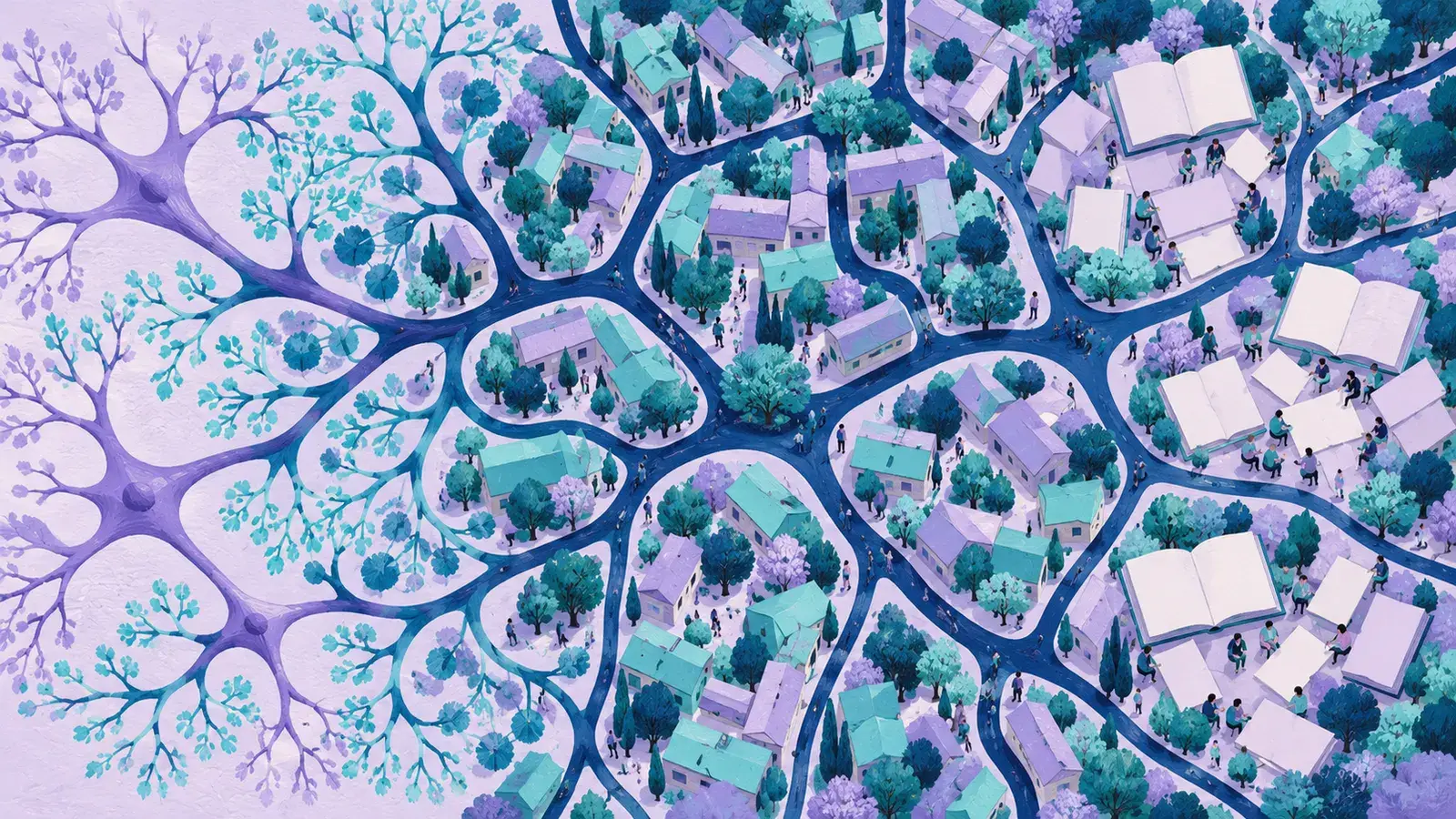
To address the problem that there are not enough genes to specify every branch, Sapolsky proposes the concept of fractal genes. A simple rule, such as "grow the tube until its length is five times its diameter, then branch," can create an entire circulatory or pulmonary system, or a dendritic tree. A mutation that slightly changes the rule—for example, from 5 to 4.9 times the cross-section—could compress the entire branching system and be catastrophic. Such scale-free mutations may explain syndromes such as Kallmann syndrome, which affects many midline structures simultaneously.
Fractal geometry also solves the packing problem. Sapolsky presents the Cantor set, the Koch snowflake and the Menger sponge: repeating simple operations that remove or add the middle third produces objects that approach infinite surface area in a finite space. This explains how the circulatory system is no more than five cells away from every cell in the body while accounting for less than 5% of the body's mass: blood vessels and lungs use fractal branching to maximize the surface area for exchange without filling up space.
Sapolsky introduces emergence through simple examples. The shape of a potato chip as it fries arises from biophysical constraints—the edge resists differently from the interior—rather than from a gene. The only mathematical solution is a double saddle. He then describes the wisdom of crowds: Francis Galton found that the average of hundreds of guesses about an ox's weight was almost exact, and on the game show "Who Wants to Be a Millionaire?" the audience gave the correct answer 91% of the time. In one real case, many naval experts guessed the location of a sunken submarine, and their combined estimates came within 300 yards.
Swarm intelligence demonstrates something more powerful than the wisdom of crowds: no individual ant knows the solution to the traveling salesman problem, but the system finds it. Sapolsky explains how virtual ants following two rules—the longer the route, the more diluted the pheromone, and if you encounter a trail, reinforce it—solve optimization problems. Telecommunications companies use such algorithms to find the cheapest wiring layout. Similarly, bees that have found a better food source dance longer, increasing the likelihood that other bees will encounter them by chance, until the swarm converges on the best choice of nest.
Rules of attraction and repulsion also produce complex structures. In urban planning simulations, rules such as "a market attracts a café, but a café repels another café" create commercial districts similar to those designed by the best urban planners. Neurons in a dish, following simple rules of attraction and repulsion, form clusters of cell bodies and extensions that resemble a city. A study compared ant colonies with the Tokyo subway and found similar solutions, with the ants achieving a more optimal distribution. Sapolsky connects the same logic to Urey and Miller's experiment on the formation of amino acids from simple molecules, and to magnetic toys that form pyramids if tossed enough times.
Sapolsky describes power-law distributions that recur in entirely different systems: earthquakes, the distances covered by phone calls, the movement of dollar bills, website links, emails and even Kevin Bacon's degrees of separation. The common pattern is that many elements have a few local connections and a few have very long-distance ones. This is optimal for networks: it allows stable local interactions as well as occasional communication with distant points. The cerebral cortex follows such a distribution. In autism, the distribution becomes steeper: more local connections and fewer long-distance ones, resulting in isolated functional "islands" and less integration. The corpus callosum is thinner in men than in women, and thinner still in autism.
Bottom-up quality assessment replaces experts. Sapolsky uses Wikipedia as an example: there are no "gray-bearded sages" writing from the top down, but a self-correcting system of many users. A Nature study had shown that Wikipedia's accuracy in the natural sciences approached that of Encyclopaedia Britannica. However, such systems tend toward conformity and struggle to identify extreme, controversial choices. The solution is to identify films or works that sharply divide opinion, because that is where the interest lies.
Sapolsky concludes that quantity creates quality. He mentions Garry Kasparov, who, after losing to the Deep Blue computer, said that "with enough quantity, you invent quality." Humans and chimpanzees share around 98% of their DNA, and differences in brain-related genes mainly involve genes for cell division: more rounds of division produce more neurons, rather than different types of neurons. The themes of emergence are quantity, the simplicity of the components, the role of randomness, gradients of information, local interactions, and generalists versus specialists.
Sapolsky's final point is philosophical: if we do not need top-down plans, we do not need someone to make them. Emergent systems show that complexity can arise without an author or central planner. He even predicts that within our lifetimes we will see revolutions in which people do not leave their living rooms but organize through emergent processes online. This perspective, he says, changes how we understand the brain, society and our place in the world.


Comments