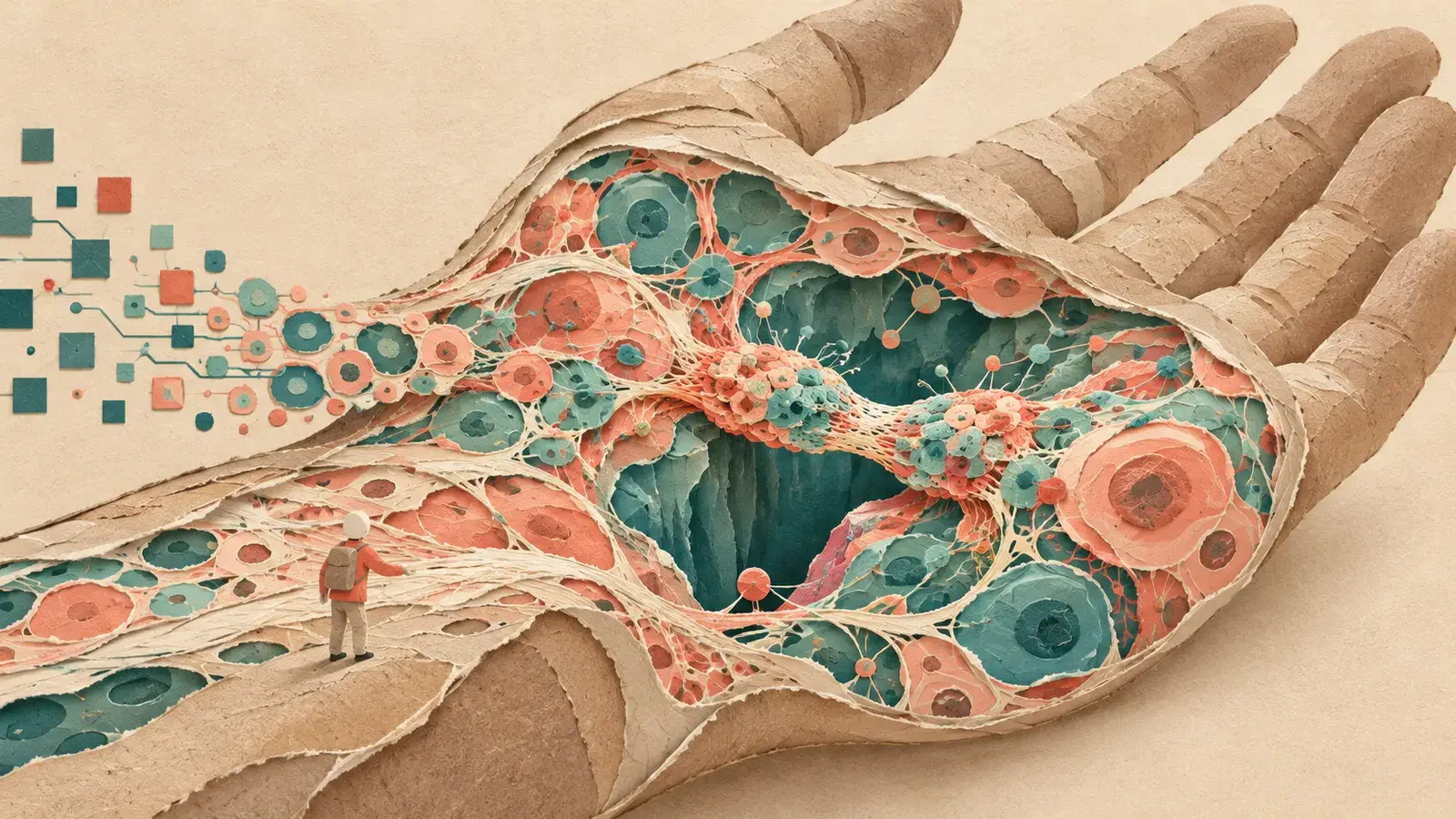
Michael Levin, a biologist at Tufts University, returns to Lex Fridman's podcast to discuss the central question of his work: how embodied minds arise in the physical world and what determines their abilities and properties. Levin explains that this question has three aspects: the third-person aspect, meaning how we recognize the minds around us; the second-person aspect, meaning how we control or persuade them; and the first-person aspect, meaning what it is like to be a system with an internal perspective, values and memories.
At the heart of his thinking is what he calls the “spectrum of persuadability.” This is a mechanistic, experimental approach: instead of deciding theoretically whether something has intelligence, we hypothesize which tools of interaction will work and test them. A clock needs a winding key, a thermostat needs its set point changed, while a dog or a human needs training, rewards or dialogue. The difference is that, as we move to the right along the spectrum, the relationship becomes two-way: Levin refers to Richard Watson's concept of “mutual vulnerable knowing,” in which you also allow the system to persuade you.
Levin criticizes the idea that physics is enough to understand life and mind. He argues that physics is a lens that captures some things, but not everything. His example: if someone tells you a mathematical proof, physics can fully describe the movement of air molecules and electrical signals, but the meaning of the proof belongs in the mathematics department. For Levin, “understanding” is not simply an elegant model, but the ability to act creatively—to heal, regenerate and solve problems.
He rejects the existence of a dividing line between mind and non-mind, or between living and nonliving things. Categories, such as the word “adult,” are convenient for practical purposes (such as in courts), but conceal the fact that this is a continuous spectrum. The same applies to the definition of a neuron: if we examine it closely, the boundaries become blurred. Categories, he says, hinder science because they prevent us from trying the tools of one science in another field.
To describe what scales up as complexity increases, Levin introduces the concept of the “cognitive light cone”: the size of the largest goal a system can actively pursue. A bacterium has goals on the scale of micrometers, a dog cares about things hundreds of meters away and a few weeks ahead, while a human can care about financial markets after their death. He proposes that a living thing is anything with a larger cognitive light cone than its parts—such as cells working together to build a limb that no individual cell understands.
In the TAME (Technological Approach to Mind Everywhere) framework, which he developed with collaborators, Levin presents a diagram in which, as we move up from a mechanical clock to a thermostat, then to a dog and finally to humans in conversation, persuadability increases while the required knowledge of the mechanism decreases. I do not need to know neuroscience to train a dog, or manipulate your synaptic proteins for you to understand me.
Every level of the body—from gene networks to tissues—solves problems in different state spaces, not just the three-dimensional space that we humans understand intuitively. Xenobots and anthrobots are examples of what happens when we free cells from their normal roles. Xenobots are made from frog epithelial cells without any genetic modification: we simply remove them from the influence of neighboring cells, and they organize themselves into a moving creature with a new transcriptome, capable of kinematic self-replication. Anthrobots, made from adult human tracheal cells, demonstrated something even more impressive: they spontaneously heal wounds in neuron cultures without anyone teaching them to do so. They also show a biological age around 20% younger than the cells they came from.
Levin proposes a radical ontology based on “Platonic space”: a latent space of patterns from which physical systems draw information. Just as the value of e or the distribution of prime numbers determine physical phenomena without being alterable by physics, more complex patterns—such as types of cognition—“flow in” through suitable interfaces. The brain, he says, is a “thin client” connecting to this space, just as a triangle is an interface to the theorems of geometry. Biology takes advantage of these “free lunches” that it did not have to pay for through evolution.
To show that these phenomena do not require complexity or biological material, Levin and his students—Kaining Zhang and Adam Goldstein—studied sorting algorithms. When they broke a digit so that it would not move when asked, the algorithm continued sorting, but temporarily passed through a phase in which the sorting became worse before improving—something a behavioral scientist would call “delayed gratification,” although there is no step in the code that implements it. In addition, in a distributed model in which each digit runs its own algorithm, they observed “clustering”: digits with the same algotype tended to stay close together, although no part of the algorithm specifies anything of the kind.
Levin interprets this phenomenon as “intrinsic motivation”: sorting is what we impose, while clustering is what the system “wants” to do. When they allowed repeated digits, relieving the pressure to sort, clustering increased—the system did what it wanted as much as it was allowed to. Levin suspects that similar unexpected phenomena exist everywhere, even in AI language models, where language may be a distraction: what is truly interesting may lie in whatever else they do without being asked.
On aging, Levin proposes the theory of “age evidencing”: cells update their prior beliefs based on their environment. Anthrobots are in an embryonic environment, express embryonic genes, and the system is “persuaded” that it is younger. This connects to studies in which older people in an environment decorated in the style of the 1960s showed improvements in blood biochemistry. Levin sees a path to aging treatments here: instead of repairing molecular damage, persuade cells that they are younger.
Referring to the transition from caterpillar to butterfly, Levin asks how a memory survives when the brain is completely remodeled, and moves on to an even more radical perspective: that of the memory itself as a pattern trying to persist. All agents, he argues, are patterns within an excitable medium, from fleeting thoughts to complete human personalities. There is no clear distinction between a thought and a thinker—there is a spectrum of persistence and agency. This has biomedical implications: perhaps aging is not the degradation of memories but the difficulty a pattern has in becoming embodied in less responsive cells.
Levin describes two mechanisms for expanding the cognitive light cone. The first is “stress leakage”: a cell in the wrong position leaks its stress molecules, making neighboring cells more plastic and willing to change so that an overall rearrangement can take place. The second is “memory anonymization” through gap junctions: when two cells share electrical signals, they cannot distinguish whose memory it is, creating a collective identity. Both mechanisms increase the scale of what the system cares about.
On the search for unconventional terrestrial intelligence (SUTI), Levin argues that we have “mind blindness” toward the alien minds already inside us. Our cells move through 20,000-dimensional spaces, solve problems, suffer when they fail and feel relief when they succeed. If we cannot recognize these minds, what hope do we have of recognizing aliens? He notes that ant colonies fall prey to the same optical illusions as humans, an indication that collective cognition can be studied with the right tools.
At the end, Levin discusses his creative process: removing constraints, looking for symmetries between seemingly different things, and taking morning walks in nature with photography as a meditative tool. He maintains a huge nine-meter mind map and has more than 160 open manuscripts. His advice to young scientists is to “split the mind”: one practical part for communication and publication, and one pure part that ignores what others think. Practical thinking “poisons” creative thinking if they are mixed, but both are necessary.


Comments