Demis Hassabis, head of Google DeepMind and a recent Nobel laureate in Chemistry, returns to Lex Fridman’s podcast for a discussion ranging from theoretical computer science to video games and energy. At its center is the idea that physical systems, having been shaped by evolutionary or selective pressures, have a structure that a classical neural network can learn.
Hassabis explains that in his Nobel lecture he proposed a deliberately provocative conjecture: every pattern that can be generated or found in nature can be discovered and efficiently modeled by a classical learning algorithm. As he puts it, projects such as AlphaGo and AlphaFold do not attempt exhaustive searches across vast spaces, but build models of the environment that intelligently guide the search. In protein folding, for example, proteins fold within milliseconds inside our bodies, so physics is already solving the problem computationally. He attributes this ability to the fact that physical systems have undergone selection processes for billions of years. He refers to an idea he calls “survival of the most stable”: from proteins to the shapes of mountains and the orbits of planets, whatever survives over time is not random.
By contrast, problems such as factoring large numbers may have no pattern to learn, and a quantum computer may be needed there. The discussion connects to the question of P versus NP. Hassabis considers it one of the deepest questions if we view physics as an information system. Information, he says, is more fundamental than matter and energy. He even wonders whether a new complexity class could be defined for systems that neural networks can learn, with the true capabilities of classical systems still unexplored.
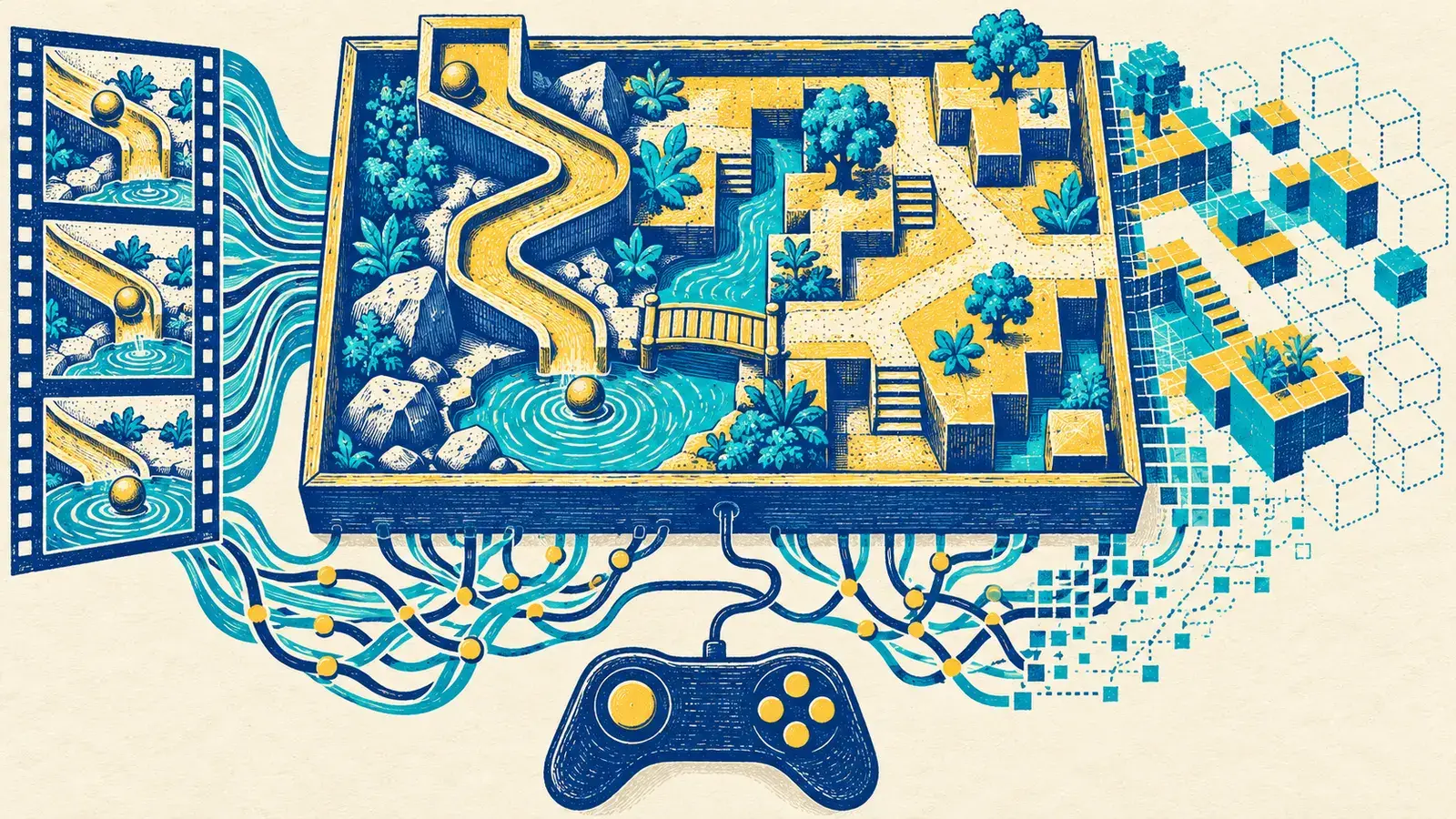
Hassabis focuses particularly on Veo 3, Google’s video generation model, because it reproduces liquids, lighting and materials with impressive fidelity. Simply by observing YouTube videos, he says, the system seems to extract an underlying structure for how materials behave. This surprises him: previously, he would have expected embodied interaction with the world to be necessary for intuitive physics. The fact that passive observation is enough suggests something fundamental to him about the structure of reality and points toward what he calls a “world model.”
For Hassabis, video games are a return to his roots. He recalls that all the games he made were open-world games, such as Black & White, with an early form of reinforcement learning. Today, he envisions interactive versions of Veo within five to ten years, where the story would adapt dynamically to whatever the player chooses. His favorite game remains Civilization, although he avoids recent editions because they consume too much time.
Hassabis sees games as more than entertainment: they are safe environments for practicing decision-making, winning and losing. As he says, as artificial intelligence takes on more and more difficult and boring tasks, games can become places of meaning and rich experiences. At the same time, he points out that we need a scientific answer to why direct experience of the physical world and other people has value.
In scientific discovery, Hassabis describes AlphaEvolve as an example of a hybrid system combining language models with evolutionary algorithms. Language models propose solutions, and evolutionary search takes them to new parts of the space. He considers creativity and “research taste” the hardest things to imitate: finding a good conjecture is harder than solving it. One test, he says, would be for a system to invent a new theory of physics or a game as deep as Go.
His great dream is the virtual cell. As he explains, AlphaFold provided a static picture of the three-dimensional structure of proteins, while AlphaFold 3 takes a first step toward protein interactions with RNA and DNA. The next steps would be to model a pathway and later an entire cell, possibly a yeast cell, so that experiments could first be conducted in silico, dramatically accelerating biological research. In the long term, he is also interested in simulating the origin of life from the primordial chemical “soup.”
Hassabis also mentions WeatherNet, Google DeepMind’s system that predicts the weather better than traditional fluid dynamics models running on supercomputers, including the paths of cyclones. He believes that even chaotic or borderline chaotic systems can be modeled to a significant degree by neural networks, which has major practical implications for civil protection.
On artificial general intelligence, Hassabis gives roughly a 50% chance by 2030. His own requirement is demanding: consistent intelligence across all cognitive domains, without the weaknesses of “jagged intelligence.” He would like tests involving tens of thousands of cognitive tasks, as well as landmark moments such as AlphaGo’s “move 37”: for example, a system inventing a new conjecture in physics or a game with depth comparable to Go. In one thought experiment, he would give a system all knowledge up to 1900 and test whether it could arrive at Einstein’s relativity.
On scaling, Hassabis is not particularly worried about data, because there is enough to create simulations that generate synthetic data from the right distribution. He sees enormous demand for computing power for training, for inference in products used by billions of people, and for “thinking systems” that become smarter with more reasoning time.
In energy, he is betting on fusion and solar power, with artificial intelligence helping to design reactors, materials and batteries. If the energy problem is solved, he says, it could usher in an era of “radical abundance” without resource constraints.
Hassabis declines to give a “P-Doom” figure because it would imply false precision. He nevertheless considers the risk neither zero nor negligible. He distinguishes risks from malicious actors, which operate over short timescales, from the risks of autonomous systems approaching general intelligence. His position is cautious optimism, and he calls for ten times as much safety research.
On consciousness, he politely disagrees with Roger Penrose and considers it more likely that the brain performs classical computation, without ruling out that something unique remains in the carbon substrate.
Finally, Hassabis draws hope from human ingenuity and adaptability. He reminds us that our brains evolved for hunting on the tundra and nevertheless cope with the modern world. He considers technology a tool that allows humans to flourish, and science and art, as Richard Feynman said, complementary ways of seeing the beauty of the world.
Comments