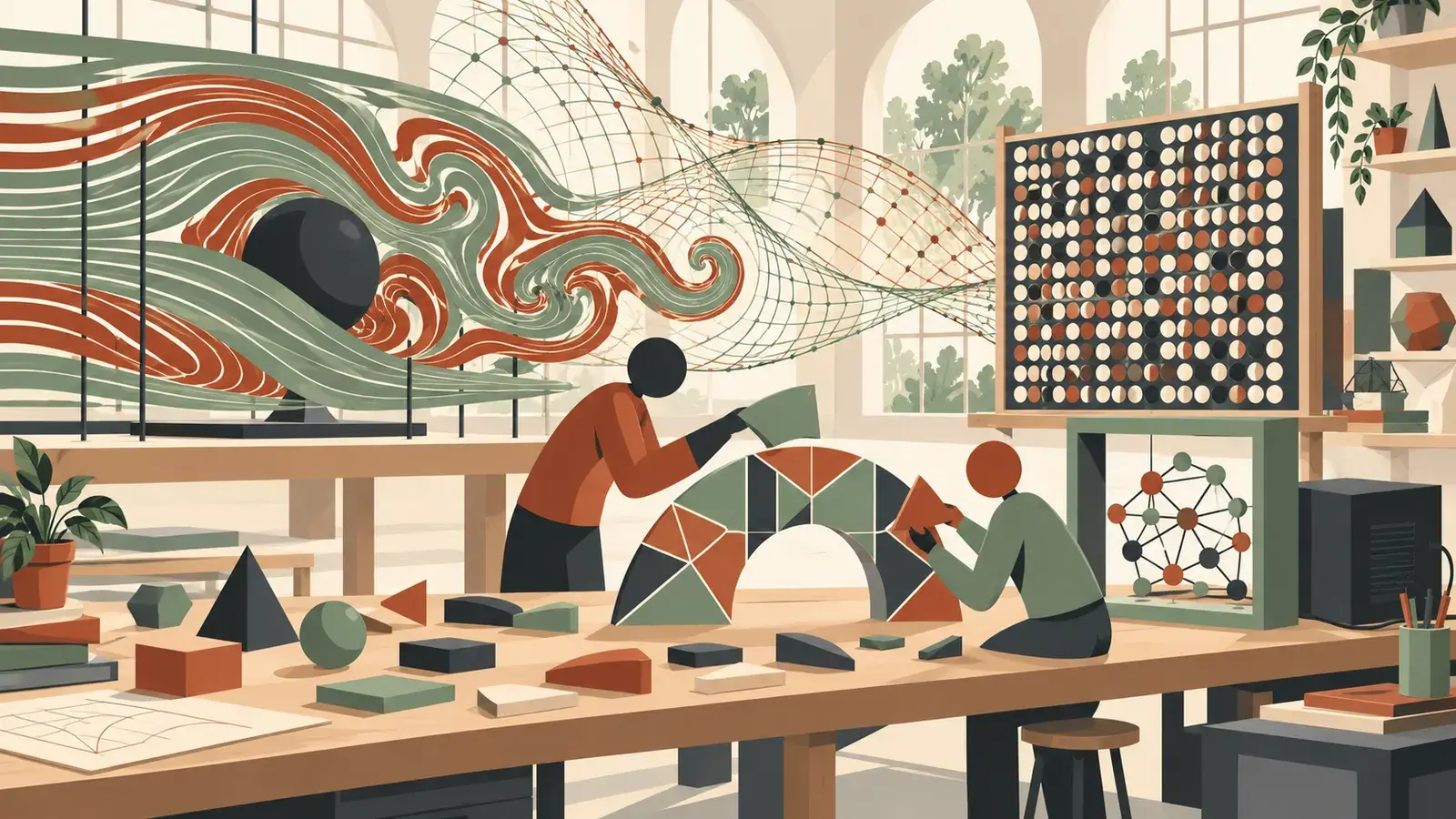
Terence Tao, one of the most influential mathematicians of our time and a Fields Medal winner, spoke with Lex Fridman about the hardest open problems in mathematics, the relationship between mathematics and physics, and the role artificial intelligence could play in research.
The conversation began with the Kakeya problem, an old puzzle about how little space a needle needs to turn in every direction. Tao explained that this seemingly simple problem is deeply connected to the concentration of waves and to questions about singular solutions of equations such as Navier-Stokes.
The Navier-Stokes equation, which describes the flow of fluids such as water, is among the Clay Institute’s seven Millennium Problems, with a prize of one million dollars. The question is whether a smooth initial state can lead to “blowup,” meaning infinite velocity at some point in finite time. Tao explained that in practice water does not blow up, but a mathematician must rule out even extremely unlikely “conspiracies” that would concentrate all the energy at one point. He described the problem through the analogy of Maxwell’s demon: statistically almost impossible behaviors that we nevertheless cannot completely rule out.
To understand why proofs of smoothness fail, Tao constructed a modified, “averaged” version of the Navier-Stokes equations in which he managed to force a finite-time blowup. As he explained, this acts as an obstruction: it shows that any proof of smoothness for the actual equation must use some feature that the artificial version lacks. His construction followed the logic of an electronic circuit, with “gates” that open and close and delays, inspired in part by his wife’s expertise as an electrical engineer. This led him to a bold idea: if water could function as a computer, perhaps a “fluid Turing machine” could be built that replicates itself at smaller and smaller scales, resulting in blowup.
Tao connected this idea to Conway’s Game of Life, where simple local rules create complex structures such as gliders and self-replicating machines. He stressed, however, that such emergent structures appear only with very carefully designed initial conditions, not from random states. Here, he said, lies a fundamental distinction in mathematics between structure and randomness that runs through many fields.
Discussing the relationship between mathematics and physics, Tao described science as an interaction between three levels: reality, observations and mental models. Mathematics, he said, is unusual because it starts from assumptions and asks what consequences follow, while most disciplines start from desired conclusions. He referred to the “unreasonable effectiveness of mathematics” and the phenomenon of universality, which explains why complex systems can be compressed into a few parameters, as in the central limit theorem. He warned, however, that universality is not always reliable, citing the global financial crisis of 2008, when systemic correlations contradicted Gaussian models.
Tao also discussed the beauty of mathematics, describing Euler’s identity not simply as a charming coincidence but as a unification of geometry, dynamics and complex numbers. He explained how the concept of energy, initially hidden behind Newton’s laws, became central with Hamiltonian mechanics and allowed intuition to be transferred from classical to quantum mechanics. On unifying general relativity with quantum mechanics, he expressed optimism, noting that the history of physics is full of unifications, although the problem is that the two theories account for almost all observations, leaving very little experimental data to guide us.
A large part of the discussion concerned the formal proof language Lean. Tao explained that Lean produces not only results but also certificates of correctness, allowing proofs to be verified with absolute certainty. Although formalization currently takes about ten times as long as writing with pencil and paper, it offers advantages: when a constant changes, the compiler immediately identifies which steps break, instead of requiring the entire proof to be checked line by line. It also enables collaboration at the level of individual steps between people who have never met, since the system itself guarantees trust.
Tao described the Equational Theories project, in which about fifty collaborators examined 22 million pairs of laws in abstract algebra to determine which laws imply which others. The project, nearly complete, would have been impossible without Lean and shows how experimental mathematical research can scale through large-scale, reliable collaboration.
On contributions, he noted that GitHub statistics are useful but can be distorted by Goodhart’s law when a metric begins to be used as an incentive.
On artificial intelligence, Tao said that systems such as DeepMind’s AlphaProof achieved silver-medal-level performance at the International Mathematical Olympiad, but with far more time and computing resources than humans. Difficulty increases exponentially with the number of steps, and large language models make errors that are often hard to detect because they look superficially perfect. What models lack today, he said, is a “mathematical nose”: the ability to sense which approach is viable before investing months of work.
Tao predicted that within this decade we will see artificial intelligence formulate a conjecture connecting fields that humans considered unrelated. Mathematical results have already been published, he said, that would not have been possible without assistance from artificial intelligence, even if apportioning the contributions is difficult. He compared today’s collaboration with artificial intelligence to “herding cats,” but believes that at some point there will be a phase transition, as happened with mathematicians’ adoption of LaTeX.
The discussion also covered some of the most famous open problems.
On the twin prime conjecture, Tao explained that one can remove a small percentage of prime numbers so that all twin pairs disappear, meaning that any proof must use subtle, nonstatistical properties. By contrast, arithmetic progressions are extremely robust, as the Green-Tao theorem showed. For twin primes, the best known result is that there are infinitely many pairs differing by at most 246, and Tao described the so-called “parity barrier” as a key obstacle, comparable to the speed-of-light limit.
On the Riemann hypothesis, Tao was cautious: he described it as essentially beyond the reach of current techniques, saying that it probably requires an unforeseen discovery from another field.
On the Collatz conjecture, he explained that he proved that almost 99% of numbers “fall” much lower than their starting point, using probabilistic methods, but a complete proof requires ruling out exceptional cases, something much harder. He stressed that the general class of such problems is so complex that Conway showed it can encode Turing machines.
Toward the end, Tao discussed Grigori Perelman, who solved the Poincaré conjecture and declined the prizes, noting that he is an extreme case even among mathematicians. He described Perelman’s proof using Ricci flow and the transformation of a supercritical problem into a critical one.
He emphasized that he prefers to change problems when he gets stuck, unlike the “hedgehogs” who persist for years with a single problem, and that psychology plays a major role in research: often a mistaken initial success provides the motivation to continue until the real solution is found.
Tao ended on an optimistic note: the human community, when its infrastructure and culture are healthy, can become much smarter than the individuals who make it up. He referred to the creativity of younger generations and the fact that problems that once killed people, such as navigation, are now trivial. For young people struggling with mathematics, he suggested looking for alternative routes, since different people use different parts of their brains to think mathematically, and stressed that new tools could open research to a much wider audience.



Comments