The Marginalian revisits a teaching by Alan Watts, the British philosopher and writer born on January 6, 1915 and died on November 16, 1973, who began popularizing Eastern philosophy in the West during the 1950s and 1960s. Watts fused ancient wisdom with the evolving insights of modern psychology, and his work addressed such concerns as presence, identity, the difference between money and wealth, timing, and how to find meaning in meaninglessness.
The article opens with a remark by Kurt Vonnegut, who observed during a lecture on the shapes of stories that we know so little about life that we do not really know what is good news and what is bad news. According to The Marginalian, Watts had articulated a version of this idea even earlier, not as resignation but as a kind of mental discipline.
Though Watts wrote books, he was also a remarkably charismatic speaker, and some of his most compelling ideas came through lectures. Many of the best were later published as Eastern Wisdom, Modern Life: Collected Talks 1960–1969. In a talk titled 'Swimming Headless,' Watts explores the psychological dimensions of Taoist philosophy and its emphasis on cultivating the mental discipline of not categorizing everything into gain and loss.
Watts argues that learning to live in such a way that nothing is experienced as either an advantage or a disadvantage is a source of enormous empowerment and liberation. He illustrates the point with an ancient Chinese parable. A short animation of the parable was produced by Steve Agnos and the Sustainable Human project.
The core claim is that the whole process of nature is an integrated process of immense complexity. Because of that complexity, it is impossible to tell whether anything that happens in it is good or bad: one never knows what the consequence of a misfortune will be, just as one never knows what the consequence of good fortune will be.
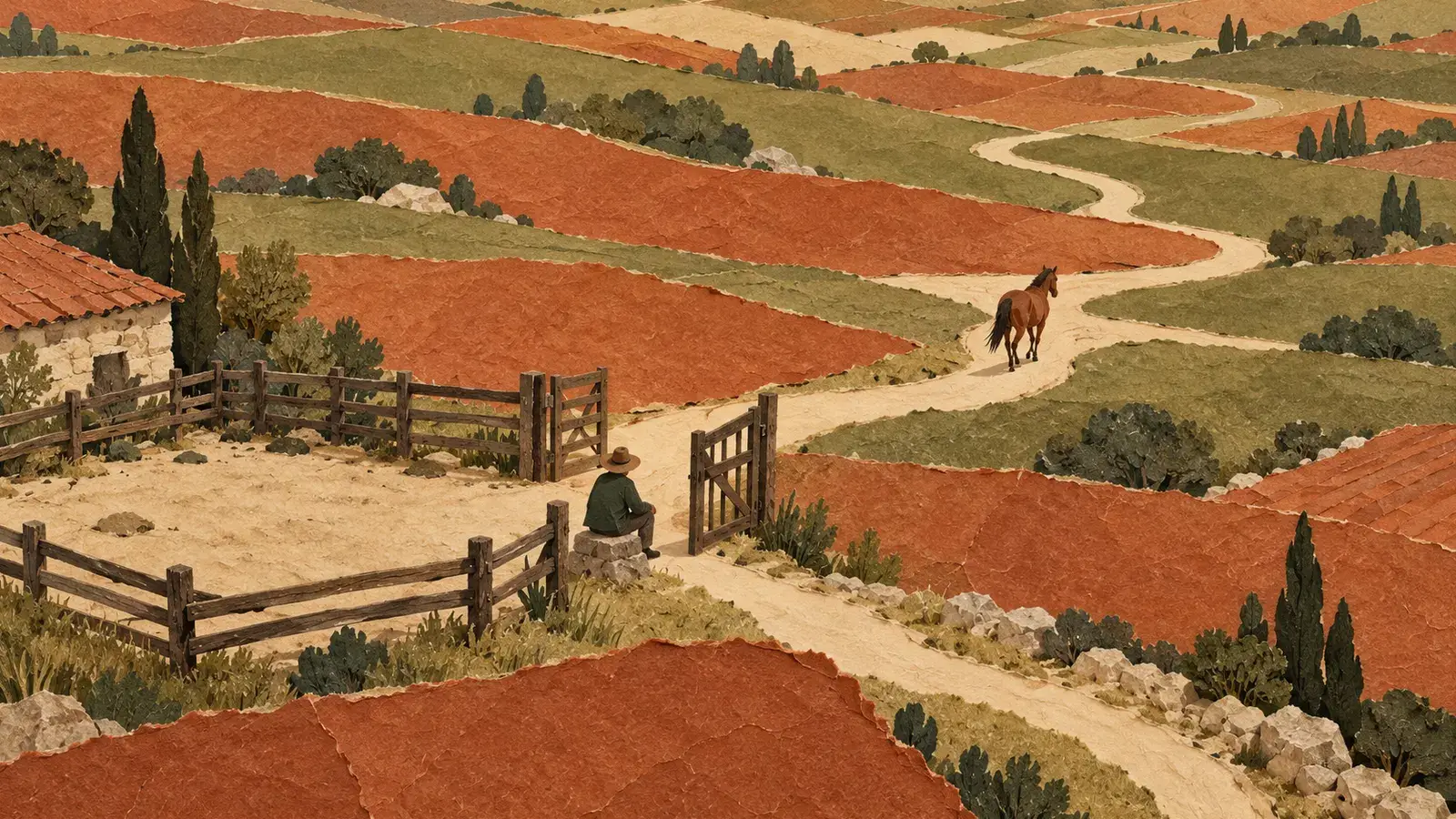
The parable describes a Chinese farmer whose horse runs away. When neighbors gather to commiserate and call it most unfortunate, the farmer says only 'Maybe.' The next day the horse returns with seven wild horses. The neighbors celebrate what they see as a great turn of events, since the farmer now has eight horses, but the farmer again says 'Maybe.'
The following day, the farmer's son tries to break one of the wild horses. He is thrown while riding and breaks his leg. The neighbors say it is too bad, and the farmer says 'Maybe.' The next day, conscription officers come to conscript people into the army, but they reject the son because of his broken leg. Once more the neighbors insist that this is great, and once more the farmer says 'Maybe.'
The farmer steadfastly refrains from thinking in terms of gain or loss, advantage or disadvantage, because one never knows. The article notes that in the book adaptation the parable makes the point in slightly more refined language: 'In fact we never really know whether an event is fortune or misfortune, we only know our ever-changing reactions to ever-changing events.' The teaching is presented as an invitation to loosen the habit of labelling events as purely good or bad, because their consequences remain open.



Comments