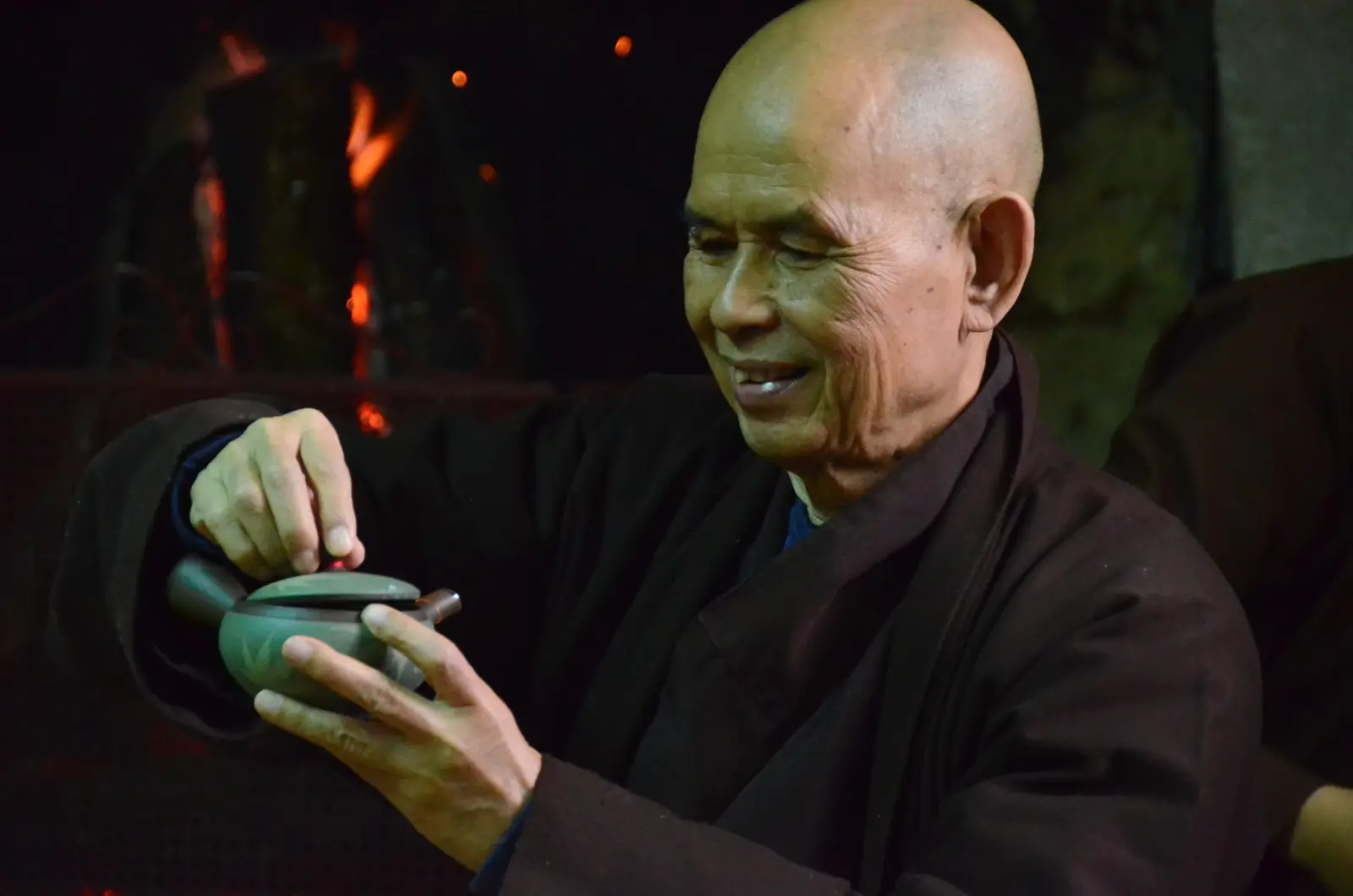
Meaningful contact with life begins in the present moment, Thich Nhat Hanh argues in an excerpt from his book Our Appointment with Life: Sutra on Knowing the Better Way to Live Alone, published by Tricycle. The past has passed and the future has not yet arrived; therefore, in the teaching he presents, peace, joy and awakening can be experienced only here and now. Mindfulness is described as a practice of returning to this direct experience, with body and mind present in the same place and time.
A cup of tea becomes a simple example of this return. Before the first sip, participants in tea meditation breathe and recite a short verse together, reminding them that body and mind are in the here and now. When they drink mindfully, the author explains, they can clearly perceive the warm cup and recognise its value as part of everyday life. The act thus gains depth through the attention with which they experience it.
The Buddhist concept of aimlessness, apranihita, follows the same logic. The text presents it as one of the three "gates of liberation", alongside emptiness and signlessness. Thich Nhat Hanh describes it as a way for practitioners to stop constantly looking to the future for what they can experience in the present. In walking meditation, for example, each step can have value without the need to arrive at a destination. According to this teaching, peace and joy are the very way of travelling.
Breathing has a central place in this practice, as it is presented as a means of uniting body and mind. The author refers to the Anapanasati Sutta, the teaching on full awareness of breathing. He makes clear, however, that returning to the present requires careful observation of both its painful and its wonderful aspects. Practitioners are called on to maintain enough awareness to avoid being swept away by desire or aversion towards what is happening.
The text connects this attitude with stability and freedom. Examining terms in the Pali language and their different translations, Thich Nhat Hanh explains that stability refers to a mind that is not easily shaken, while freedom refers to the absence of bonds that keep it trapped. The linguistic distinction sheds light on the aim of the practice: to observe life deeply while maintaining inner calm and ease in the face of experience. The text connects these qualities with nirvana.
According to the author, deep observation leads to recognition of impermanence and the absence of an independent self in things. Impermanence is described as continuous transformation, while the absence of an independent self is explained through interdependence: a tulip could not exist without the sun, clouds and earth. In this Buddhist perspective, the two concepts are foundations of life. Thich Nhat Hanh attributes some human suffering to the tendency to treat what changes as permanent and what is interdependent as self-existent.
Awareness of fragility can also deepen our appreciation of beauty, he argues. A rose, a rainbow or a sunset becomes even more precious when we recognise that it will not last. The text describes the Buddha observing the beauty of landscapes and sharing it with Ananda, aware that they would change. Similarly, the author suggests that a glass of clean water, a cool breeze or a comfortable step can be sources of joy in everyday life.
This approach also includes contact with suffering. Illness, old age, death, hunger, unemployment and natural disasters are mentioned as painful aspects of life, in the face of which deeper understanding can, according to Thich Nhat Hanh, reduce suffering. He stresses that we need to keep our eyes open to suffering, because contact with it can cultivate love and compassion. These, in turn, can move us to take action that brings relief to others.
The excerpt ends with fear of the unexpected, which can restrict life and fill it with anxiety. Since no one knows in advance what will happen to them or their loved ones, the author suggests living each moment mindfully and treating those close to us with kindness and understanding. He thus connects being present in the now with fewer future regrets and the possibility of inner healing. This is a Buddhist proposal for daily practice in which personal peace and care for others are closely connected.


Comments