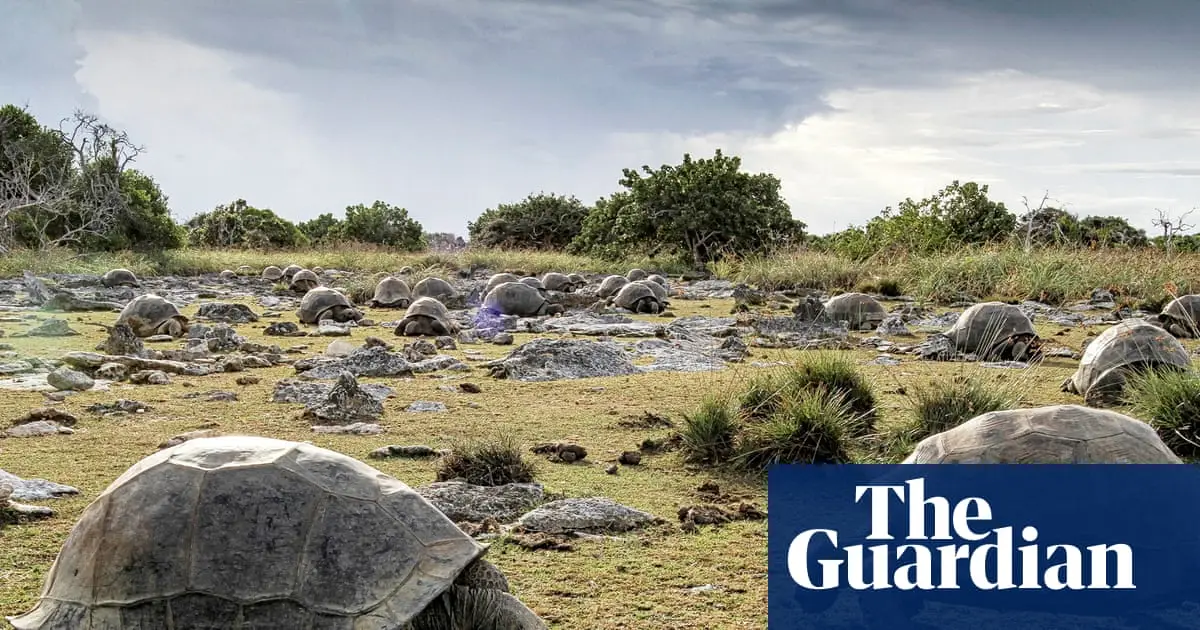
A new census of the Aldabra giant tortoise population on Aldabra Atoll in the Seychelles recorded about 180,000 animals, the highest number ever recorded for the species. The figure far exceeds the human population of the Seychelles and changes the picture of a once-threatened species.
The research, led by the Seychelles Islands Foundation (SIF) and the University of Exeter, analyzed five years of counts, from 2018 to 2022. It is the first official update since the widely cited figure of 100,000 tortoises from the late 1990s.
Dr Frauke Fleischer-Dogley, chief executive of SIF, said that having more than 180,000 giant tortoises roaming freely on the atoll demonstrates what a long-term commitment to conservation can achieve. “This is wonderful news for the Seychelles, for the world and for everyone who worked to protect Aldabra,” she said.
According to the study, published in the scientific journal Ecology and Evolution, the population was relatively stable during this period, with a best estimate of nearly 183,000 adult and subadult tortoises. The researchers note that the atoll’s dense vegetation makes counting difficult in some areas, so they used modeling to account for what they could not see directly.
The recovery has deep historical roots. In the 19th century, exploitation of the animals had left fewer than 1,000 Aldabra tortoises on the island. A restoration program led to the area being designated a strict nature reserve in 1981 and a UNESCO heritage site in 1982. Aldabra Atoll is one of only two places in the world where giant tortoises live in the wild, with a much smaller population in the Galápagos.
However, the authors warn that vigilance is needed. Aldabra’s climate is changing, with longer and more frequent droughts expected to reduce shade and food, while rising sea levels threaten the atoll’s low-lying areas. Invasive mammals, such as stray cats and black rats, also prey on eggs and hatchlings.
Dr Nancy Bunbury, a co-author of the study, explained that Aldabra’s monitoring program is among the longest-running in the region, but dense vegetation makes counting very difficult in places. By also modeling what they had not seen, the researchers produced the most reliable baseline for this iconic species, establishing a benchmark for the coming decades.
Dr Dave Hudson, a postdoctoral researcher at the University of Exeter, stressed that the results are great news and a testament to the fieldwork, but the numbers are a baseline rather than an endpoint. The authors believe that the planned eradication of the remaining invasive mammals could remove the last barriers to further population growth and help the tortoises withstand future climate pressures.


Comments