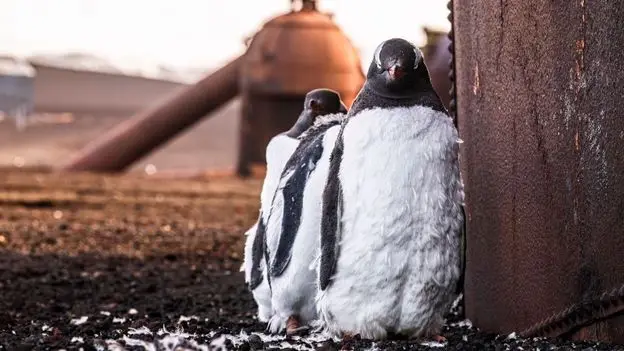
On Deception Island, an active Antarctic volcano with a flooded caldera, three gentoo penguins were photographed molting beside rusty remnants of the whaling industry. Wildlife photographer Romain Barats's image was a finalist in the Ocean Photographer of the Year 2026 competition.
The island bears clear traces of human activity. Whale oil tanks have sunk into the dark sand, and wooden boats are slowly rotting in the harsh Antarctic weather. When Barats arrived, the whaling and sealing industries had long been abandoned, and the animals had taken over again. “The three gentoo penguins look almost like guards beside the ruins,” he says. In purely visual terms, he adds, “it's like Chernobyl”: places where human activity abruptly receded and nature began moving into the structures we left behind.
But the photograph also reveals a deeper story about how penguins respond to a world shaped by humans. The gentoo penguins featured in the image are among the rare winners of climate change. Their numbers are growing in Antarctica and soaring in some areas: along the western Antarctic Peninsula, they have risen by almost a quarter since 2013.
Heather Lynch, a professor of ecology and evolution at Stony Brook University in New York, explains that the penguins in the image are molting. “They can't go into the water when they're molting,” she says. “It's itchy, it's uncomfortable, and they get cold very easily.” The three penguins came out of the sea to warm themselves with the volcano's heat. The rusty tanks, remnants of the whaling industry that dominated the island in the early 20th century, give them additional protection from the wind. “They're trying to stay as warm and comfortable as possible for as long as it takes to grow their new feathers,” Lynch adds.
This adaptability is what helps gentoos thrive. “Gentoo penguins are what we call climate change winners,” Lynch says. “Their numbers have soared in this part of Antarctica because they prefer warmth and can tolerate wet conditions. They just keep moving farther south.” Their global population grew by about 11% between 2013 and 2020, with sharper increases on the western Antarctic Peninsula, where growth reached 23%.
Meanwhile, their two closest relatives, chinstrap and Adélie penguins, are climate change losers. Chinstraps have already declined dramatically on the Antarctic Peninsula, while Adélies have declined by 65% over 25 years in the same region; scientists predict that most of their populations will be declining by the end of the century. Gentoos stand out from their relatives because they are not picky eaters: they can switch their diet from krill to fish and back again depending on availability. If their eggs are destroyed by a sudden flood or an unusual snowstorm—something that is becoming more common with climate change, Lynch notes—they can simply lay more. It is an unusual ability: neither chinstraps nor Adélies can lay multiple clutches in the same season if they lose the first. Gentoos can also radically shift their breeding season to adapt to changes in the climate.
The result, Lynch says, is increasingly visible. “Everywhere we look on the Antarctic Peninsula, we find more gentoo penguins,” she notes. “It's a gentoo takeover.” For now, no penguins breed on Deception Island. Volcanic eruptions over the past 7,000 years have repeatedly decimated penguin populations in the area. However, Lynch is watching for gentoo nests to appear. “If someone asked me who would be the first to try breeding inside Deception Island, it would be the gentoos,” she says. “It would be so typical of them to turn up and build a few nests inside the caldera.”
Despite the eruptions and its industrial past, the island remains a unique wildlife refuge. “The outer part of Deception Island is one of the most spectacular penguin amphitheaters we have in Antarctica,” Lynch says. For Barats, it is a place where natural and human forces collide. “You can feel something very powerful,” he says. “It's like coming face to face with something much bigger than us. Geological time, nature, perhaps the transience of our civilization.”
Comments