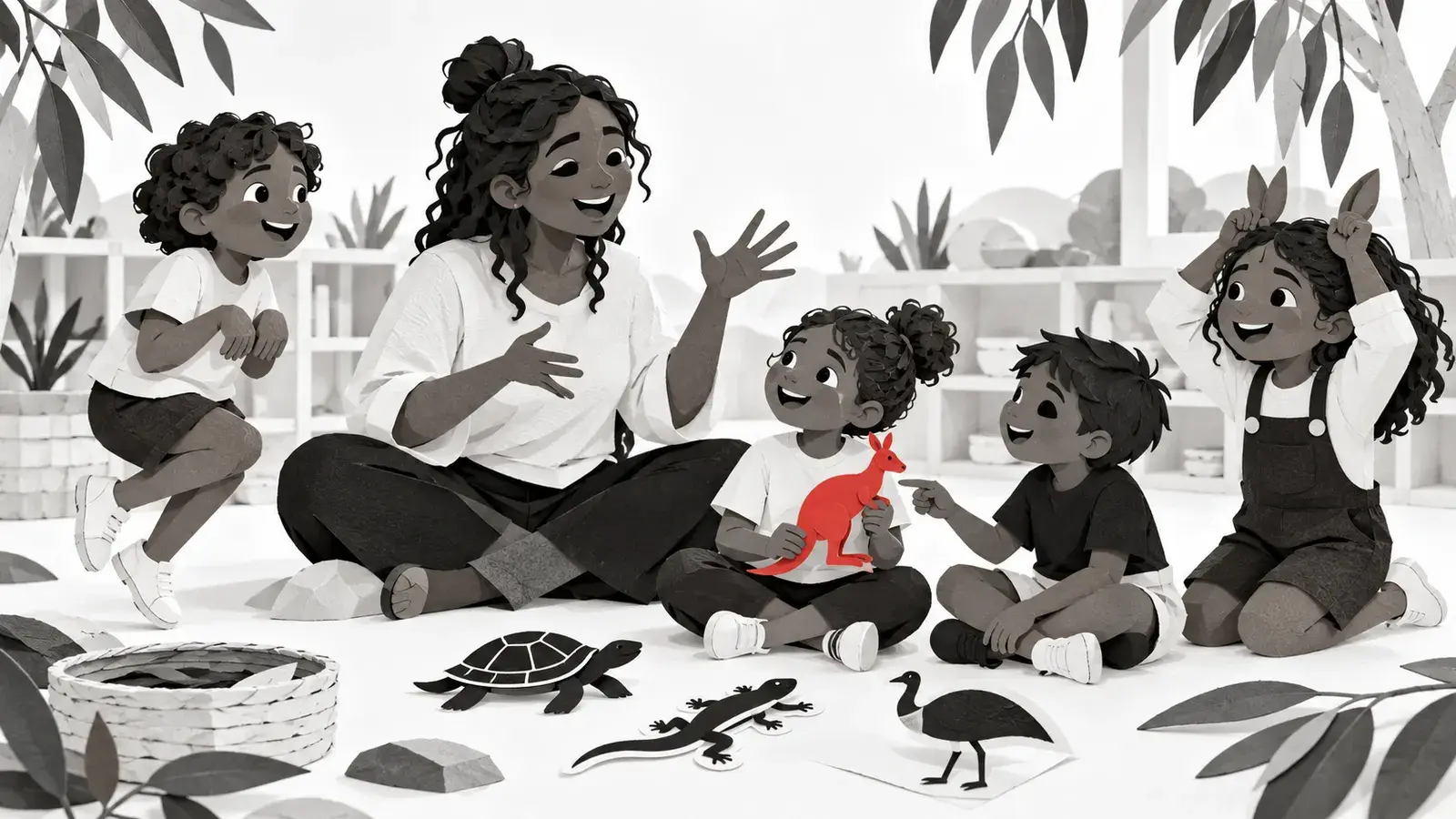
A new approach to teaching Australia's Indigenous languages could, according to researchers at Curtin University, encourage children's participation and help pass on their cultural heritage. The team developed the method by working for a year at an Aboriginal children's playgroup at Meerilinga. In the study, preschool children learning Noongar took part in storytelling circles, songs and story-based activities.
The model is called “translingual yarning pedagogy”, abbreviated as TYP. It combines “yarning”, a traditional Aboriginal practice of storytelling and collective learning, with translanguaging: drawing on all the language skills a child has to communicate. English and Indigenous languages are thus used alongside gestures, singing and play, rather than being treated as separate forms of expression.
The researchers observed that this flexible approach, rooted in the children's culture, helped them participate more actively and confidently in language learning. The children could move naturally between languages while also engaging with Aboriginal cultural knowledge. Language was thus connected to stories, activities and everyday experiences.
The study's lead author, Professor Sender Dovchin of Curtin University's School of Education, argued that the findings show a need to move away from rigid methods dominated by English. As she explained, the children freely used English, Noongar and gestures together to convey meaning, without the teaching focusing on separating languages or on “correct” forms. In her view, this created room to connect learning with culture and identity.
The need to preserve these connections is particularly significant in Australia's linguistic landscape. More than 250 Aboriginal languages were once spoken, but today only a small number are still actively learned as first languages. These languages are also often underrepresented in formal education, limiting their place in the classroom.
Study co-author Tamara Tucker, founder of Yalkarang Consulting and a Noongar language educator, believes approaches such as TYP can make learning meaningful and sustainable. She says stories, singing, movement and a connection to place help children experience the language beyond memorising words. She also argued that this process strengthens pride, confidence and a connection to their identity, which she considers essential for passing languages on to future generations.
The research also raises the question of Indigenous languages' place in school curricula. According to the university's text, they are often excluded from core programmes for teaching languages other than English, which prioritise internationally used languages. Dovchin believes that recognising students' full linguistic and cultural backgrounds can create more inclusive classrooms and help revitalise languages that have been marginalised for generations.



Comments