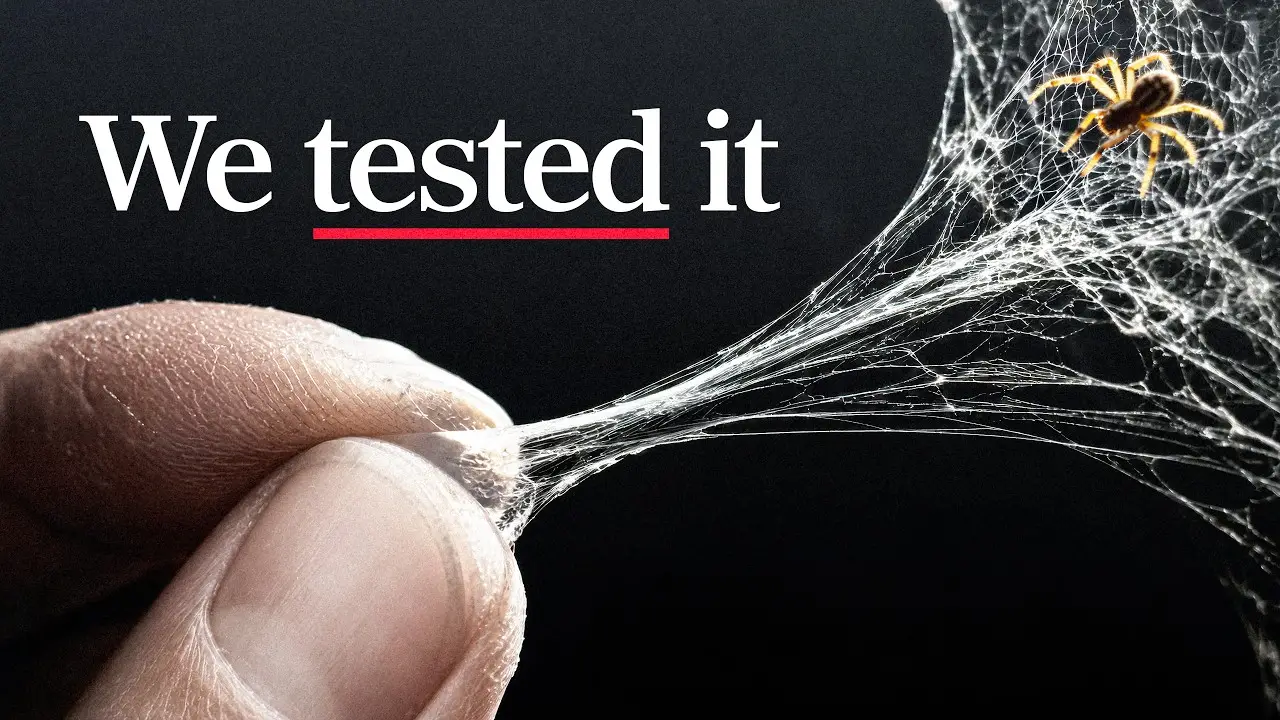
In this Veritasium video, Derek Muller visits the Blackledge Spider Lab at the University of Akron, one of the leading centers for spider silk research, to test whether the claim that spider silk is stronger than steel and ten times tougher than Kevlar holds up.
Spiders produce seven different types of silk, but the strongest is called dragline silk, which forms the spokes and outer frame of the web. Its job is to stop insects that fly into the web, absorbing their kinetic energy without letting them bounce off.
To measure its strength, researchers “milk” spiders: they anesthetize them with CO₂, secure them in place and slowly draw out the thread. A tensile testing machine then records the force per unit area (stress) and the elongation (strain). The sample they tested broke at 600 megapascals, but silk from Darwin's bark spider in Madagascar reaches 1,600 MPa. Experimental ultrahigh-strength steel can reach 3,000 MPa, but steel is six times denser; for equal mass and length, spider silk has six times the cross-sectional area and withstands about twice as much force before breaking.
Strength, however, is not the only critical measure. Toughness, the energy a material absorbs before breaking, is equally important. Kevlar has a toughness of up to 50 MJ/m³, experimental steel about 170 MJ/m³, while the spider silk sample reached 205 MJ/m³. Darwin's bark spider silk can reach 520 MJ/m³, about three times that of the strongest steel and ten times that of Kevlar. This is because Kevlar is very stiff and breaks before it can stretch much, while spider silk combines strength with considerable elongation — up to 70% before breaking.
The secret lies in the silk's nanostructure. In some regions, the silk proteins, called spidroins, form aligned nanocrystals, like stacked egg cartons, that provide stiffness, while in other regions they remain disordered and flexible. This works like a network of rigid blocks connected by elastic cords: the cords stretch and absorb energy, while the blocks distribute the pulling force. This allows the silk to absorb enormous amounts of energy before breaking.
So why aren't we already using spider silk in ropes, bulletproof vests or airbags? Because spiders are cannibals and cannot be farmed close together; they need vast amounts of space, and harvesting the silk is difficult. Back in 1709, François Xavier Bon made stockings from spider silk, but the quantity needed was prohibitive. Three centuries later, Simon Peers and Nicholas Godley needed years and more than a million golden orb-weaver spiders in Madagascar to weave a single golden cape. Today, one supplier charges $700 for 100 milligrams, or about $7 million per kilogram — 50 times the price of gold.
Scientists tried to get around the problem by producing spider silk proteins in other organisms. In the late 1990s, DuPont introduced the genes into E. coli bacteria and yeast. In 2001, German researchers put them into plants such as tobacco and potatoes. The Canadian company Nexia created genetically modified goats that produced the proteins in their milk — they called them “spider-goats.” All these efforts produced proteins, but none managed to make fibers with the properties of natural spider silk, because they could not reproduce the spider's spinning process.
Inside the spider, spinning begins in the silk gland. The proteins are secreted into an aqueous solution, where pH regulation keeps them apart because they carry the same negative charge and repel one another. They form micelles and larger globules. They then pass through a narrow, winding duct, where shear forces stretch and align them, while water removal and a drop in pH neutralize the charges and allow the proteins to connect into chains. The final stretch through a small opening, called a spigot, fully aligns them, creating the beta sheets that form the nanocrystals. The exact process is not fully understood, which makes it difficult to reproduce in the laboratory.
A different approach is to use an organism that already has a spinning apparatus: the silkworm. Humans have been raising silkworms for almost 5,000 years. According to legend, a Chinese empress discovered silk when a cocoon fell into her tea. China kept the secret for 2,000 years, until two monks stole it for the Byzantine emperor Justinian, hiding silkworm eggs in hollow walking sticks — perhaps the first recorded case of industrial espionage. Each moth lays 500 eggs every 30 days, making them extremely efficient to farm.
Kraig BioCraft Laboratories in Michigan uses genetically modified silkworms to produce silk with spider genes. The process begins by microinjecting spider DNA into silkworm eggs. They use a natural transposable element, piggyBac, which works like a cut-and-paste system: it cuts and inserts the gene at a random position in the genome. However, because the position is random, the resulting silk contains only 6–10% spider DNA. Even so, the fibers achieve about 60% of natural spider silk's mechanical performance. The next step is to replace the silk gene in a targeted way using CRISPR-Cas9, to produce pure spider silk.
It is not the only company in the field. Germany's AMSilk produces proteins for fibers, coatings and hydrogels, while Japan's Spiber ferments proteins for fabrics already used by brands such as Goldwin and The North Face. The US military funded Kraig to develop ballistic protection panels, while Newrotex is exploring the use of spider silk for nerve repair. Last year, Kraig produced half a tonne of transgenic silk cocoons.
The video ends with a spectacular test: at a climbing gym, Derek hangs from a continuous thread made of ten strands of transgenic silk. He is the first person ever to hang from real spider silk. The thread held his weight, but because it was extremely thin and strong, it cut his fingers. Derek challenges Tom Holland and the other actors who have played Spider-Man to try it too.

Comments