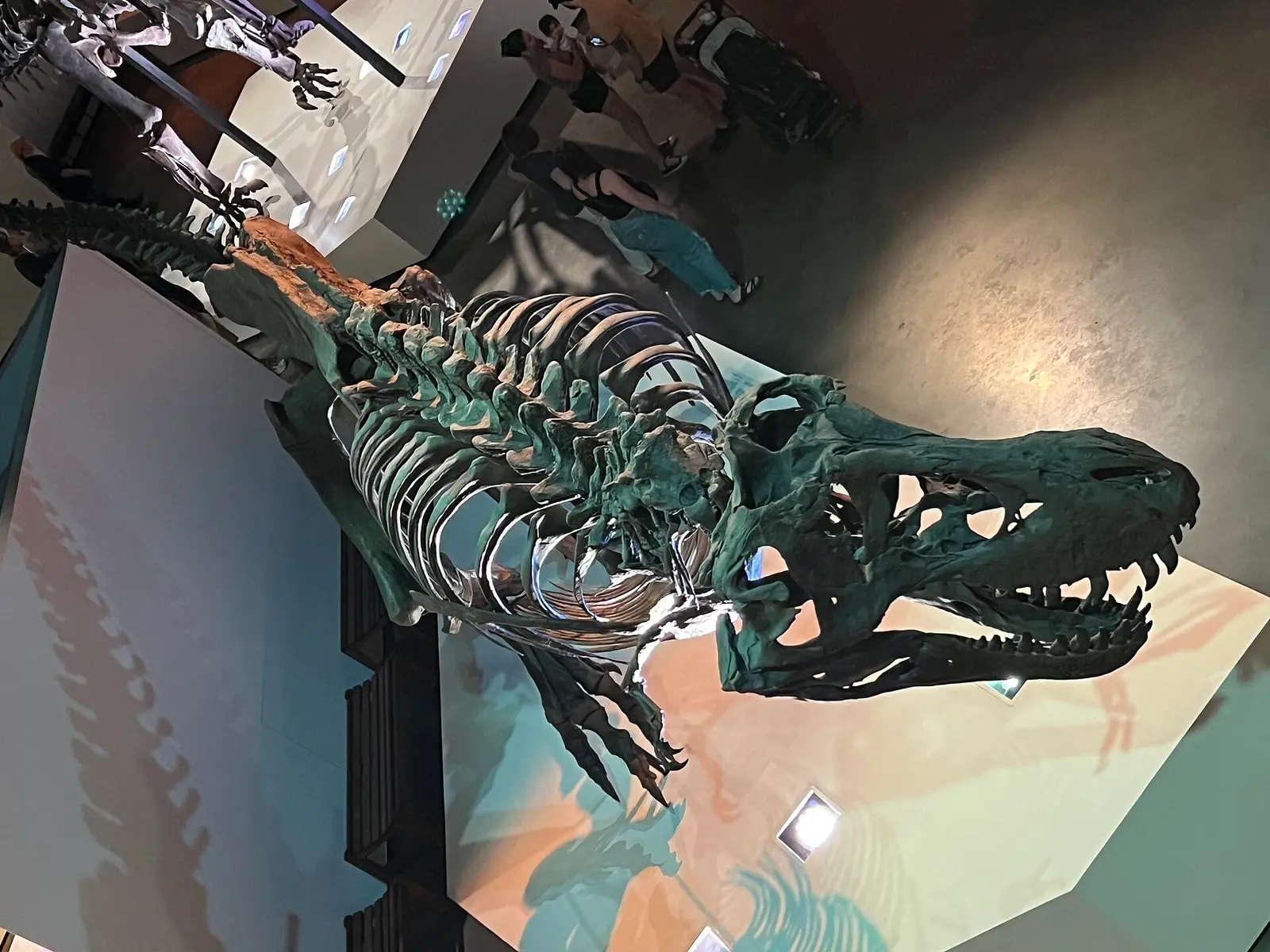
Paleontologist Dave Hone, a dinosaur specialist and co-host of the Terrible Lizards podcast, talks to Lex Fridman, beginning with Tyrannosaurus rex. Hone stresses that the animal's size is hard to grasp: about 12 meters long, up to 5 meters tall and weighing around 7 metric tonnes—like an orca on land, according to his colleague Tom Holtz. Its skull is massive and “overengineered,” with eyes the size of tennis balls, enormous teeth and an exceptionally powerful bite. By contrast, its two-fingered arms are disproportionately small and, as the small ligaments and only slightly curved claws suggest, probably played no significant role.
Hone explains that T-Rex walked efficiently thanks to a special arrangement of its foot bones. The middle metatarsal is shaped like a flattened diamond that “locks” the bones together, reducing energy loss with each step, a feature that evolved independently in several dinosaur groups. Its tail housed enormous muscles that pulled the thigh backward and provided propulsion. On speed, he says recent estimates put the upper limit at around 40 km/h, but T-Rex probably did not run in the strict sense of having both feet off the ground; it was a “fast walker” with an enormous stride.
Asked what it ate, Hone rejects the image of T-Rex hunting adult Triceratops. As with modern carnivores, most predators attack prey much smaller than themselves; he noted that data on the small dinosaur Microraptor and modern predators typically put prey mass at 5–20% of the predator's mass. T-Rex therefore probably targeted young herbivores, which were weaker, inexperienced and often forced to feed in more dangerous areas. Bite marks with healed bones and broken teeth prove that attacks also occurred, while other marks on already weathered bones clearly indicate scavenging.
Much of the discussion concerns paleontological methods. Hone describes how fossils are found either in fine-grained limestone quarries, such as the Archaeopteryx beds, or through field searches in known geological formations. He recounts the discovery of Linheraptor, a nearly complete skeleton found after a colleague spotted less than a centimeter of claw sticking out of a hill. Excavation may require heavy machinery or entirely manual work, depending on the regulations; skeletons are covered in plaster and burlap for transport. One example is the famous skeleton “Stan,” which required more than 30,000 hours of cleaning and documentation and was sold in 2020 for $31.8 million to Abu Dhabi's Department of Culture and Tourism.
Hone explains that around 1,500–1,600 valid dinosaur species have been named, with 40–50 new ones added each year, while many areas, including India, Ecuador, Australia and Argentina, remain barely explored. Despite progress, technology has not radically changed how discoveries are made; experiments with seismic methods, radioactivity or drones have not replaced the human eye. Half-jokingly, he argues that all science funding should go to paleontology because fossils erode and are lost forever, unlike other subjects of study.
Returning to T-Rex, Hone compares its skull with that of Giganotosaurus: although the two animals are similar in length, T-Rex has much more bone, thicker jaws and smaller openings in its skull, features associated with its enormous bite. Tyrannosaurs had fused nasal bones from very early on, making the snout more rigid.
Their evolutionary history begins with small, feathered animals two to three meters long in the Middle Jurassic and culminates in giant tyrannosaurines at the end of the Cretaceous. Hone refers to Cope's rule, according to which lineages tend to grow larger, but large animals are more vulnerable to mass extinctions because of their resource needs, smaller populations and slow reproduction.
Hone prefers the term “apex predator” to “top predator,” because in ecological terms the latter usually describes predators that eat other predators. T-Rex was unusual because it was by an enormous margin the largest carnivore in its ecosystem; the gap between it and the next predator was like comparing a lion with a weasel. This means that large bite marks on large bones can confidently be attributed to T-Rex. He also explains the difference in strategy: carcharodontosaurs cut into and wore down their prey, while T-Rex crushed it with its bite.
A large part of the discussion is devoted to Jurassic Park. Hone stresses that many details are wrong and that the claim “T-Rex can't see you if you don't move” is pure fiction, with no research basis. Velociraptor was much smaller, probably feathered, and there is no strong evidence for pack hunting. He examines the famous assemblages of Deinonychus and Tenontosaurus: even if many individuals are found together, that does not prove they hunted together, since these could be predator traps or successive arrivals at a carcass. He points out that even modern hyenas, which live in social groups, mostly hunt alone.
On social life and sexual selection, Hone explains that the crests and horns on many theropods' heads were probably signals of social and sexual selection, like a lion's mane. He discusses the two main theories: the “honest signal,” or handicap, in which striking features demonstrate resilience, and the “sexy sons” hypothesis, in which a preference can begin almost at random. Because these signals occur in both sexes in many dinosaurs, there may have been mutual sexual selection and cooperation in breeding, as in black swans. However, distinguishing sex is extremely difficult: only medullary bone identifies egg-laying females, and only for a limited period.
On intelligence, Hone says that endocranial casts allow us to see the size of the olfactory and visual lobes, but estimating intelligence is much harder. A recent paper that attributed primate-level intelligence to T-Rex based on three billion neurons was quickly refuted; the revised estimate is 250 million to 1.7 billion, close to crocodiles. Hone stresses that a large animal needs a large brain to operate its body, and the brain-to-body-mass ratio does not support exceptional intelligence. Tool use would, in theory, be difficult to demonstrate through fossils.
Hone confirms that there is evidence of cannibalism in T-Rex: a T-Rex foot bone bears characteristic feeding marks from another T-Rex, and broken teeth have also been found. However, cannibalism is rare in nature because carnivores accumulate parasites, and eating a member of the same species carries a high risk of infection. Tyrannosaurs also very frequently had facial injuries from fighting, but the marks on the foot showed no healing and resembled feeding traces rather than signs of combat.
On extinction, Hone describes the asteroid impact near the Yucatán Peninsula 66 million years ago, which created an almost instantaneous nuclear winter and climate change. All five major mass extinctions are associated with climate change too rapid for adaptation. Large land animals suffered most because they needed more resources, had smaller populations and reproduced more slowly. He would be surprised if there had not been local dinosaur populations that survived briefly in isolated areas, but considers it unlikely that they could have recovered and recolonized the planet.
Hone explains that birds are literally dinosaurs, in the same way that we are apes and mammals. Feathers appeared long before birds, at least 165 million years before the extinction, in tyrannosaurs and many other groups. Their likely initial functions were insulation and communication/sexual selection. Birds survived largely because they were small.
Wrapping up the subject of “dragons,” Hone doubts that fossils inspired the myths, since dragons also appear in cultures with almost no dinosaurs.
Finally, Hone talks about evolution as a game of numbers and trade-offs. He stresses that organisms are not perfect, but “patchwork”; the example of the dark-maned lion shows the tension between attractiveness and overheating. He also mentions Protoceratops as the only dinosaur with a sample of more than 100 individuals from the same place and time, allowing population studies, but even there distinguishing sex remains difficult.
The discussion closes with Carl Sagan's statement that extinction is the rule and survival the exception.

Comments