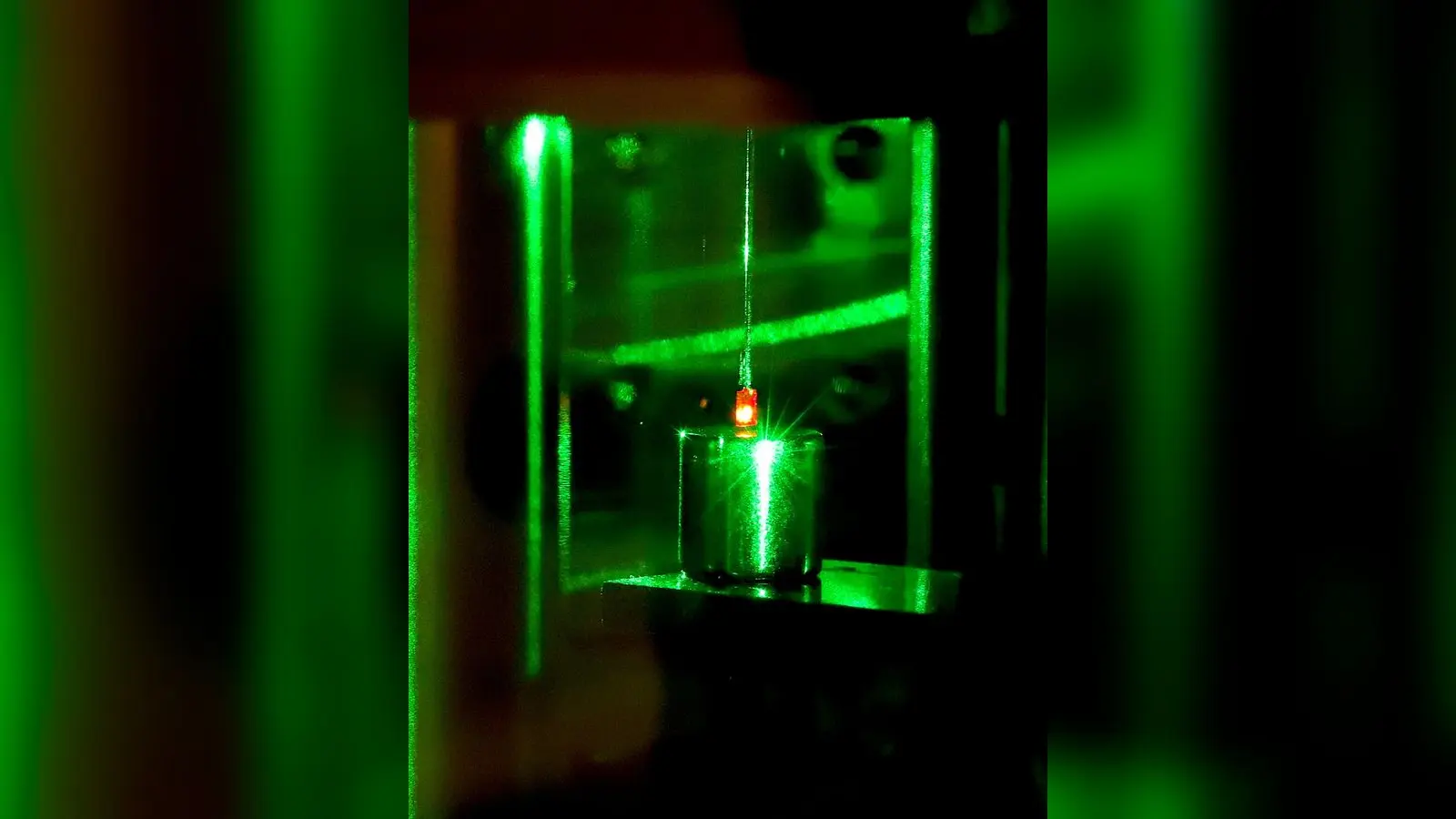
For the first time, researchers at the Okinawa Institute of Science and Technology (OIST) have managed to move a levitated diamond about one centimeter wide using only the force generated by electron spins. The experiment, published in Science Advances, is the first direct observation of a quantum phenomenon moving an object large enough to be noticeably affected by gravity.
Quantum mechanics has given us lasers, MRI scanners, semiconductors and quantum computers, but research remains largely at the subatomic scale. Demonstrating quantum phenomena in objects large enough to be affected by gravity is difficult because large objects are hard to isolate from heat and vibrations.
However, the OIST team overcame this obstacle. Professor Jason Twamley of the Quantum Machines Unit explains that, until now, attempts to test whether quantum mechanics applies to anything larger than a few tens of nanometers had been unsuccessful. In the new experiment, the researchers observed a classical mechanical response to a quantum force in an object eight to nine orders of magnitude more massive than anything previously achieved in spin-mechanics experiments.
The setup combines a diamagnetically levitated graphite plate fitted with a mirror, connected by a carbon rod passing through magnetic shielding to a diamond suspended above a magnet. The diamond contains billions of so-called nitrogen-vacancy (NV) centers, which trap unpaired electrons and act as tiny, controllable quantum magnets through the quantum force of their spins. Periodically illuminating the diamond with a green laser polarizes these centers into a predetermined spin state, creating tiny magnetic fluctuations that push the diamond downward. The motion is recorded by an interferometer that reflects a laser off the mirror on the graphite plate and measures changes in distance with picometer precision. This setup made it possible to clearly observe the classical displacement of an object weighing 100 milligrams from a purely quantum cause.
First author Anshuman Nayak explains that testing the quantum nature of gravity requires putting objects with sufficiently large masses into quantum superposition while levitated in a vacuum. The usual approach starts with very small levitated objects and gradually increases their mass. The OIST team, by contrast, is moving from large to small: just as diamagnetic levitation lifts maglev trains, it can levitate centimeter-wide objects carrying diamonds, where gravity is strong but quantum phenomena had not been observed.
Co-author Daehee Kim notes that NV diamonds are well understood and easy to control. In addition, NV centers have some of the longest known coherence times, maintaining quantum superposition at room temperature much longer than other systems. This makes them attractive for the future creation of a macroscopic superposition of motion or of an object.
The demonstration opens the way for experimental investigation of questions that troubled Einstein: is gravity quantum or classical? What happens to information at the center of a black hole? What are dark matter and dark energy? Can an object with mass be in two places at once? The researchers say their platform could also lead to a new class of highly precise sensors for detecting dark matter, gravitational waves and other exotic phenomena.
Twamley concludes: “We have shown a large classical response from a small quantum phenomenon. It is no longer a question of whether such technology is possible, but how we can improve the experimental conditions to achieve quantum superposition in the regime of Einstein’s general relativity. And along the way, we are developing a new class of highly precise sensors. We are moving from nanometers to centimeters. All we need is one more order of magnitude, and we can finally observe Schrödinger’s cat in real life.”


Comments