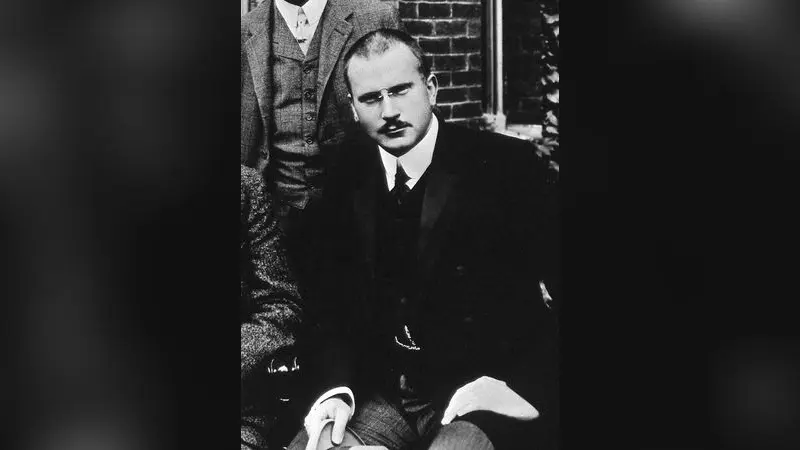
Carl Jung (26 July 1875 – 6 June 1961) was just twenty years old and had recently entered medical school when he began to see death as a way of understanding life. His father, who had died six weeks earlier, appeared to him in a dream and announced that he would be returning home after a holiday. Struck by how real the dream felt, Jung began developing a psychological cosmology of death that would take half his life to complete.
His central position was clearly expressed in his 1929 commentary on “The Secret of the Golden Flower”, a Chinese book of life. There, he wrote that death is psychologically as significant as birth and, like birth, an integral part of life: “Seen in the proper psychological perspective, death is not an end but a goal.”
Five years later, Jung developed these ideas in his essay “The Soul and Death”, included in Jenny Yates’s anthology “Jung on Death and Immortality”. There, he argued that life is an energy process, in principle irreversible and therefore directed towards a goal: a state of rest. “Whatever happens,” he wrote, “is merely the initial disturbance of a perpetual state of rest that constantly seeks to re-establish itself.”
His acquaintance with Einstein played a pivotal role in his thinking: the two men had dined together during the early years of the theory of relativity. The revelation that space and time are one, and that spacetime tells matter how to move while matter, under the influence of gravity, tells spacetime how to curve, allowed Jung to conceive of death not as the endpoint of a straight line, but as a curve following the curvature of spacetime itself.
Eternity would then be a realm where all directions are relative, and consciousness bends spacetime in one way that we call life and another that we call death, while the energy causing the bending remains uninterrupted.
In his reply to a pastor who described a conversation with his brother at the moment of his brother’s death, despite a continent separating them, Jung noted that it was quite possible that only what we call consciousness is contained within space and time, while the rest of the psyche, the unconscious, exists in a state of relative timelessness and is not isolated from other psyches. Acknowledging that “no one knows what the psyche is”, he argued that regarding death as the fulfilment of life’s meaning rather than a simple, meaningless interruption is more consistent with humanity’s collective psyche.
As he was finishing the essay, his sister died. Jung found comfort in a psychological analysis of the Tibetan Book of the Dead, in which he saw a parallel between the Buddhist concept of enlightenment and the goal of psychiatry: withdrawing our psychological projections so that we can see clearly. Our conception of death, he argued, is a projection of our hopes and fears through our intuitions about space and time — intuitions that have repeatedly misled us, from the shape of Earth to the centrality of the solar system.
Jung himself came into conflict with his own intuitions when, during the fourth winter of the world’s deadliest war, he suffered cardiac arrest and survived a near-death experience. In a letter, he wrote that what happens after death is so indescribably glorious that our imagination cannot even begin to grasp it, and that the dissolution of our time-bound form into eternity does not entail a loss of meaning.
Central to his thinking was the concept of synchronicity — the meaningful alignment of two events in space and time — which he had developed jointly with his former patient Wolfgang Pauli shortly after the physicist was awarded the Nobel Prize. Decades later, as Jung himself approached death, he would insist that we cannot rule out “the possibility of an existence outside time that runs parallel to existence within time”.
His most mature formulation concerns middle age. Half a century before Ursula K. Le Guin wrote about menopause as rebirth, Jung observed that from the middle of life onwards, only those who are ready to die with life remain alive: “At the secret hour of life’s midday, the parabola reverses, and death is born.
The second half of life does not mean ascent, unfolding, growth or abundance, but death, since its end is its goal. Refusing life’s fulfilment is synonymous with refusing to accept its ending. Both mean that we do not want to live, and not wanting to live is identical to not wanting to die. Growth and decline form a single curve.”


Comments