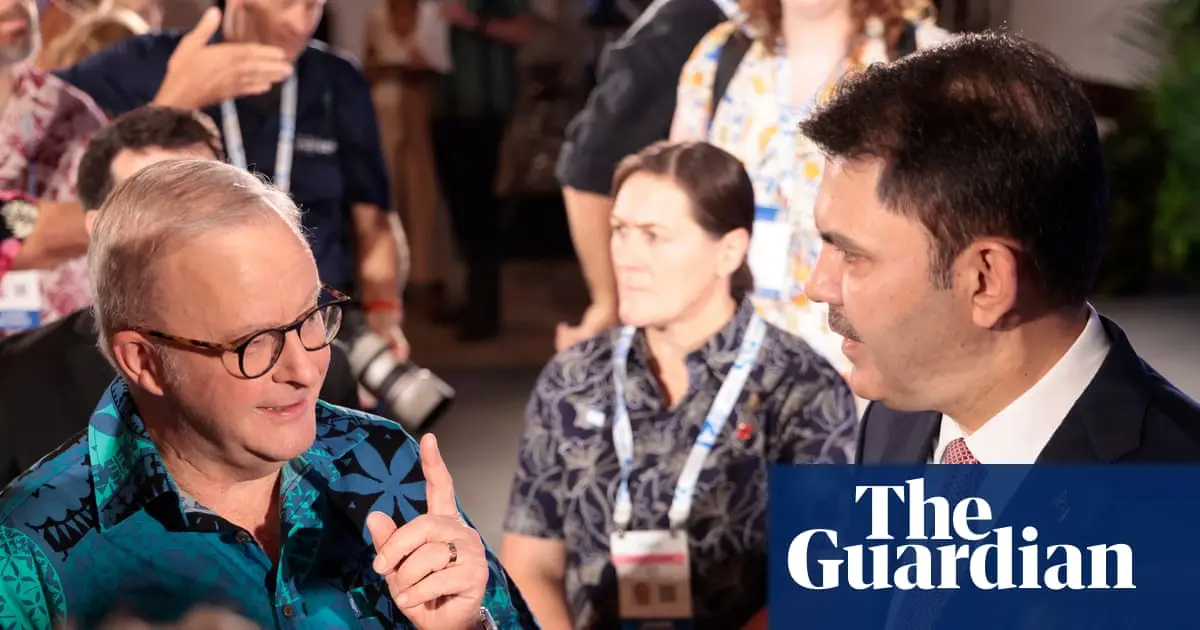
Wealthy countries should spend far more on tackling the climate crisis than they have pledged to spend on defence, Murat Kurum, Turkey's climate change minister and COP31 president-designate, told the Guardian. Referring to NATO members' commitment to defence spending equivalent to 5% of GDP by 2035, he argued that the climate crisis poses an even greater security risk. At the same time, he was cautious about whether the conference should pursue a new explicit agreement on transitioning away from fossil fuels.
The remarks came during the preparatory meeting in Fiji, ahead of COP31, which will take place in November in Antalya, Turkey. Australia, which is taking on the new role of president of negotiations, had sought to hold the meeting in the Pacific to highlight the needs of island states. Australian prime minister Anthony Albanese was joined in Nadi by 13 other national leaders, mainly from the Pacific, around 30 ministers and about 4,000 other attendees. Major emitters, including China and Saudi Arabia, were also represented.
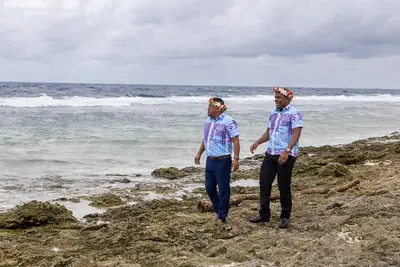
On Tuesday, a delegation visited Tuvalu, a nation of low-lying coral islands with around 10,000 residents that is among the most exposed to the climate crisis. The visitors saw a project to reclaim 20 hectares of land and heard the experiences of residents of a country where most of the land lies only about two metres above sea level. Rising seas, storm flooding and increasingly severe extreme weather threaten its survival.
Thirteen-year-old Melelusi Sokotia described to the visitors how her friends' dreams of becoming teachers, doctors or builders are overshadowed by uncertainty about whether they can grow up safely in Tuvalu. In her closing address in Fiji, climate minister Lynda Tabuya urged delegates to remember the people they had met and bring the Pacific's experiences into the negotiations. She stressed that the end of the preparatory meeting did not mean the end of their responsibility.
The governments of around 190 countries will arrive in Antalya with evidence showing that current action remains insufficient. According to a recent UN Environment Programme report cited in the article, even the most optimistic outlook leads to global warming of at least 1.8°C, above the Paris Agreement's 1.5°C limit. The report calls for immediate and sustained emissions reductions. It stresses that every fraction of a degree of warming avoided saves lives and reduces economic losses.
Pacific leaders reiterated that the 1.5°C target must remain achievable, oceans must be protected and climate finance must be easily accessible to poor and vulnerable communities. Australian climate change minister Chris Bowen said that just 0.2% of global climate finance goes towards adaptation in small island developing states. Countries such as Tuvalu, which need the most help, receive the least, he said. He described changing this situation as a key priority for COP31.
Kurum linked the need for more funding to the cost of disasters, arguing that prevention is cheaper than recovery. To illustrate the difference, he said that failing to spend one unit of money before a disaster could mean having to spend ten afterwards. He and Bowen also said they would seek support for a global electrification target: by 2035, electricity should supply 35% of the energy used in homes, businesses, factories and vehicles, compared with around 21% today.
More controversial is the issue of immediate action to phase out fossil fuels, the main cause of the climate crisis. In Fiji, Turkey and Australia supported a joint statement by countries in favour of transitioning away from them, repeating wording adopted at COP28 in Dubai three years earlier. However, both faced criticism and accusations of hypocrisy for continuing to support new coal and gas projects. They were also criticized for their relative silence on the issue before the preparatory meeting.
Bowen argued that the transition away from fossil fuels should come from building enough renewable energy facilities to make fossil fuel plants unnecessary, rather than restricting their supply. Kurum said the transition was already under way and questioned whether insisting on the relevant wording in agreements could bring further progress. At COP30 in Brazil, delegations from Saudi Arabia, Russia and other oil-producing states had strongly opposed explicit references to fossil fuels.
Dozens of countries that believe the negotiations have reached a deadlock met separately in Colombia this year to discuss a pathway away from fossil fuels. They plan another meeting in Tuvalu next July and want the issue included in an agreement in Antalya. Tzeporah Berman, chair of the Fossil Fuel Non-Proliferation Treaty Initiative, said Pacific leaders had clearly called for an urgent phase-out of fossil fuels. In her view, this requires an end to new projects, as the continued expansion of production runs counter to the goal of ending it.

Comments