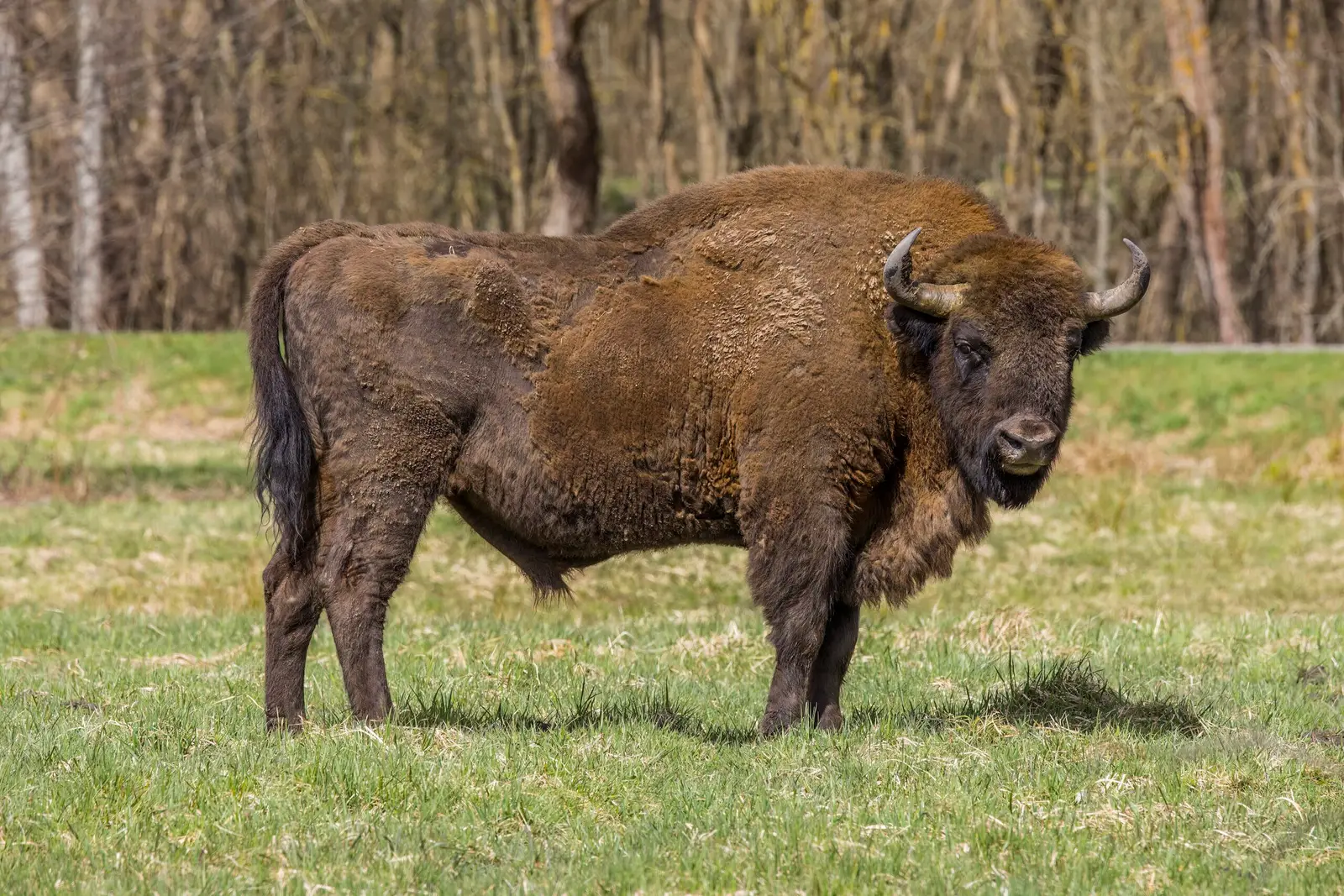
Poland has officially incorporated ecological restoration into its national defense strategy, making Białowieża Forest — Europe's last primeval forest — part of a natural line of defense along the country's eastern borders. The idea, known as “WarWilding,” was proposed in July 2024 by Polish scientists as an alternative to the conventional East Shield, the 700-kilometer fortification program extending along the borders with Belarus and the Russian exclave of Kaliningrad.
For Michal Żmihorski, deputy director of the Institute of Environmental Protection, it began on August 1, 2023, when two Belarusian helicopters entered Polish airspace over the village of Białowieża. The forest, covering an area equivalent to 200,000 football pitches and a UNESCO-listed site, is home on its Polish side to 900 European bison, lynx, wolves and up to 4,000 species of fungi.
East Shield, with a budget of $2.6 billion and a completion target of 2028, includes concrete anti-tank barriers, anti-tank ditches, preparations for minefields and drone detection systems. Żmihorski argues that wet forests full of water, dead wood and tall grass are impassable for heavy tanks.
Nature has been used as a weapon in wars for centuries: in 2022, Ukraine blew up a dam on the Irpin River, flooding 13,000 hectares and stopping the Russian advance toward Kyiv, while last year three American soldiers died in a swamp in Lithuania. The Ministry of Defense adopted the idea, and in 2025 Poland became one of the first NATO countries to incorporate ecological restoration into national defense. “The landscape can fight, and we would be foolish not to take advantage of it,” says Colonel Marek Pietrzak, a spokesman for the General Staff.
There are also critics, however: the University of Warsaw's Strategic Yearbook described East Shield as a modern version of the Maginot Line, saying that attacks are now carried out with missiles and drones. The military replies that no matter how many drones the enemy sends, it will ultimately want to put soldiers on the ground.
In May 2026, the Ministry of Climate announced that it would allocate about $120 million to reflood peatlands and marshes along the borders with Russia and Belarus. Poland has drained almost 85% of its peatlands, releasing about 44 million tonnes of CO2, and reflooding them would significantly reduce emissions while also strengthening resilience to climate change.
At the same time, the authorities banned the removal of dead wood from border forests and logging within 5 kilometers of the border. This “exclusion zone” forms the first line of defense, intended to stop heavy military vehicles; a second line, extending 50 kilometers inland, will slow the enemy. Government officials estimate that these natural defenses will protect up to 60% of the country's eastern and northern flanks.
Białowieża Forest badly needs this respite. Groundwater levels have fallen by 40 centimeters over the past 200 years, and the wetlands have remained dry since 2023. In 2017, loggers cleared an area equivalent to 980 football pitches as part of an operation against the insect Ips typographus, and logging stopped only after a ruling by the EU Court of Justice. In 2022, Poland built a 186-kilometer steel fence, cutting the forest in half: dozens of animals died in road accidents, and the fence blocked their migration routes. In 2025, the IUCN warned that the forest's condition was “critical.”
Water retention solutions are already being tested on the ground. Edyta Kapowicz, director of the Polish Society for the Protection of Birds (PTOP), together with the German organization Frankfurt Zoological Society, Białowieża National Park and local authorities, is filling drainage ditches with soil and dead wood. The aim is to restore water retention across 3,500 hectares and then reconnect the Lutownia and Narewka rivers with their floodplains along a 25-kilometer stretch, restoring another 8,500 hectares of marshland. These wetlands are a key habitat for the strictly protected lesser spotted eagle.
One serious obstacle remains: about 2,000 kilometers of roads fragment the forest and disrupt hydrological connectivity. The recent widening of provincial road 687 prompted fierce opposition; Żmihorski calls it “sabotage.” The Regional Road Construction Authority explains that the project is modernizing a road that has been in use for years, that preparations began in 2014 and that the environmental decision was issued in 2016, long before East Shield. The organization Workshop for All Beings has nevertheless denounced construction during the bird breeding season and is calling for European funding to be halted; the regional environmental authority in Białystok acknowledges that the project could have been carried out with less disruption.
In June, Poland approved a new forest management plan that will take effect in 2027 and leave 96% of the Polish side to natural processes, up from 37% today.
With the country on high alert for a possible Russian attack or provocation, Żmihorski stresses that the question is no longer whether nature can defend the borders, but whether there is enough time and will. “We need drastic measures,” he says. “We cannot afford to spend another five years thinking it over, because the political situation is very uncertain.”


Comments