Nate Hagens welcomes Matthew Monahan, co-founder of Ma Earth, an organization working on regenerative finance for community projects. Monahan started out in Silicon Valley, sold a startup, moved to New Zealand and spent twelve years living on a farm; today he connects philanthropy, agriculture and technology. Alongside Ma Earth, he is involved in Biome Trust and Mangaroa Farms, a regenerative farm and education center in Aotearoa New Zealand.
The discussion begins with the observation that today’s economic system does not support the conditions for life on the planet. Monahan cites examples such as it being more profitable to destroy the Amazon rainforest for palm oil plantations, or to deplete marine ecosystems through bottom fishing for a company’s profit margins. Yet, as he says, in every town and community there is an invisible thread of people acting on behalf of life: organizing composting, school gardens, plant nurseries, reforestation or coastal cleanups.
These initiatives often lack resources. Monahan reminds us that only 2 to 4 percent of global philanthropy goes to environmental and climate issues, even though philanthropy moves hundreds of billions of dollars annually. The question, he explains, is how to get these resources to communities and the front lines of the work. Even small amounts, such as tools for a beach cleanup or fuel for volunteers, can remove obstacles for people who already want to contribute.
The term “regenerative finance” is, according to Monahan, ambitious and still taking shape. He refers to John Fullerton, who introduced the term “regenerative economics.” The goal is to place life at the center of the economic paradigm, bringing the health of the planet and the economy into harmony. Hagens adds that nature is not entirely non-extractive; plants also draw nutrients from the soil, but there is reciprocity. The movement, then, is from pure extraction toward living systems with ecological feedback.
Monahan identifies three main obstacles in existing funding. First, systems are too centralized and abstract: net-zero commitments or COP-style conferences do not reach the mother who wants to create a school garden. Second, efforts are fragmented: philanthropy, impact investing and government funding operate in silos, and nonprofits compete with one another for the same funds. Third, trust is eroding and feedback loops are absent; people who give money want to see what difference it made.
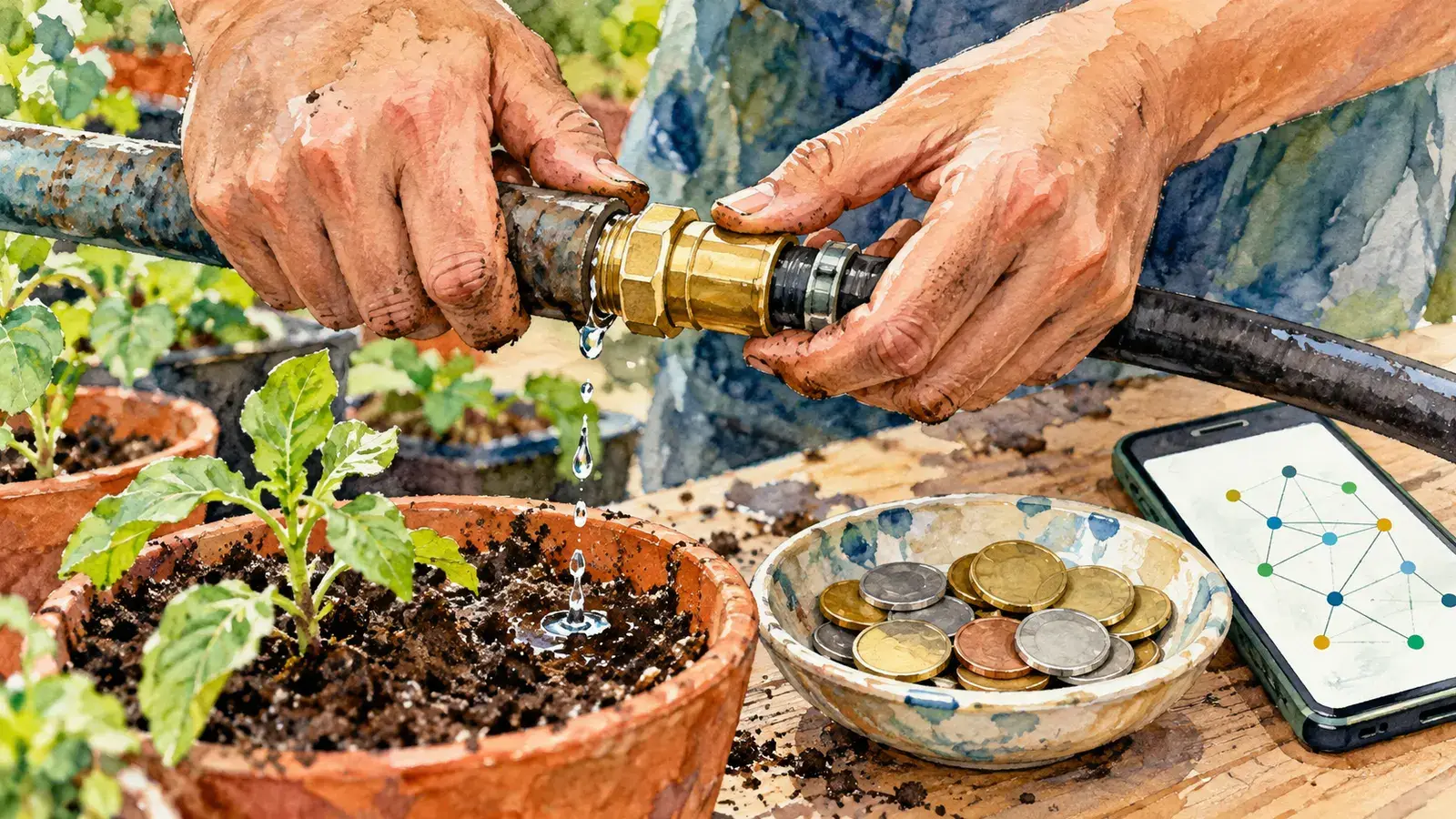
Ma Earth grew out of the experience of Biome Trust. Monahan and his family run Biome Trust as a philanthropic fund, but repeatedly saw how difficult it is to get money to the ground. So they created Ma Earth, a collective funding platform for community regeneration that combines philanthropic capital with crowdfunding from the public. The process runs in rounds: every six months, a group of projects is selected, the projects run a three-week campaign in their communities, and the matching philanthropic funds are then allocated based on the signal from the community.
In the third round, which began on July 1 and runs for three weeks, Ma Earth received more than 800 applications from 101 countries. Around 175 projects from more than 60 countries were selected, with a matching fund of one million dollars. Monahan emphasizes that the average grant is about $5,000; it is no silver bullet, but it gives visibility and support to projects that usually lack access to funding. In the first two pilot rounds, approximately $400,000 was given to around fifty projects.
Among the examples he mentions is Learning Environment in Whanganui, New Zealand, which hosts young people on a farm for nature-based education and connection with mental health. Rights-of-nature projects also stand out: Taranaki Maunga in Aotearoa, the first mountain to gain legal personhood, and Pyramid Mountain in the United States, which also “owns itself.” Another application that moved Monahan was Farmers on Crutches in Congo, which creates livelihoods for people who have lost limbs in wars.
On the technology side, the platform relies on infrastructure maintained by the Hypercerts Foundation and on the AT Protocol, the protocol that emerged from BlueSky. According to Monahan, each project retains control over its data, which can be transferred to other applications rather than being trapped in silos. This aims to reduce the “bureaucratic violence” of continually submitting applications and impact reports, and to create a kind of data commons for assessment, verification and endorsements by trusted organizations.
On cryptocurrencies, Monahan says he shares the skepticism, but believes it will be difficult to change the rules of the economy within the 180 national fiat currency zones. He does not propose replacing existing currencies with Bitcoin, which he describes as digital gold without much utility. Instead, he sees Ethereum as a decentralized “smart contract” infrastructure that could support complementary or local currencies and value mechanisms linked to ecological health.
Hagens raises the risk that regenerative finance could repeat the logic of pricing and commodifying nature. Monahan acknowledges that this is a deep concern of his. He describes how carbon incentives at Mangaroa Farms led to inappropriate planting to satisfy carbon sequestration tables, rather than putting the right species in the right place. This is why he prefers to start with what the community itself considers important, rather than imposing a measure from above. As he says, even buying vegetables from a local farmer puts a price on nature, but the relationship can be healthy if awareness of the paradox is maintained.
Monahan describes Ma Earth as a small step that aspires to scale up. He wants to test and iterate, as he learned in Silicon Valley, so that the infrastructure can move much larger sums. In future rounds, the fund may expand into multiple funds, with the option to create separate funds, direct matching and competitions. His goal is to launch the fourth round on Earth Day in 2027. Biome Trust has given approximately ten million dollars in grants over time, while around twenty million dollars has been invested in Mangaroa Farms.
On a personal level, Monahan advises caring for the body — sleep, water, good food, time outdoors — during a period of polycrisis. He tells young people that they do not necessarily have to listen to advice from “wise old men” like him and Hagens, but should follow their own compass. He reminds them that their actions will have cosmic significance for the future of life, not just humans. Asked what he would do with a magic wand, he replies that he would wish for all of us to be a little kinder to one another.
The discussion closes with Monahan acknowledging Hagens’s contribution as a beacon for the community. Hagens admits that after the interview he will return to everyday tasks, such as feeding the animals, but sees the conversation growing and society awakening to a broader ecological perspective. Monahan’s central invitation remains open: to find people, partners and funders who want to connect capital with the real work on the ground.


Comments