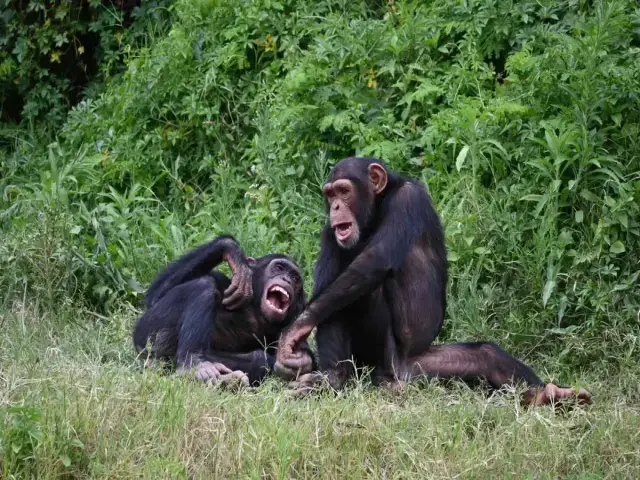
Chimpanzees take another chimpanzee's food less often when they share a close bond, according to a new study by UC Berkeley researchers. In an experiment involving pieces of pineapple, theft occurred in 61% of trials between closely bonded animals, compared with 70% between animals with a weaker relationship. The relationship also influenced the emotional responses of both the animal that lost the food and the one that took it. The findings suggest that these bonds can curb certain antisocial behaviors.
Previous research has shown that chimpanzees choose particular partners for mutual grooming and share their food selectively. These behaviors offer clues to the evolutionary history of human sociality. The new study asked how a close relationship influences actions that harm the other animal. The paper was published online in September and was scheduled to appear in the November issue of Evolution and Human Behavior.
To identify close relationships, the team observed 26 chimpanzees for more than 800 hours at the Ngamba Island Chimpanzee Sanctuary in Uganda. They recorded grooming, everyday interactions and how often the animals were within arm's reach of one another. These observations were used to identify pairs with a strong social bond. As the report notes, some scientists avoid the term “friendship” for such relationships because we cannot fully know their cognitive and emotional complexity.

The experiment took place in two rooms. In one, a chimpanzee had three trays containing pineapple, while a rope attached to the trays extended into the second room. There, another chimpanzee could either leave the rope untouched or pull it and take the food. The setup allowed the researchers to examine whether this choice changed depending on the relationship between the two animals.
The difference of nine percentage points is particularly significant because of the study's design, according to the researchers. Each chimpanzee took part in trials both with a closely bonded animal and with an animal with which it had a weaker bond. This comparison increases confidence that the difference is related to the relationship and is not simply random variation. Lead author Oded Ritov, a doctoral candidate in psychology at Berkeley, describes the work as the first to show that chimpanzees restrain antisocial behavior toward their friends.
The researchers also assessed the reactions of the animals that lost their food, observing foot stamping, fist pounding and shrieking. When a close partner took the food, the animals initially showed stronger anger. They then calmed down faster, however, than when the bond was weaker. This pattern shows that the close relationship influenced both the initial reaction and how it developed.
Differences were also observed in the animals that took the pineapple. When they were not closely bonded with the other animal, their negative emotional responses lasted longer. The researchers interpret this behavior as a sign that they viewed the interaction as more hostile. Ritov believes that the reactions on both sides suggest mutual expectations within the relationship, recalling the complexity of human friendship.
Jan Engelmann, an associate professor of psychology and head of the Social Origins Lab, stresses that human friendship involves heightened expectations of the other person's behavior. In his assessment, the study offers the first evidence that chimpanzees also expect, and perhaps demand, special treatment from their close partners. The researchers suggest that such expectations may form evolutionary foundations for human cooperation and moral principles. This is an interpretation of the findings: the experiment records specific choices and reactions, while their connection to broader human norms remains the authors' hypothesis.


Comments