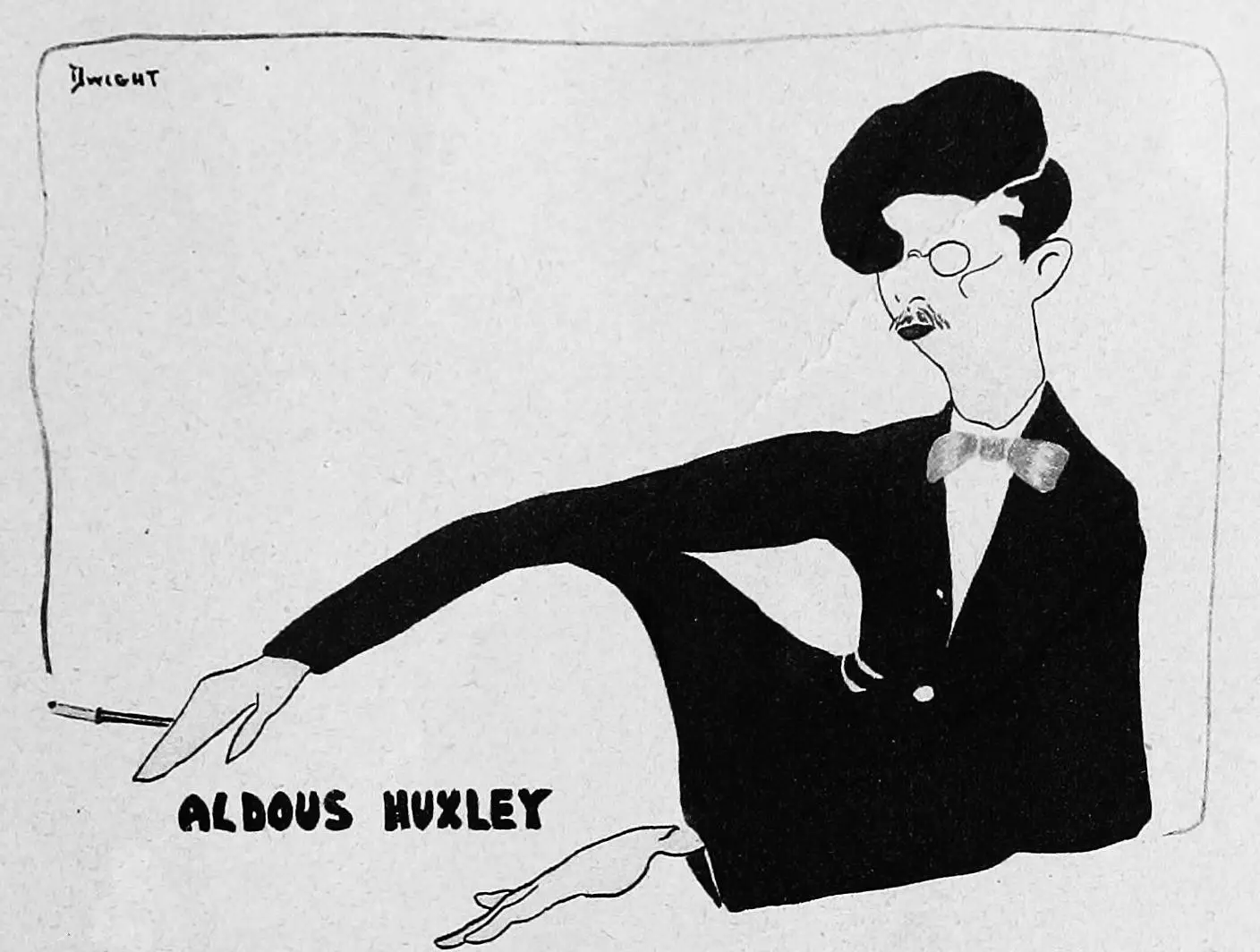
Aldous Huxley was born on July 26, 1894, in Godalming, Surrey, the third son of writer and headmaster Leonard Huxley and Julia Arnold. He was a grandson of the zoologist Thomas Henry Huxley, known as “Darwin's bulldog,” while his brothers Julian and Andrew became distinguished biologists. As a teenager, he contracted the eye disease keratitis punctata, which left him virtually blind for two to three years and ended his dream of becoming a doctor. He studied English at Balliol College, Oxford, graduating with first-class honors in 1916.
His first published novels were social satires: “Crome Yellow,” “Antic Hay,” “Those Barren Leaves” and “Point Counter Point.” His fifth novel, “Brave New World” (1932), was his first dystopian work. According to an introduction to the book, his experience in the 1920s at a chemical factory in Billingham, where he sensed “an orderly universe within a world of unplanned incoherence,” was an important source for the novel.
Huxley was a peace activist and a member of the Peace Pledge Union, and wrote anti-war essays such as “Ends and Means.”
In 1937, he moved to the United States with his wife Maria, their son Matthew and his friend Gerald Heard. Heard introduced him to Vedanta, meditation and vegetarianism through the principle of ahimsa. Huxley joined the circle of the Hindu Swami Prabhavananda and wrote “The Perennial Philosophy” (1945), which examined the common ground between Western and Eastern mysticism. During the same period, he became friends with Jiddu Krishnamurti, wrote a foreword to his book “The First and Last Freedom,” and worked as a Hollywood screenwriter, using much of his income to help Jewish and left-wing refugees leave Nazi Germany.
His first experience with mescaline came in 1953 with British psychiatrist Humphry Osmond, who administered the substance to him under supervision in California. That experience led to “The Doors of Perception” (1954). He later tried LSD under Oscar Janiger's supervision and became an adviser to Timothy Leary and Richard Alpert in Harvard's early psychedelic research, although he distanced himself from Leary when he felt that Leary was promoting the substances indiscriminately. Huxley wrote that mystical experience “is doubly valuable” because it offers a better understanding of oneself and can lead to a less self-centered and more creative life.
In his final years, he warned about the dangers of overpopulation, hierarchical social organization, the use of technology on masses susceptible to persuasion, and the transformation of politicians into marketable products. In a letter to his brother Julian in December 1962, he wrote that unless we quickly began thinking about human problems in ecological terms rather than in terms of political power, “we will very soon find ourselves in a bad situation.” In his last book, “Literature and Science,” he argued that the ethical and philosophical implications of modern science were more Buddhist than Christian.
Huxley's eyesight remained a subject of controversy. Around 1939, he encountered the Bates method and later wrote “The Art of Seeing” (1942), claiming that his vision had improved dramatically through exercises and the desert's natural light. However, journalists and critics questioned his claims: Bennett Cerf described how Huxley appeared to read without glasses but had actually memorized his speech and needed a magnifying glass. Huxley himself reportedly told Brazilian writer João Ubaldo Ribeiro humorously: “I can hardly see at all. And, really, I don't care at all.”
Huxley was diagnosed with laryngeal cancer in 1960. As his health deteriorated, he wrote the utopian novel “Island” (1962) and gave lectures on “Human Potentialities” at UCSF Medical Center and the Esalen Institute, which are considered foundational to the Human Potential Movement. On November 22, 1963, no longer able to speak because of metastases, he asked his wife Laura in writing for “LSD, 100 μg, intramuscular.” She administered one dose at 11:20 a.m. and a second an hour later; Huxley died that same day at 5:20 p.m., aged 69.
His death, like that of C. S. Lewis, was overshadowed by the assassination of John F. Kennedy on the same day.
Huxley was nominated nine times for the Nobel Prize in Literature and was named a Companion of Literature by the Royal Society of Literature in 1962. From the dystopian “Brave New World” to the utopian “Island,” his work encourages ecological thinking, personal transformation and the cultivation of a “pure receptivity” beyond the verbal symbols that constrain us.
Comments