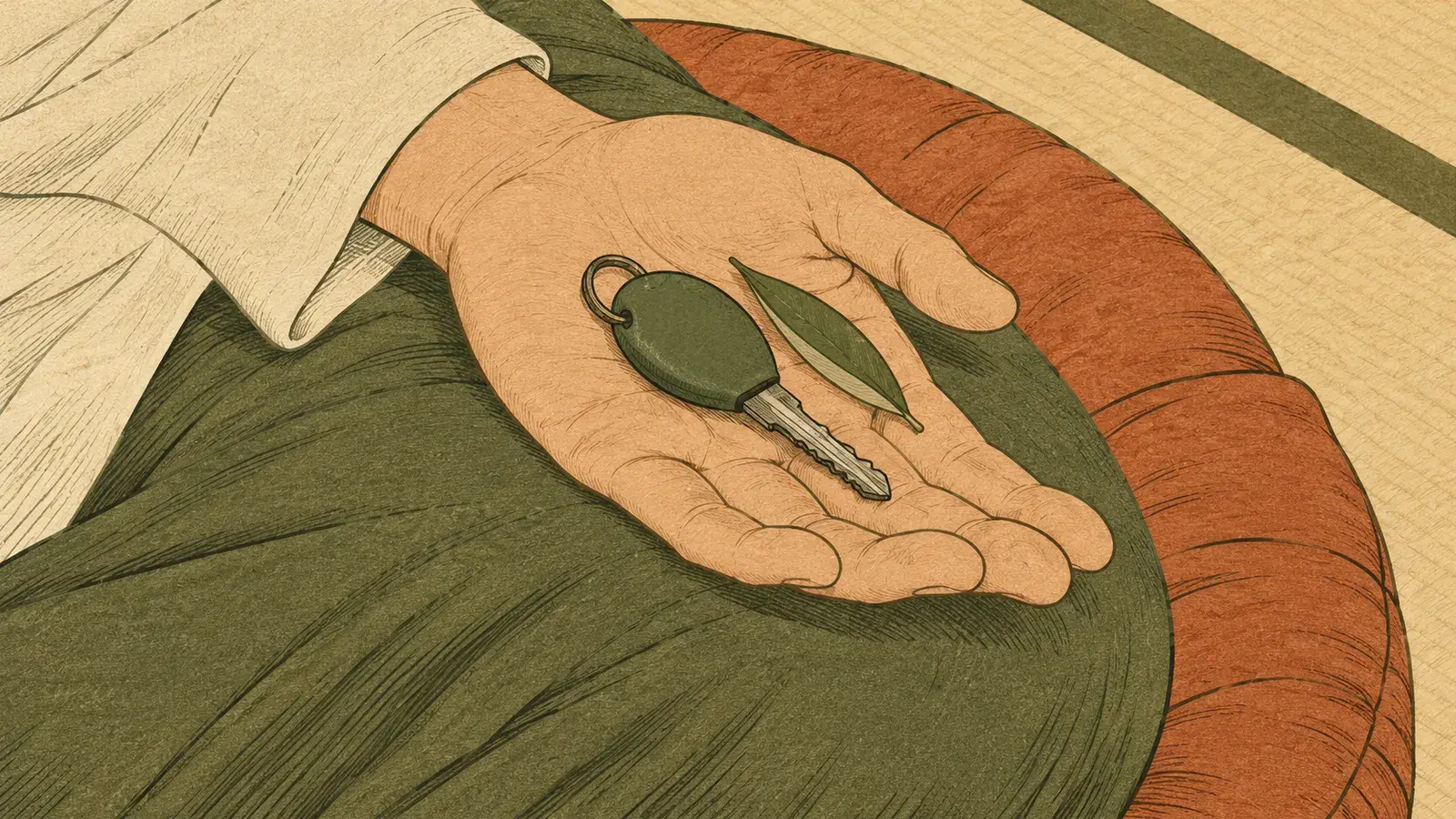
The text begins with a scene from a meditation program at a remote center aiming for “profound change in the self and society”. There, amid a sincere longing for spiritual growth, the friction between material success and self-transcendence becomes strikingly clear. One participant mentioned that she had almost come in her Porsche but had ultimately chosen the other car—a remark that shows how spiritual seeking can become another sign of the good life.
This friction, the text argues, is not simple hypocrisy but a conflict of desires woven into modern life. Part of the attraction is a real desire for better communication with the universe. Another part treats “enlightenment” as one more box to tick on the checklist of self-actualization. Alan Watts, who popularized Eastern philosophy in the West, explored precisely this split.
Watts examined recurring oppositions: productivity versus presence, belief versus trust, haste versus procrastination, money versus wealth, and the egoic self versus true existence. Underlying these is the question of what is real—what makes a person real in their own eyes and those of others, and what makes the world real to us. His essay “What Is Reality?” from the collection Become What You Are poses this question in the early 1950s.
He begins with a parable. In a restaurant, a group is asked to say what they mean by the word Reality. After vague discussions of metaphysics and psychology, one of them simply points to the salt shaker. The others do not understand him, because they regard Reality as a special kind of existence and Life with a capital L as a particular way of life, distinct from that of people who merely exist.
Watts connects this confusion with the Taoist principle of wu wei, the paradoxical art of “trying not to try”. He says that many people try very hard to become real, from students of occult wisdom to audiences of popular speakers on personality and success. Yet he has never met anyone who succeeded by trying. The effort leads to a loss of personality; those who try to become great become small, and even if they try indirectly to become great by making themselves small, they remain small.
In his view, many modern religions and schools of psychology make the fundamental mistake of wanting the tail to wag the dog—which is precisely what the pursuit of personality amounts to. Honoring “real personality” in others can make us imitators; honoring it as an ideal for ourselves brings back the old problem of self-promotion. It is a matter of pride, because if we recognize Life and Reality only in certain kinds of personal life, we deny them to humble things such as salt shakers, dust, worms, flowers and the great mass of people.
By contrast, a Life, a Reality, a Tao that can be Christ, Buddha, Lao Tzu, an ignorant person and a worm all at once is, for Watts, truly mysterious and worthy of devotion. Life and Reality are not things you can keep for yourself unless you recognize them in everyone else. They do not belong to particular people, any more than the sun, the moon and the stars belong to them.
The text closes by recommending Become What You Are as essential reading in its entirety and directing readers to Watts's reflections on death and living in the present.




Comments