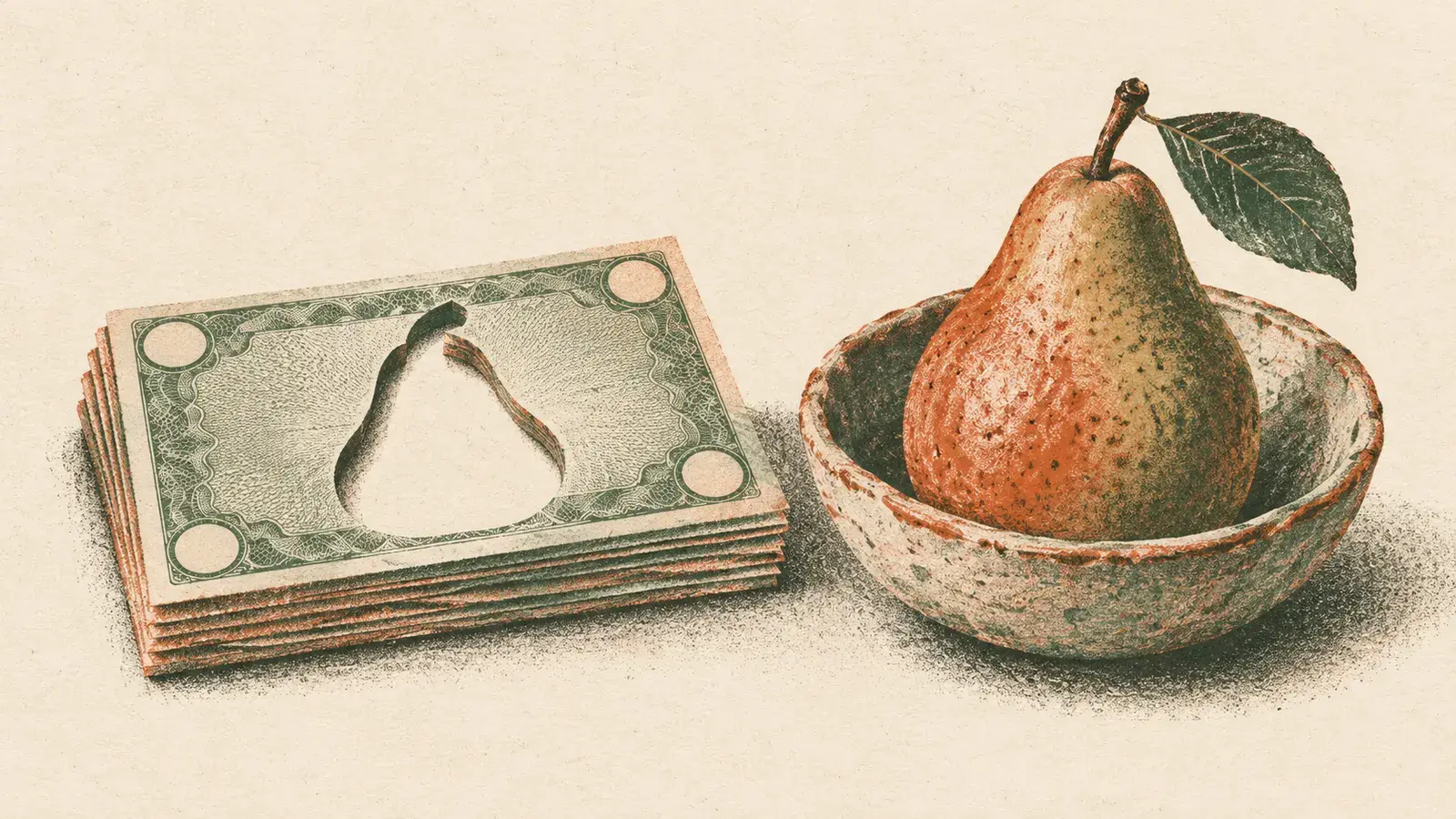
British philosopher Alan Watts once asked what a person would do if money were no object. In his essay “Wealth Versus Money,” collected in the 1970 anthology Does It Matter? Essays on Man’s Relation to Materiality, he returns to that question in greater depth. The Marginalian presents the essay as an exploration of our tendency to confuse money with wealth—a manifestation of a broader inclination to mistake symbol for reality, which Watts calls “the peculiar and perhaps fatal fallacy of civilization.”
Civilization, Watts argues, comprising all the achievements of art and science, technology and industry, is the result of humanity’s invention and manipulation of symbols: words, letters, numbers, formulas, concepts, clocks, rulers, scales, timetables, schedules and laws. These tools let us measure, predict and control the behavior of the human and natural worlds with such apparent success that the trick goes to our heads. The danger is that we confuse the world as we symbolize it with the world as it is.
Among the most toxic symbol-as-reality tricks is money. Watts writes that money is a way of measuring wealth but is not wealth itself. A chest of gold coins or a fat wallet of bills is of no use to a wrecked sailor alone on a raft; that sailor needs real wealth, such as a fishing rod, a compass, an outboard motor with fuel and a companion. He says this ingrained confusion of money with wealth is now the main reason we are not going ahead full tilt with technological genius to produce more than adequate food, clothing, housing and utilities for every person on earth.
Watts makes a prediction that if we get our heads straight about money, by the year 2000 no one will pay taxes, no one will carry cash, utilities will be free, and everyone will carry a general credit card. The Marginalian notes that some of this came true, and some may come true as we shift away from traditional currency, but we have largely replaced one monetary currency with another rather than evolving to redefine wealth. For Watts, true wealth is “the sum of energy, technical intelligence, and raw materials.”
He calls the national debt “a roundabout piece of semantic obscurantism.” Watts argues that no one goes into debt except in an emergency, so prosperity depends on maintaining the perpetual emergency of war. We are reduced, he writes, to the suicidal expedient of inventing wars when we could instead simply invent money—provided the amount invented was always proportionate to the real wealth being produced. If we shifted from the gold standard to the wealth standard, he says, prices would stay more or less where they are at the time of the shift and everyone would discover that they have enough or more than enough to live with affluence and merriment.
Watts recognizes that this awareness faces enormous cultural resistance. He notes that humanity existed for perhaps one million years with relative material scarcity, while only about one hundred years had passed since the beginning of the industrial revolution. He compares the difficulty to persuading people that the earth is round and orbits the sun, or that the universe exists in a curved space-time continuum. It may be just as hard, he suggests, to get through to common sense that the virtues of making and saving money are obsolete.
He also points out that there are limits to the real wealth any individual can consume: nobody can drive four cars at once, live simultaneously in six homes, take three tours at the same time, or devour twelve roasts of beef at one meal. Watts writes that this picture is semi-serious, but the deadly serious point is that an economic utopia is not wishful thinking; in substantial degree, it is the necessary alternative to self-destruction. The moral challenge, he adds, is that the life of affluence and pleasure requires exact discipline and high imagination.
Watts observes that affluent people in the United States have seldom shown much imagination in cultivating the arts of pleasure. He echoes Bertrand Russell’s lament about the good of conquering leisure and health if no one remembers how to use them. A leisure economy, Watts suggests, would provide opportunity to develop the frustrated craftsman, painter, sculptor, poet, composer, yachtsman, explorer or potter that is in us all—if only we could earn a living that way. Even if many amateurs produce bad or indifferent work, the general long-term effect should be a tremendous enrichment of fine art, music, food, furniture, clothing, gardens and homes, largely on a do-it-yourself basis.
But he warns that we cannot proceed with a fully productive technology if it must inevitably “Los Angelesize” the whole earth, poison the elements, destroy all wildlife and sicken the bloodstream with the promiscuous use of antibiotics and insecticides. That, he writes, is the certain result of a technological enterprise conducted in the hostile spirit of a conquest of nature with the main object of making money. He adds that many corporations—and even more their shareholders—are unbelievably blind to their own material interests, because profit is identified entirely with money, as distinct from the real profit of living with dignity and elegance in beautiful surroundings.
Watts is skeptical that passing laws will correct this irresponsibility; most law, he says, has as little relation to life as money to wealth. What is necessary is at once simpler and more difficult: financiers, bankers and stockholders must turn themselves into real people and ask exactly what they want out of life. They must come to their senses. For Watts, that means experiencing our own existence as living organisms rather than as “personalities” acting out an artificial plot. Man and world are a single natural process, like a whirlpool to a river, yet we behave as invaders and plunderers. The body is a dancing pattern of energy that exists only in concert with myriads of other patterns—animals, plants, insects, bacteria, minerals, liquids and gases. We do not come into the world; we come out of it, as a branch from a tree. The root of mistaking money for wealth is the illusion of the separate ego: the ego, like money, is a concept, a symbol, even a delusion, not a biological process or physical reality.


Comments