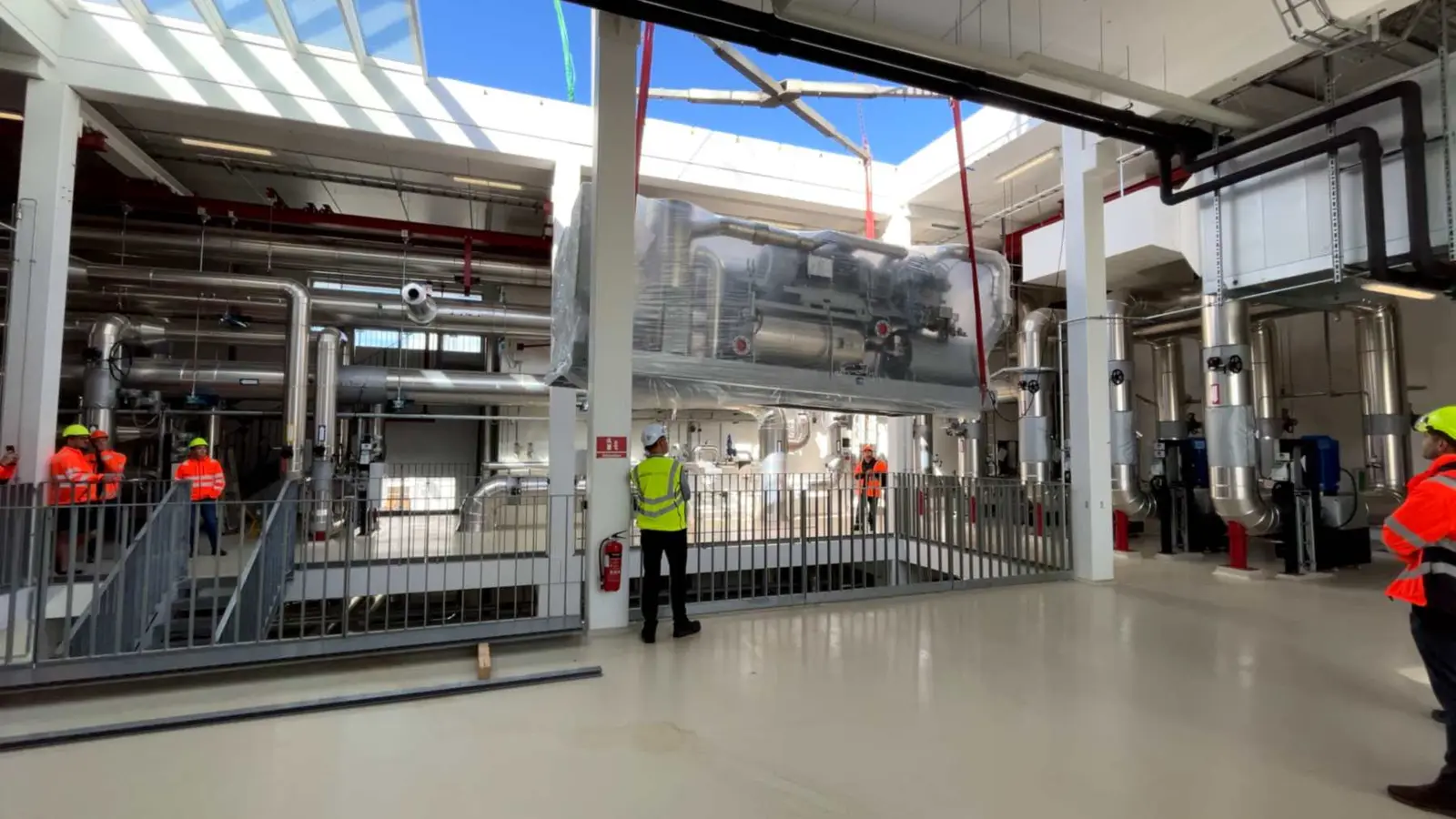
On September 10, 2026, six seawater heat pumps were switched on in a building at Aarhus Ø harbor, which Danish utility Kredsløb calls “Maskinrummet,” meaning Engine Room. At full capacity, the pumps draw up to 317,000 gallons, about 1.2 million liters, of water from Aarhus Bay every hour. According to Kredsløb, the system heats about 1,900 homes and, as the company writes in its announcement, “1.2 million liters of seawater an hour will soon warm almost two thousand living rooms in Aarhus.”
They work on a similar principle to domestic heat pumps, but on a much larger scale. As John Halkier Christensen, head of district heating at Copenhagen’s HOFOR, explains, it is “a kind of reverse refrigerator that collects and boosts heat.” Even cold winter seawater contains heat, which warms a refrigerant that evaporates at a very low temperature; a compressor then puts the vapor under high pressure so that it becomes hot enough for district heating. The seawater returns to the harbor a few degrees cooler, while the water in the network reaches about 70°C and flows to radiators through underground pipes. In summer, the pumps reverse their operation and provide district cooling to large buildings, while excess heat is recycled into the district heating network.
The investment amounts to 300 million kroner, about $46 million, and according to Kredsløb CEO Bjarke Munk Jensen, “the economics of this are really good.” He explains that the system can keep radiators warm even in a cold winter because the water is drawn from the bottom of the harbor basins, where it does not freeze. Researchers and operators stress that the pumps deliver up to 3.5 times as much heat as the electrical energy they consume.
The real goal in Aarhus is to move away from wood. Kredsløb’s plan, titled “Fremtidens fjernvarme” (District heating of the future), aims to replace the heat currently produced by burning wood pellets and coal in unit 3 of the Studstrup power station outside the city. The city council has voted to phase out the roughly 600,000 tonnes of wood pellets burned each year to heat Aarhus. “We have chosen to phase out the use of wood pellets for heating Aarhus, and the large ships carrying pellets to be burned will soon be a thing of the past,” said Nicolai Bang, the deputy mayor responsible for technical services and the environment.
Under the plan, biomass’s share of the city’s district heating falls from about 70% in 2025 to 20% after 2030, and in some years as low as 15%. Unlike Sweden, which imports and burns other countries’ waste, Aarhus wants its remaining biomass to come mainly from locally harvested straw, followed by wood chips from the surrounding area. Mayor Anders Winnerskjold called the new pumps “another important milestone toward a greener future,” stressing that it is essential for district heating to be produced from renewable sources instead of wood pellets.
Seawater is not the only source. Kredsløb also relies on air-to-water heat pumps, geothermal energy, wastewater heat pumps, electric boilers, batteries and large tanks that store hot water, allowing the units to run when electricity is cheap. Last year, the mayor opened a geothermal plant in the Skejby area that uses hot water from underground. Brian Vad Mathiesen, a professor of energy planning at Aalborg University, explains that seawater pumps operate more economically when cheap solar and wind energy is available, and that switching between multiple sources creates “greater security of supply and more stable finances” for the district heating system.
Eight additional seawater pumps are expected at the old Aarhusværket power station from 2028. All fourteen together will deliver heat equivalent to the annual consumption of about 5,000 households. The total cost of the plan is estimated at about 2.8 billion kroner, roughly $430 million, with Kredsløb saying it can complete the transition “without costing district heating customers more.” However, the price promise rests on forecasts for construction costs, electricity prices, raw materials, emissions allowances and taxes, which could change before 2030.
Similar projects are moving forward in other Danish cities. In Esbjerg, DIN Forsyning switched on the first of two MAN Energy Solutions seawater pumps in November 2024; when both are running, they will deliver 70 megawatts, with director Helle Dam-Henriksen describing it as “the largest CO2-based seawater heat pump operating to date.” HOFOR’s 24-megawatt pump in Copenhagen’s Nordhavn is expected to heat about 12,500 apartments from early 2028, supplying water at up to 78°C, while Aalborg is preparing a plant that will cover one-third of the city’s district heating needs.
In Aarhus, however, the sea cannot be used on the same scale as in Esbjerg or Aalborg. As Munk Jensen says, “there isn’t enough space,” since forests or buildings line the coast and there are no large unused harbor areas. He also points out that “the green transition begins with a green attitude” and that significant work remains to complete the system by 2030.




Comments