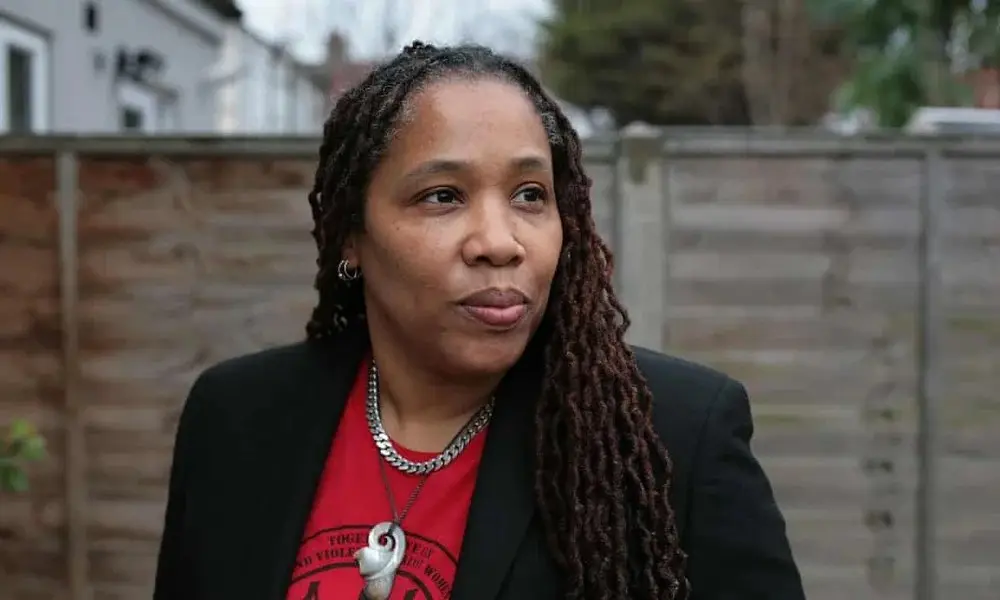
As part of his research for “How to Fall in Love with the Future”, Rob Hopkins spoke in 2023 with Professor Marai Larasi, a Black British feminist of African-Caribbean heritage, community organiser and consultant with more than twenty-eight years of work in justice. Larasi describes herself as a “Black feminist, troublemaker and time traveller”. As she explains, time travel has two sides for her: it is an energetic movement back and forth across the Atlantic to recover fragments of memory from precolonial and colonial times, and at the same time a way to imagine a liberated future.
Larasi describes herself as a “by-product of colonialism, like rum or sugar”; her African ancestors were transported to the Caribbean as “units of labour”, rather than as full human beings. This is not self-deprecation, but a tool for understanding: understanding the dehumanisation of colonialism means understanding how we arrived at the present. Her practice, she says, includes ancestral recall as part of her everyday life, because she knows no other way to live.
Moving through time helps her feel accountable: to her ancestors, to future generations, to “Mama Gaia, Mother Earth” and to the world beyond the human. “We are incredibly arrogant as human beings and say, ‘Life is now’,” she notes. If we thought of life as a journey towards this moment and towards future journeys, perhaps we would care more about the planet and one another.
In the lineage of the radical Black imagination, her heroine is Nanny of the Maroons, the legendary Maroon warrior and general in Jamaica, but also a spiritual figure who called on herbal medicine and spirit. “I believe she dreamed us into existence,” she says. Among the thinkers who nourish her, she names June Jordan, with the phrase “we are the ones we have been waiting for”, the Afrofuturist writers Nalo Hopkinson and Marlon James, and the younger Alexis Pauline Gumbs. She herself, she says, is “a drop in the ocean of the radical Black imagination”.
What she is trying to dream of is collective liberation: a healed planet, a space for making amends, a world where future generations will ask, “What was patriarchy, what was white supremacy, what was settler colonialism?” To stand in this hybrid space, in imagination and time travel, you have to accept that you will break: “You have to be willing to break a little, sometimes deeply.”
There is no single practice, she stresses. Everyone must find their own way, depending on their journey, lineage and relationship with the land. Some take a cognitive route, reading and asking questions; others move through spiritual practice, prayer or journalling; others move through the different impressions they experience during the day. For her, it happens sometimes by chance and sometimes deliberately. She points out that imagination and time travel can emerge from joy, but also from deep grief and pain; survivors often develop the ability to “leave” in order to survive.
In the tradition of the Black political movement, she says, there is always a dual movement: responding to crisis while also holding an abolitionist, liberating vision. Martin Luther King, bell hooks, June Jordan, Audre Lorde and Angela Davis were both alert to trauma and oriented towards a future without oppression. Such narratives have been deeply suppressed, but for her they are everywhere. Stuart Hall was an “alchemist, magician, time traveller and dreamer” who helped her make peace with her hybridity and pushed her to look at the plantation and Orientalism while always asking, “What are we dreaming of?”
Asked whether this makes her optimistic, she answers “yes and no”. She invokes Mariame Kaba, who says that “hope is a discipline”: not fluffy optimism, but something that requires right relationships and action. “I am always hopeful and terrified, probably in equal measure. I am never hopeless,” she says. When she began working on violence against women, she realised she had to believe it could end, otherwise she would remain paralysed by the scale of the problem.
For Larasi, the past and the future are inseparable. Hopkins mentions artist Camille Turner’s statement that, to change the course of the future, the silenced past must be reconnected with the present. Larasi replies that this means confronting the destruction on “Turtle Island”, extraction on the African continent, land theft in Australia, and what happened to the Māori in Aotearoa. Healing is not only a matter for the colonised: white people, she insists, must do their own work, understand the plantation economy and sit with it emotionally, “with the heart and the stomach”, so that denial and avoidance stop. Hopkins refers to Octavia Butler’s “Kindred” as an example of a narrative that uses time travel to reconnect us with that era. Larasi recommends the series “Lovecraft Country”, which Jordan Peele was involved in, and discusses the question of whether the real horror is the monster or white supremacy and oppression.
The attitude with which one should travel into the future is not that of the colonial “explorer”, but one of humility, apology, love and service. If she could train time travellers, she would tell them to ask those living there: “What do you want us to go and heal when we return to 2023?”—and to carry “a cauldron, a drum or a water gourd” instead of a weapon. The more embodied activists become, the more powerful the experience of time travel becomes, because liberation also includes returning to the self and the body.

Comments