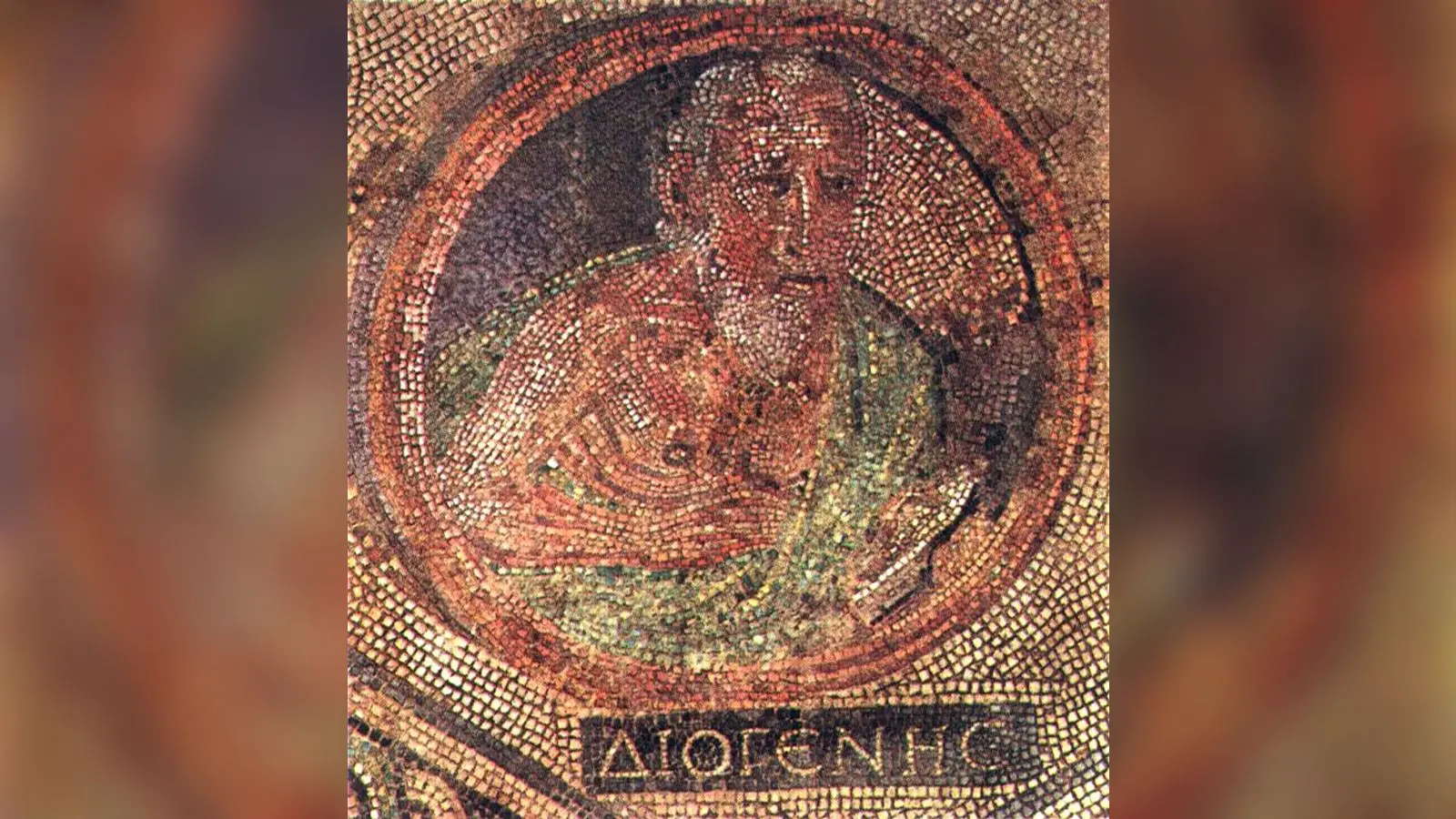
Diogenes the Cynic (c. 413/403 – c. 324/321 BC), also known as Diogenes of Sinope, was an ancient Greek philosopher of the classical period and one of the founders of Cynicism. He became famous for his ascetic way of life and radical criticism of social conventions. He has gone down in history through anecdotes that depict him living in a large jar, walking around with a lit lantern in daylight and calling himself a “citizen of the world.”
He was born into a wealthy family in Sinope, a colony of Miletus on the Black Sea. His father, Hicesias, was a banker responsible for exchanging foreign currencies. Diogenes received an education and athletic training, but his life changed dramatically after a scandal involving the “counterfeiting of currency.” Ancient sources disagree over whether he or his father was responsible; modern scholars are divided between a historical basis and later fiction symbolizing his aim to “revalue the currency,” meaning to question conventional values. The exile that followed was a turning point and brought a profound intellectual transformation.
He spent the mild winters in Athens, surviving by begging and sheltering in a large ceramic jar, while spending his summers in Corinth. According to the sources, the Athenians valued him so much that they replaced his jar when a young man broke it. He walked through the marketplace with a lit lamp during the day, saying, “I am looking for a human being,” meaning a wise person. He tested himself through extreme practices: in summer he rolled in hot sand, and in winter he embraced freezing statues, seeking to show his indifference to physical comfort.
His most famous encounter was with Alexander, son of Philip II, probably in 336 BC near the Isthmus of Corinth. When Alexander approached him and asked whether he wanted anything, Diogenes replied: “Yes, move a little out of my sunlight.” Alexander is said to have been so impressed by the philosopher’s courage and arrogance of spirit that he told his courtiers: “If I were not Alexander, I would wish to be Diogenes.”
Ancient sources offer various accounts of his death: suffocating himself, eating raw octopus, fever or an infected dog bite. The more dramatic accounts are probably philosophical inventions; he most likely died of old age, in or near Corinth. He himself showed indifference to his burial, asking for his body to be thrown outside the walls or into the river, and posed a question with his characteristic logic: if he perceived nothing after death, how could the bites of wild beasts harm him? The Corinthians eventually buried him near the western gate.
In philosophy, Diogenes is considered a pupil of Antisthenes, who had in turn studied under Socrates. From Socrates he inherited the public questioning of false wisdom, but his methods were much rougher: Socrates called himself a gadfly, while Diogenes called himself a dog. His shameless behavior—eating in the marketplace, spitting, even masturbating in public—was more than mere provocation: it was a way of teaching virtue by examining what was natural and what was conventional. Plato called him “Socrates gone mad”; when Plato defined a human being as a “featherless biped,” Diogenes brought in a plucked rooster and said: “Here is Plato’s human being.”
Diogenes introduced early ideas of cosmopolitanism: when asked where he came from, he answered with a single word, “cosmopolitan.” He was not, however, preaching universal brotherhood; he wanted to show that the city-state was an artificial construct rather than a natural condition. His ascetic life was a means of achieving self-sufficiency: he even threw away his cup when he saw a boy drinking water from his cupped hands, saying that nature had already given him a cup. He distinguished real poverty from the feeling of poverty created by social expectations, arguing that even tyrants could be “poor” if they felt they were failing to meet the obligations of their class.
His legacy followed two paths: on the one hand, Zeno of Citium transformed Cynicism into Stoicism, retaining virtue as the sole basis of happiness, while on the other, a succession of Cynics preserved the original practices. In antiquity, he was often treated as a harmless eccentric, while critics such as Cicero condemned his shameless behavior. In later art, he appears lying on the steps in Raphael’s “The School of Athens,” and inside his jar in paintings by Gérôme and Waterhouse. His name was also given to a family of hermit crabs, while the so-called “Diogenes syndrome” is considered a misnomer, because he consciously chose simplicity and sought human contact daily in the Agora.
Although his writings have not survived, his anecdotes and sayings remain alive. To this day, Diogenes symbolizes philosophical defiance of established authorities and artificial values. His choice to live with very little, identify himself as a citizen of the world and seek the true human being resonates in every era that questions consumerism and seeks meaning beyond material goods.



Comments