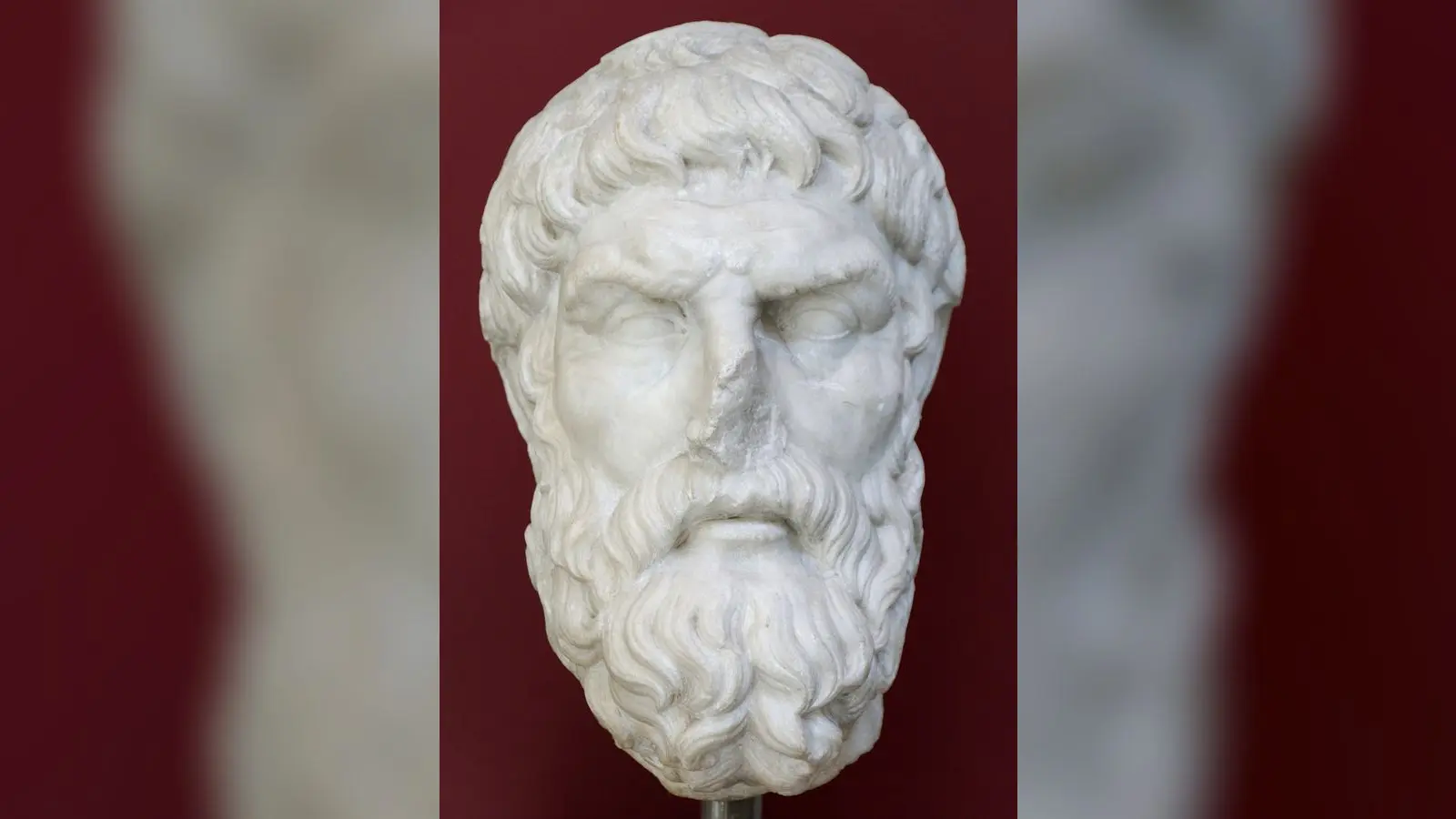
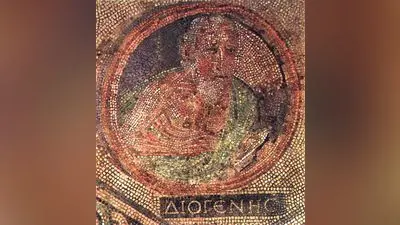
Epicurus (341–270 BC) was an ancient Greek philosopher and the founder of Epicureanism, a school that taught that managing desires, removing unnecessary fears, friendship and a virtuous life lead to a pleasant life and lasting happiness, the highest good. He and his followers lived simply and discussed philosophical questions in the “Garden,” the school he founded in Athens. Of the more than 300 works he is said to have written, only a few letters, the “Principal Doctrines” and fragments of other texts survive; most information about his philosophy comes from later writers such as Lucretius and Diogenes of Oenoanda.
Epicurus was born in February 341 BC in the Athenian settlement on Samos. He grew up in the final years of the Classical period: Plato had died seven years earlier, and Epicurus was seven when Alexander crossed the Hellespont. He received a typical aristocratic education, studied under the Platonist Pamphilus and probably had extensive training in rhetoric. After Alexander’s death, the Athenian settlers were expelled from Samos, and Epicurus followed his family to Colophon.
Although strongly influenced by Democritus, he denied any influence and described himself as self-taught. He agreed with the Cynics in their pursuit of honesty but rejected their “shamelessness and vulgarity,” teaching that honesty should be combined with courtesy and kindness.
Around 311 BC, at about thirty years of age, he began teaching in Mytilene, where his teachings caused tensions and he was forced to leave. He founded a school in Lampsacus and returned to Athens around 306 BC, where he established the Garden, between the Stoa and the Academy. People lived communally in the Garden, sharing property without a strict hierarchy, and took part in festivals, banquets and funerals. The school also admitted many female students, including Themista, Leontion and Nikidion, which was unusual for the time.
In physics, Epicurus believed in an eternal universe consisting of matter and void. Matter is made of atoms, infinite in number but with a finite range of types, which move constantly through the void. He proposed the idea of the atomic “swerve”: atoms can deviate randomly from their paths, allowing people to have free will in an otherwise deterministic universe. He believed that sensations arise from atoms continuously emitted by objects; the atoms themselves do not have properties such as redness, but cause the corresponding experience in the observer’s mind.
On knowledge, he regarded sensory perception as the foundation of science. Errors arise only from the way we judge perceptions, and reason is needed to organize information from the senses. He proposed three criteria of truth: sensations, preconceptions (concepts derived from earlier sensory information), and the feelings of pleasure and pain that determine what we choose and avoid. He also applied the “principle of multiple explanations”: for phenomena such as thunder or the phases of the Moon, all possible explanations should be recorded rather than just one, to avoid relying on mythology and divine intervention as explanations.
In ethics, Epicurus was a hedonist: what is pleasant is the only good, and what is painful is the only evil. However, he redefined pleasure as the absence of pain and taught that the goal is ataraxia, a state of complete freedom from pain and disturbance. Virtues are not goods in themselves but means to a pleasant life. He distinguished physical from mental pleasures, considering mental pleasures superior because they are affected by the past, present and future. He also distinguished kinetic pleasure from katastematic pleasure, meaning the pleasure of a state without pain; the highest goal was the absence of physical pain (“aponia”) and the absence of mental disturbance (“ataraxia”).
Epicurus classified desires into three categories: natural and necessary (such as friendship, knowledge of natural science, food, water, clothing and shelter), natural but unnecessary (such as tasty food, sex and a nice house), and neither natural nor necessary (such as wealth, power and fame), which should be avoided because they cause more pain than pleasure. Controlling desires leads to aponia and ataraxia, and therefore to the highest form of happiness.
In politics, Epicurus emphasized friendship rather than power or wealth and generally advised against political involvement, although his approach could adapt to circumstances. He was an early thinker to develop the concept of justice as a social contract based on mutual agreement rather than divine command: laws that do not promote human happiness are not just. He believed that all people are naturally equal because they consist of the same atomic material.
In theology, he accepted the existence of gods but denied their involvement in the world, freeing people from the fear of divine punishment. The “Epicurean paradox,” attributed to him by Lactantius, is a version of the problem of evil: if God wants to and can eliminate evils, why do they exist?
Epicurus died in 270 BC at the age of seventy-two from a urinary tract obstruction, enduring great pain but remaining cheerful and teaching until the end, according to the sources. In a short letter to Idomeneus, he describes the joy of mind that comes from remembering philosophical contemplation as a counterweight to physical suffering.
During the Middle Ages, Epicurus was inaccurately remembered as a patron of drunkards and gluttons. His ideas became more widely known after the 15th century and were rehabilitated in the 17th century by the French priest Pierre Gassendi; his influence grew significantly during the Enlightenment, affecting thinkers such as John Locke and Karl Marx.


Comments