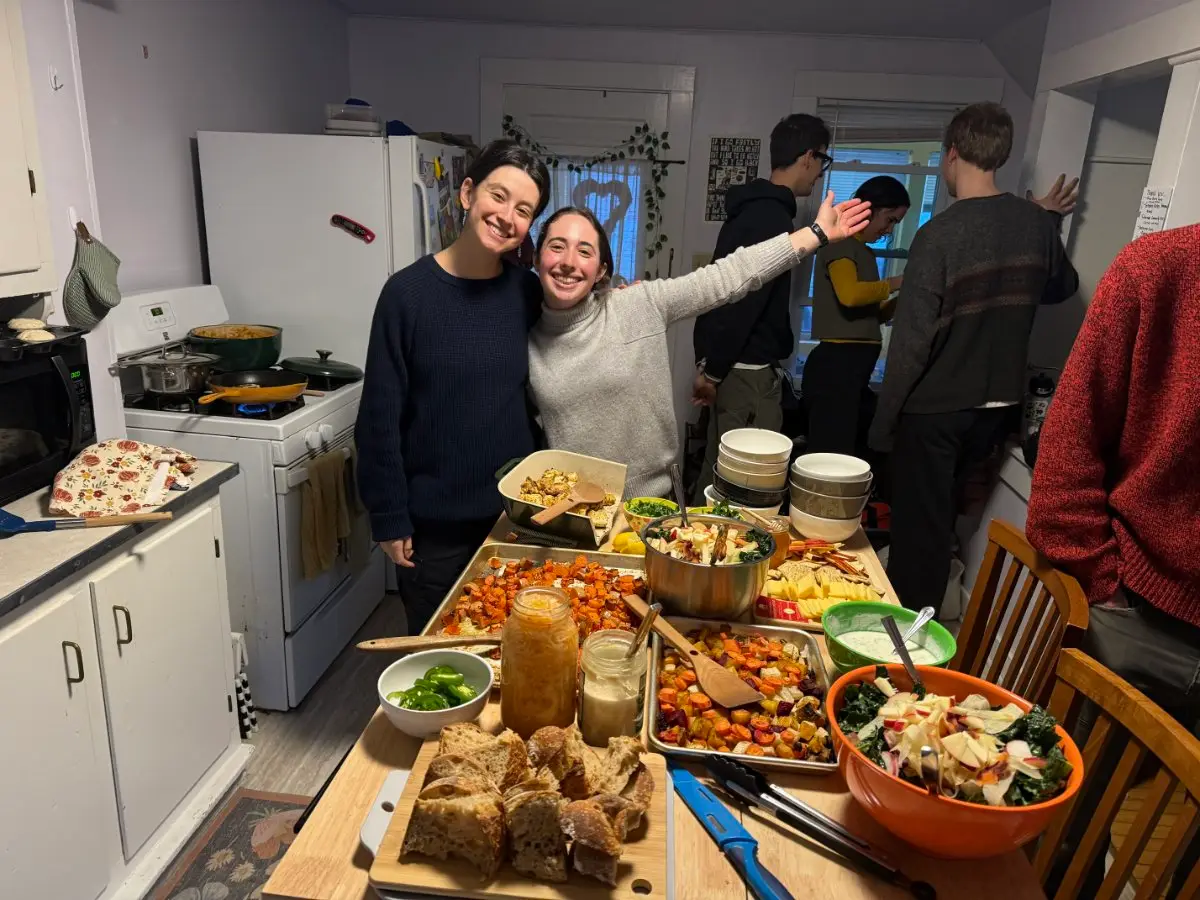
The Northeast Organic Farming Association of Vermont (NOFA-VT) awarded $200 microgrants to its members this year to organize dinners for their neighbors, aiming to reduce social isolation and build community around local and organic food. The “Long-Handled Spoons Dinners,” named after a folk parable, took place in more than two dozen homes across all 14 counties in the state.
One host, Megan Humphrey, a former executive director of an organization that brought healthy food to older adults facing food insecurity, welcomed more than 60 neighbors to her home in Burlington’s Old North End. It is one of Vermont’s most multicultural neighborhoods, with lower incomes and at least 30 languages spoken at the local elementary school. Humphrey sent 100 email invitations and handed out flyers door to door, telling everyone the same thing: no one at the dinner would know everyone.
“I think many of us feel lost these days, uncertain in a deeply divided country and a divided world,” Humphrey says. “Making connections in the neighborhood can be the first step toward new friendships, and gathering around food offers a simple model.”
Before opening her home, she sourced ingredients from nearby farms and producers for sweet potato and black bean chili, vegetarian lasagna and chocolate beet cake.
Erin Buckwalter, NOFA-VT’s deputy director, links the initiative to a time of “extreme rupture” in society: farmers and farmworkers being arrested by immigration authorities, marginalized communities and growing numbers of people without enough food. “We feel we can keep one another safe, keep one another fed, and this is one way to seed hubs in communities so we can build the networks we really need,” she says.
Demand exceeded all expectations. The organization had budgeted for ten grants, but received 50 applications within the first 24 hours and 175 within a week. With additional support from the baking company King Arthur and the brewery The Alchemist, it was able to award 28 microgrants of $200. In a second round in July, working with the national organization With Neighbors, it awarded 66 microgrants, 22 of which went to farmers or farmworkers.
Emily Talkow, a graduate student at the University of Vermont, and Marin Warshay, a writer at a climate solutions organization, jointly hosted about 20 people. They prepared a meal of naan with lentils, roasted carrots and kimchi from the local market, and used local tofu from the co-op for the first time. At dinner, Warshay sat next to two strangers—and the next day they went skiing together. “Friendships are what came out of all this,” she says.
The problem the program is trying to address is measurable. Former US Surgeon General Vivek Murthy declared loneliness a public health epidemic in 2023. According to a 2026 report from the Survey Center on American Life, only 40% of Americans said in 2025 that they regularly talked to their neighbors, compared with 59% in 2012. Many applicants wrote about isolation: one woman said she had lived on her rural road for five years, only waving to her neighbors from a distance, and the dinner gave her a reason to finally knock on their doors.
Some hosts also added an element of giving back. Humphrey’s guests brought around 11.3 kilograms of canned soup, beans, tuna and pasta for the Feeding Champlain Valley food bank, as well as blankets, toiletries, clothes and boots for Street Cats, a mutual aid group that supports people living on the streets.
NOFA-VT was founded in the 1970s by farmers who believed in agriculture that benefits people and the land. It helped establish the state’s farmers’ markets, developed organic certification standards before the national program and contributed to the farm-to-school movement. Today, it has about 2,600 members.
The organization asked hosts for nothing specific beyond a good meal with their neighbors, but hopes the dinners will provide a foundation for something bigger—such as volunteering at food banks or informal networks of mutual support for the most vulnerable members of their communities. Whether the program continues will depend on funding and the organization’s priorities, though it has published a guide for anyone who wants to host a dinner like this at their own expense. The advice is simple: invite 5 to 10 neighbors, share local and organic food, think about your goals and discuss next steps—from another dinner to a shared communication channel for the neighborhood.
The idea shows how a small, low-cost intervention can rebuild a frayed social fabric, one table at a time.

Comments