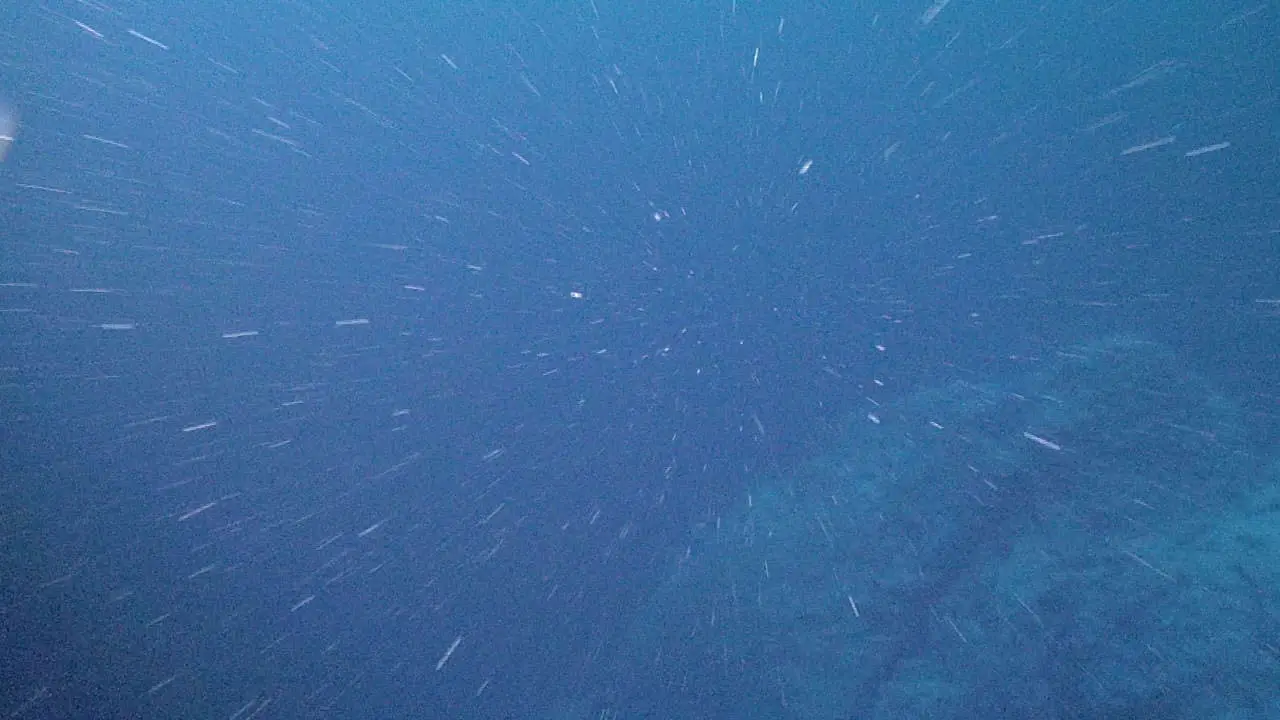
Scientists at UC San Diego's Scripps Institution of Oceanography have developed a new microscopy technique showing that the viscosity—how “sticky” it is—of marine snow affects how quickly it breaks down and how deep it sinks toward the ocean floor. Their study, published on October 8 in Science, found that the stickiest marine snow particles can carry more than six times as much carbon into the ocean depths as less viscous particles.
Marine snow describes microscopic clumps of organic and inorganic debris—mucus, feces, silt, dead plankton and more—that fall from shallow waters into the depths. As they sink, they carry tons of carbon with them. Scientists estimate that marine snow removes more than 10 gigatons of carbon from the surface each year. However, only 2 gigatons are thought to sink deep enough to be stored for hundreds or thousands of years.
Researchers have long been seeking the factors that limit this essential part of the carbon cycle. The new study from Scripps Institution of Oceanography and the University of Lincoln revealed that the viscosity of marine snow can have a significant effect on how quickly it breaks down and how far it sinks. This is the first time scientists have studied live bacteria interacting with the physical structure of marine snow, or of any mucus more generally.
Such interactions are critical to the health of life on the planet, as coral reefs, kelp forests, the root systems of land plants and the digestive tracts of animals and humans all depend on interactions between mucus and bacteria. The researchers say their findings and the new mucus imaging method will help scientists studying how bacteria behave inside mucus.
The research began in 2021, when Bryce Inman, then a postdoctoral researcher at Scripps Oceanography, began looking for a way to image what he calls the “muscoscape,” or mucus landscape. As he explains, observing individual bacteria interacting with the physical structure of mucus had never been possible before. Together with Farooq Azam, a microbiologist and emeritus professor at Scripps, he spent four years trying before they found a way to do it in 2025.
Using a combination of three-dimensional confocal microscopy and specialized fluorescent molecules, the researchers were able to map the “physical terrain” of individual marine snow clumps and see how bacteria interact with it. They found that bacteria can colonize the less viscous regions near a particle's surface much more easily, while the stickier regions deeper inside are difficult to reach. Inman compares the process to a worm in an apple: “the flesh is easy to burrow through, but the core is hard to chew.”
In a series of laboratory experiments, the researchers found that more viscous marine snow particles take longer for bacteria to break down and fragment. Computer simulations also suggest that the stickier marine snow is, the deeper it will sink. Inman and his colleagues estimate that particles with high viscosity can carry more than six times as much carbon into the depths as those with low viscosity. “How far marine snow can sink is a surprisingly complex problem, and we have added another—very sticky—piece to the puzzle,” Inman said.
The findings are relevant not only to Earth's carbon cycle, but also to those studying the role of mucus in areas ranging from human health to coral reef recovery. According to Inman, mucus has “a surprising amount of structure”: bumps, cracks and other structures on a scale smaller than bacteria that researchers had not known about. The method is described in detail in a companion paper in Nature Communications, while additional funding was provided by the Simons Foundation and the Engineering and Physical Sciences Research Council.

Comments