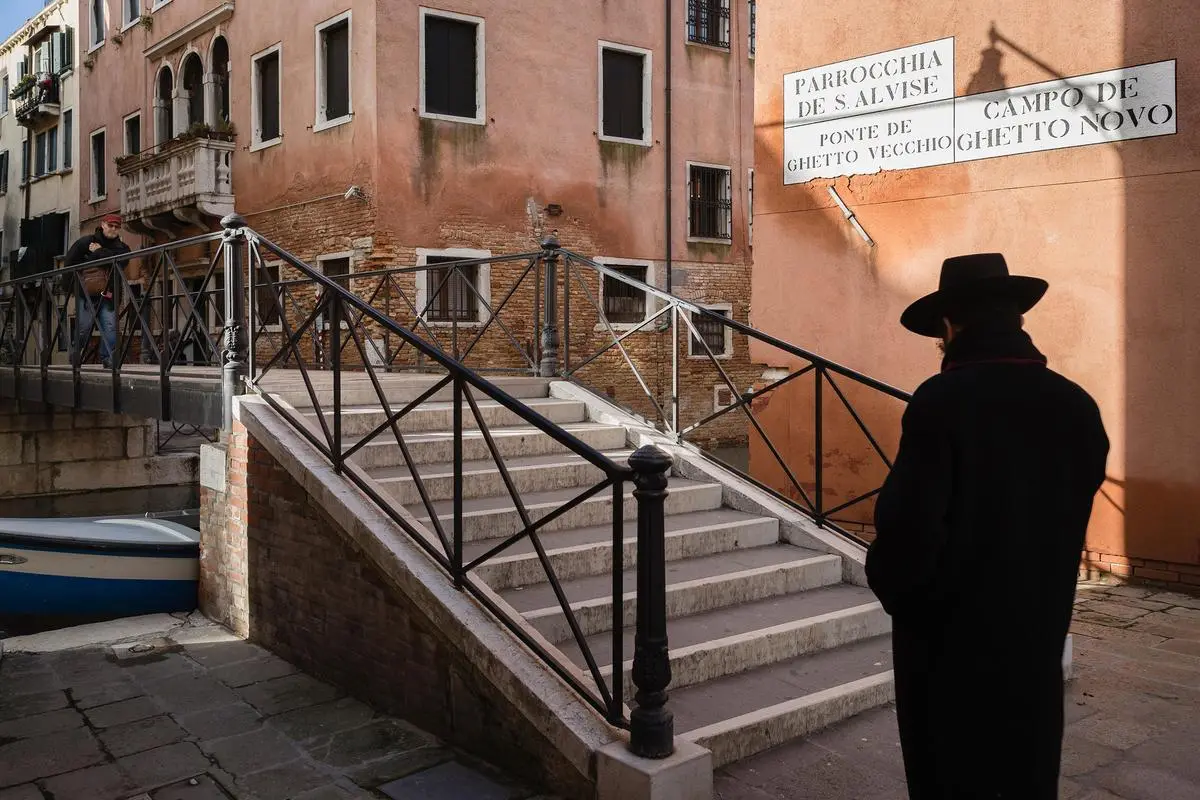
On 29 March 1516, the Venetian Senate voted to create the world's first “ghetto”. All Jews then living in the city—as well as any who would arrive later—were ordered to move immediately to a small island in the city's northeastern district of Cannaregio, in an area known as the geto novo.
The place was far from attractive. It had previously served as a rubbish dump for the municipal copper foundry and was later converted into workers' housing. When Venice's Jews were forced to settle there, it looked more like a prison: all outward-facing doors and windows were sealed, additional walls were built to block access to the water, and two sturdy iron gates were installed at the ends of the bridge leading to Cannaregio. The gates closed at sunset and opened in the morning when the marangona bell rang, while four guards—paid by the Jews themselves—patrolled the canals “day and night”.
This was not the first time Jews had been confined to a separate district. In France and the German lands, Jewish communities had already been living in designated neighbourhoods for almost 300 years. Even Venice itself had required the Jews in Candia (present-day Heraklion), in its colony of Crete, to live in a separate area since the 13th century.
What made the Venetian Ghetto distinctive was its name. The word geto had nothing to do with Jews. It came from the verb gettare, meaning “to throw” or “to cast”, and was simply the local name for the foundry—and, by extension, the rubbish dump beside it. But even after the Venetian government moved the foundry elsewhere, people continued to call the area by its old name. When the Jews settled there, the island gave its name to the institution of segregation—just as we use “the White House” today to refer both to the building and to the administration based there.
This mattered. Before then, Jewish districts had many different names (Judenstraße, Judengasse, Juiverie, etc.), but none had entered everyday language as a way of describing segregation itself. “Ghetto” was different. Precisely because the word was used metonymically, it could describe any segregation of Jews anywhere.
Around 1562, people began calling Rome's Jewish district a “ghetto”; less than ten years later, another “ghetto” was established in Florence. The word continued to spread until the eve of the French Revolution.
After Jewish segregation was abolished in Italy in the wake of the Napoleonic invasions, the word “ghetto” was applied even more widely. It reached the United States in the late 19th century to describe the poverty and insecurity of any immigrant group. After the Nazi invasion of Poland in September 1939, it was applied with terrifying force to places of captivity and genocide. Even today, its meanings continue to multiply—it is used to stigmatise the “other” or to reclaim lost power.
All these “ghettos” trace their origins to Venice.
The establishment of the Ghetto was not the result of a long-term plan. It was a compromise that emerged from a period of confusion, experimentation and failure—an attempt to balance the seemingly incompatible demands of religious prejudice and economic necessity.
Jews had already been a familiar presence in the Venetian lagoon since the 10th century, but as merchants passing through. In the mid-14th century, a new wave of Jewish immigrants began arriving from Germany. These ebrei Tedeschi (German Jews) were not visitors but refugees, forced to leave their homeland by the waves of persecution unleashed by the Black Death. They settled first in Mestre, across the lagoon, and found their place as pawnbrokers—since Christians were forbidden to lend to one another at interest.
When Venice's economy collapsed after the disastrous war with Genoa, the city needed cheap credit and put pragmatism above prejudice: in 1382, it offered any banker who would lower interest rates the right to live in the city for five years. Almost everyone who responded was Jewish.
But as soon as Venice recovered, the “need” for tolerance diminished and prejudice resurfaced: in 1397, the Jews were ordered to leave. The government soon realised, however, that it was almost impossible to manage without them—ordinary people still needed small loans. The Jews found a way around the ban: after their 15 days in Venice, they would take a boat to Mestre for a short while and return, maintaining an almost permanent presence without “official” residence.
The situation changed dramatically with the Italian Wars, which began in 1494. After the disastrous defeat at the Battle of Agnadello on 14 May 1509, Venice's control over the mainland collapsed and hundreds of Jewish refugees flooded into the city. The government tried to expel them, but the frightened refugees refused to leave.
Pressure for expulsion grew—with religious preachers such as Fra Rufin Lovato even proposing the plundering of the Jews—but even the fiercest critics admitted that Jewish bankers were essential in a time of crisis. The chronicler Marin Sanudo the Younger, though he complained about the “large number” of Jews in the streets, acknowledged that he could say nothing because “they need them”.
Segregation was proposed again by Giorgio Emo on 23 April 1515, with a plan to confine the Jews to Giudecca. The Jews protested fiercely, fearing attacks by the mercenaries stationed there. The proposal was temporarily rejected, but the principle of segregation remained.
The following year, under the threat of another invasion and with public anxiety rising, the patrician Zaccaria Dolfin presented a new proposal: the Jews should be moved to the island of geto novo. Despite strong opposition from the Jewish community, the College approved the proposal, and on 29 March 1516 the Senate confirmed the decision. By 25 July, all of Venice's Jews were in the geto novo.
The Ghetto was never intended to be anything more than a temporary measure. But the continuation of the war and the government's reluctance to establish a monte di pietà in Venice kept it in place.
As Venice's fortunes declined, two more ghettos were created—the Ghetto Vecchio (1541) and the Ghetto Nuovissimo (1633)—to house Jewish immigrants from the Iberian Peninsula, whose involvement in international trade increasingly sustained Venice's faltering commercial position. The Ghetto was abolished for good only after Napoleon's arrival in 1797.
The Ghetto was a place of exclusion from the outset, but it was never completely sealed off. Its very existence depended on the need for exchange, interaction and even coexistence. The credit market, and later international trade, required constant communication between Jews and Christians. The same was true of cultural life: in Venice, where humanists were as interested in Hebrew as in Latin and Greek, the exchange of ideas was inevitable.
The Ghetto thus reminds us of the paradox at the heart of every form of social exclusion: every attempt to marginalise a community grows out of ties that bind—and speaks more eloquently about the failures of those doing the marginalising than about the “differences” they invoke.
The Ghetto's most powerful lesson for our time lies in its contingent nature. The road to its establishment was travelled in hesitant small steps, not great strides—small, gradual decisions, each one contested and all seemingly temporary. At any stage, the process could have stopped. Venice could have changed course.
Today, antisemitism is once again on the rise. It advances in small steps—a piece of graffiti, a shout, a random attack in the street—steps we tell ourselves are isolated. But Venice shows where those steps lead—and reminds us that each one can, and must, be confronted.




Comments