Nate Hagens interviews University of Chicago political scientist Robert Pape in a conversation recorded on 15 September. Pape is introduced as the author of Bombing to Win and Why Economic Sanctions Do Not Work and as director of the Chicago Project on Security and Threats. The immediate trigger is the Ansar Allah attack on Saudi Arabia’s East-West pipeline.
Pape says the attack was fully predictable. He points to his 15 June post, “Iran and the era of maximum leverage,” in which he predicted that Iran would enter a period of maximum leverage from mid-July, open a second front in the Red Sea, expand its objectives to evict American forces from the region, and increasingly become the initiator of violence rather than merely responding to it. He describes the recent Houthi action as a spurt after a ramp-up that began around 20 July.
The fragile memorandum of understanding broke almost immediately, Pape says. Once major wars begin, there is another side; Iran has been attacked and its leaders killed during the past fifteen months. The early cushions that absorbed the oil shock—the strategic petroleum reserve, China taking five million barrels a day off demand, and the Red Sea bypass through the East-West pipeline—were temporary and are now shrinking, he argues.
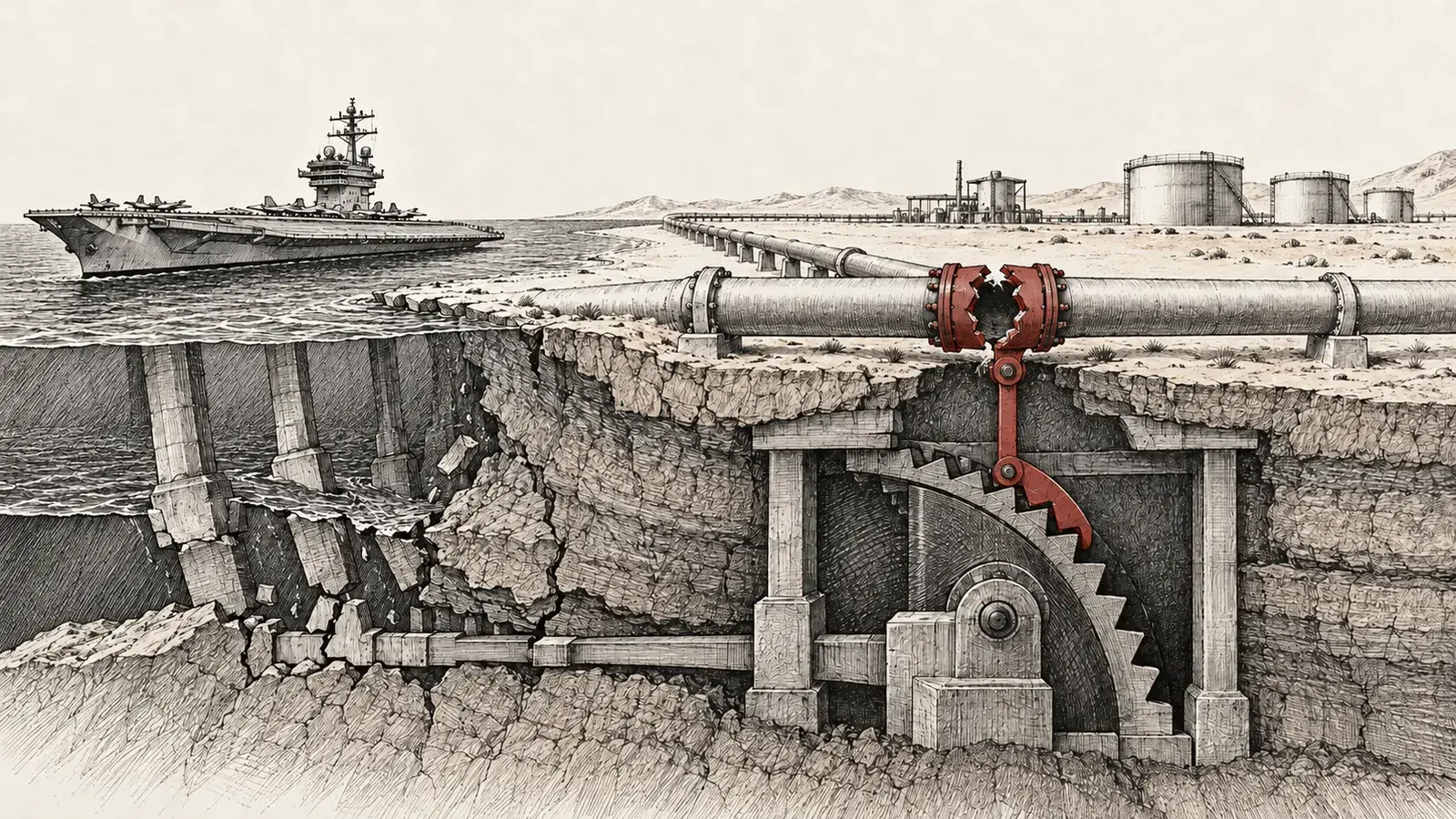
The pipeline was hit at eight different points, with subsurface damage and repair likely to take weeks. Even if repaired, Pape says, it remains hyper-vulnerable: it can be hit again by the Iran-backed Iraqi militia that carried out the attack, by the Houthis, by Iran itself, or through ground saboteurs. The nearby Abqaiq refinery could also be struck. He says this is not an isolated episode but part of a cohesive Iranian strategy that could get worse before it gets better.
Pape defines an escalation trap. In stage one, the attacker bombs targets and achieves tactical success by hitting aim points and killing leaders. In stage two, the other side does not collapse but gains power, transforming tactical success into strategic failure. Stage three is the decision to walk away or escalate further. Iran, he says, did not invade with a large army; it used cheap mass drones and mines—what he calls the Second Precision Revolution—to selectively control the Strait of Hormuz. That allows it to turn oil flows off and on, which is political control, not just physical disruption. The US-Israeli attack, he argues, gave Iran the pretext to pursue power.
Hagens notes that much of the world’s remaining recoverable oil lies within a few hundred miles of Iran. Pape agrees that a huge share of global reserves is concentrated near the Gulf. Since the 1970s, he says, the United States has worked to prevent an oil hegemon. Iran waited until it was attacked in June and February, he argues, so that it could shift blame to America and Israel. Global opinion now blames America and Trump more than Israel, he says, eroding the American protector role established after the first Gulf War and reversing the stability that underpinned globalization.
Pape describes President Trump’s strategy as punishment. Whether killing leaders, bombing, imposing an economic blockade, or threatening more costs, Trump keeps trying to inflict pain to force the Iranian government to cave. Pape says this is not producing cooperation. It is congealing opposition inside Iran and making the Revolutionary Guards’ problem easier by making the Iranian government more popular. He illustrates the point with a schoolyard story: when a bully named Alvin demanded lunch money, fighting back—not paying—was the only way to stop future punishment.
Pape offers the historical parallel of Germany bombing London and Coventry in 1940. Hitler intended punishment to make Britain back down, but it fired up the British public. Churchill replaced his air staff and installed Bomber Harris, leading to plans to firebomb fifty-eight German towns and kill 900,000 civilians. Pape says this shows how punishment strategies generate enormous backlash.
Saudi Arabia, Pape says, is in a very difficult position. Mohammed bin Salman originally egged on the regime-change bombing, but after April the Saudis refused American use of their airspace and tried to move toward neutrality. Pape argues this will not be easy, because Iran may work under the radar with tribes inside Saudi Arabia to seek a new government in Riyadh, not merely the eviction of American forces. At the same time, the US position in the Gulf has moved from near-preeminence to vulnerability: thirteen military bases have been severely damaged, the Fifth Fleet base in Bahrain has been pummeled, the USS Abraham Lincoln had to return to Diego Garcia for resupply, and carriers are threatened by Mach 5 missiles.
That vulnerability feeds into the petrodollar system, Pape argues. Gulf central banks buy US Treasury bonds with petrodollars. Iran’s aim, he says, is to shake those governments enough that they stop buying bonds or eventually flood the market. The Iranian president’s appearance at the BRICS summit and talk of trading oil in a basket of currencies rather than yuan alone points in that direction. China and Russia, he says, are siding with America’s rival because they do not want Trump to control the Strait of Hormuz and the oil going to China. A new security architecture is emerging that excludes the United States.
Pape places the US in a recurring pattern of strong powers launching preventive wars that become disastrous: Germany before World War I and World War II, Japan before World War II, Russia against Ukraine, and now the United States against Iran. He warns that the next stages could include an Iranian nuclear test or the use of tactical nuclear weapons against Natanz or Pickaxe Mountain. A CSIS report on increased activity there is, in his view, preparing the public for such operations. Breaking the nuclear taboo, spreading radiation in the Middle East, and unsettling Treasury auctions with forty trillion dollars in debt would make America a pariah and could seriously hurt bond demand.
The best case, Pape argues, is not regime change or simply walking away but a multi-year strategy of offshore balancing aimed at regional stability. The United States would still have a role but would do only about twenty percent of the heavy lifting, with local actors carrying the rest. He cites the campaign against ISIS and the strengthening of Ukraine as examples. For the Gulf, he recommends sending military advisors to frontline states to help build actual militaries, not committing US ground troops. Decline is not yet inevitable, but if the current trajectory continues the United States would shrink back into a regional power in the Western Hemisphere. The result, he says, would be a much more conflict-prone world with power vacuums and escalation. His advice is to seek depth rather than team-based social media shouting and to stay ahead of risks.

Comments