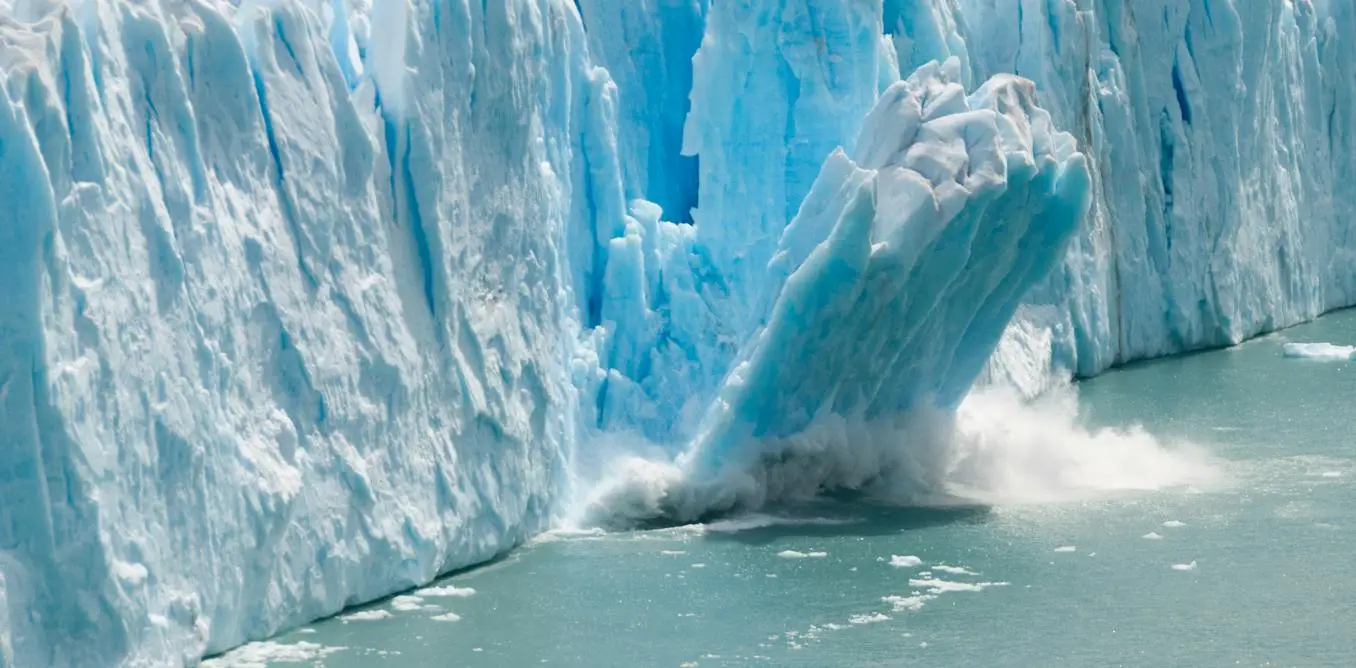
Scientific research into potential climate tipping points has grown rapidly, but attention is unevenly distributed among Earth's systems. A new study in Proceedings of the National Academy of Sciences finds that systems estimated to potentially cross a critical threshold at relatively lower levels of warming do not consistently attract more publications. At the same time, only a small proportion of the relevant literature explicitly examines the processes that can make a transition abrupt, self-sustaining or irreversible.
The researchers analysed 20,736 scientific publications from 2000 to 2025 on 14 climate systems with potential tipping points. These include the Greenland and Antarctic ice sheets, the Amazon rainforest, coral reefs and major ocean currents. These are systems that may change abruptly when warming pushes them beyond critical thresholds. The analysis examined where scientific attention is concentrated and whether it is linked to estimated warming thresholds.
The Greenland ice sheet dominated the sample, appearing in 4,141 publications, or 20% of the total. By contrast, abrupt thawing of permafrost in boreal forests south of the Arctic appeared in just 139 papers, or 0.7%. The North Atlantic subpolar gyre, a circulation system south of Greenland, accounted for 649 publications, or 3.1%. Research was also relatively limited on winter sea ice in the Barents Sea and the subglacial basins of East Antarctica.
Comparison with estimated warming thresholds highlighted another aspect of this uneven distribution. The best available estimate for abrupt ground thaw in boreal forests puts the threshold at about 1.5°C above pre-industrial temperatures, the same as for Greenland. For the North Atlantic subpolar gyre, the corresponding estimate is about 1.8°C. Despite these similar, relatively low thresholds, some systems have been studied thousands of times and others hundreds of times or fewer.
The authors stress that a warming threshold is not a countdown to a known date. Estimates carry significant uncertainty, while the behaviour of several potential tipping systems remains a matter of scientific debate. The number of publications also does not indicate how strong the evidence is for a particular tipping point. The analysis measures scientific attention, rather than certainty, the quality of each paper or the relative importance of individual systems.
There are also reasons why some fields attract larger research communities. Some systems have been monitored for longer, are easier to measure or simulate, and fall within more established scientific disciplines. The fields also overlap: the subpolar gyre is closely linked to the Atlantic meridional overturning circulation, known as Amoc. Relevant papers may therefore be included in the much larger Amoc literature without examining the gyre as a separate tipping system.
The study also examined the content of publications, looking for explicit analysis of abrupt change, self-reinforcement, the persistence of a new state and irreversibility. These features distinguish a potential tipping event from gradual environmental change: the system may not return to its previous state even if the initial pressure is reduced. Only 8.1% of papers examined one or more of these features. For the North Atlantic subpolar gyre specifically, only 53 such peer-reviewed studies were identified over 26 years.
The researchers do not suggest abandoning research on Greenland and Amoc or redirecting it elsewhere. They do, however, point out that priorities are also shaped by funding programmes, scientific institutions and decisions on new monitoring and simulation capabilities. Additional studies of less-researched systems with low estimated thresholds could clarify what we know and which uncertainties have the most significant consequences. As warming continues, the authors say the task is to identify potentially serious climate risks that remain difficult to assess because of limited scientific attention.



Comments