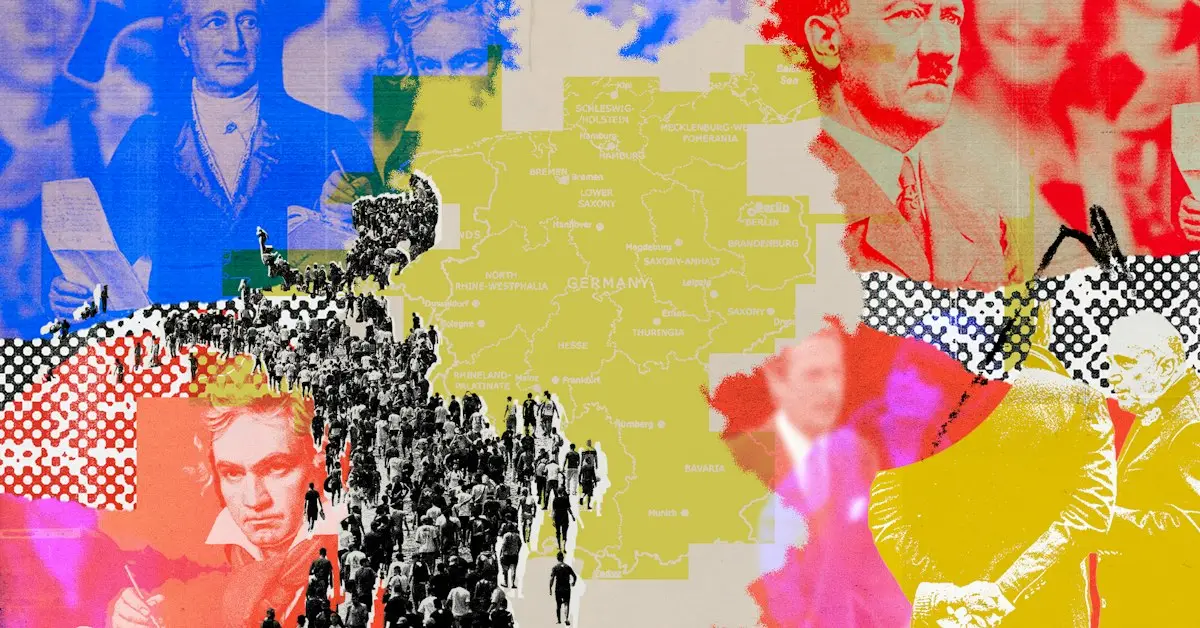
Germany is experiencing the return of things it thought were over: after the defeat of Nazism and, later, the fall of the Berlin Wall, “history” did not end. The steady rise of neo-Nazi parties, particularly in former East Germany, and the weakening of postwar governing coalitions are bringing unresolved issues to the surface, Noema’s editor-in-chief, Nathan Gardels, argues in an analysis for the magazine.
Gardels recalls that around three decades ago, New Perspectives Quarterly published an issue on nationalism in Germany. Contributors included Daniel Cohn-Bendit, Hans Jürgen Syberberg, then-president Richard von Weizsäcker and then-foreign minister Hans Dietrich Genscher. Even then, the tensions concerned immigration, asylum policies and a “longing for a lost sense of belonging”. Individual groups were setting fire to immigrants’ homes; today, he notes, the same feelings are channelled into parties that reach as much as 44% in regional elections.
In the introduction to that issue, Gardels described postwar Germany as a country that had adopted an identity for the sake of others, hiding its “soiled soul” beneath NATO and the European Community. Syberberg believed that the cold logic of rational liberalism repressed emotion and cultural distinctiveness, causing buried passions to return in an ugly form. “Heimat”, the homeland as a place of lived experience, was aesthetically taboo after the war; East Germans, who lost their homeland after the fall of the Wall, developed a strong sense of “Heimat” precisely because they had lost it.
The playwright Heiner Müller offered a similar explanation: after the collapse of actually existing socialism and reunification, a vacuum emerged. Capitalism, without a rival, no longer had an alibi when people failed to prosper; right-wing extremism took on the role of its harshest critic. He believed that dialogue with neo-Nazis was impossible because they followed the “logic of the void” and filled it with nationalism. Cohn-Bendit, for his part, pointed out that East Germans expected their living standards to converge rapidly with those in the West, but predicted that their lives would get worse before they got better; amid this anxiety, refugees became a visible target for aggression.
As deputy mayor of Frankfurt, Cohn-Bendit had found that 25% of the population was already foreign-born. He therefore proposed stricter rules on immigration and asylum, bringing him into conflict with the left that favoured open borders. Meanwhile, Europe’s leaders were moving in the opposite direction: Genscher prioritised a culture of coexistence, and François Mitterrand declared that “nationalism means war”. This gap between the effort to escape the past and the lost sense of belonging, Gardels says, did not narrow; it grew.
The situation worsened, according to the article, when Chancellor Angela Merkel opened the doors in 2015 to around 900,000 refugees from the Syrian civil war. Gardels believes that the dilemma of how to balance the human need to belong with compassion for displaced people remains unresolved and is global: it haunts Europe, the United States and countries from South Africa to the Bangladesh–India border. For this reason, he argues, it is wrong to describe every government that tightens immigration policy as a “shift to the right”; democratic systems are responding to a concern that has now become dominant.
The first lesson he draws is that liberals should not treat every defence of belonging as a return of Hitler. He cites Isaiah Berlin, who said that belonging is a human need and that if cultural currents dry up, if people have no kin, language or place, everything human withers. Second, communities and states have a duty to control immigration using criteria that ensure newcomers will respect the rules and contribute to the economy. Borders, he notes, must be secure rather than porous; James Talarico expressed this through the image of a front porch with a welcome mat, but also a lock.
Third, Gardels calls for asylum to be redefined for the present day. Asylum was designed in the mid-20th century for persecuted people and temporary protection from war, not as a route to permanent settlement or a refuge for mass exoduses from weak states. Expanding it too far, he says, exceeds the capacity of even the most compassionate states; good intentions turn into bad faith when there is no capacity to meet moral demands. In the future, climate refugees, for whom the industrialised countries of the North bear historical responsibility, will pose the same dilemma.
Fourth, the ageing societies of the North cannot survive without legal immigration, so they need active assimilation and integration policies to prevent cultural enclaves like the suburbs of Paris from becoming entrenched. Canada, according to the article, integrates immigrants better because around 60% enter on economic criteria, while in the US two-thirds of permanent residents are admitted for family reunification and fewer than 20% on the basis of skills. For neighbouring countries that need workers, he proposes work permits with regulated employment rights, without permanent residence, and cites the California State University system, which acts as a “cultural mixer”, as a successful institutional example.
Gardels concludes that open societies need defined borders to sustain a shared sense of identity; one is a prerequisite for the other. If either is missing, the result is the unsustainable situation seen today. Of the many challenges of the 21st century, balancing belonging and becoming is, he says, the one closest to everyday life.

Comments