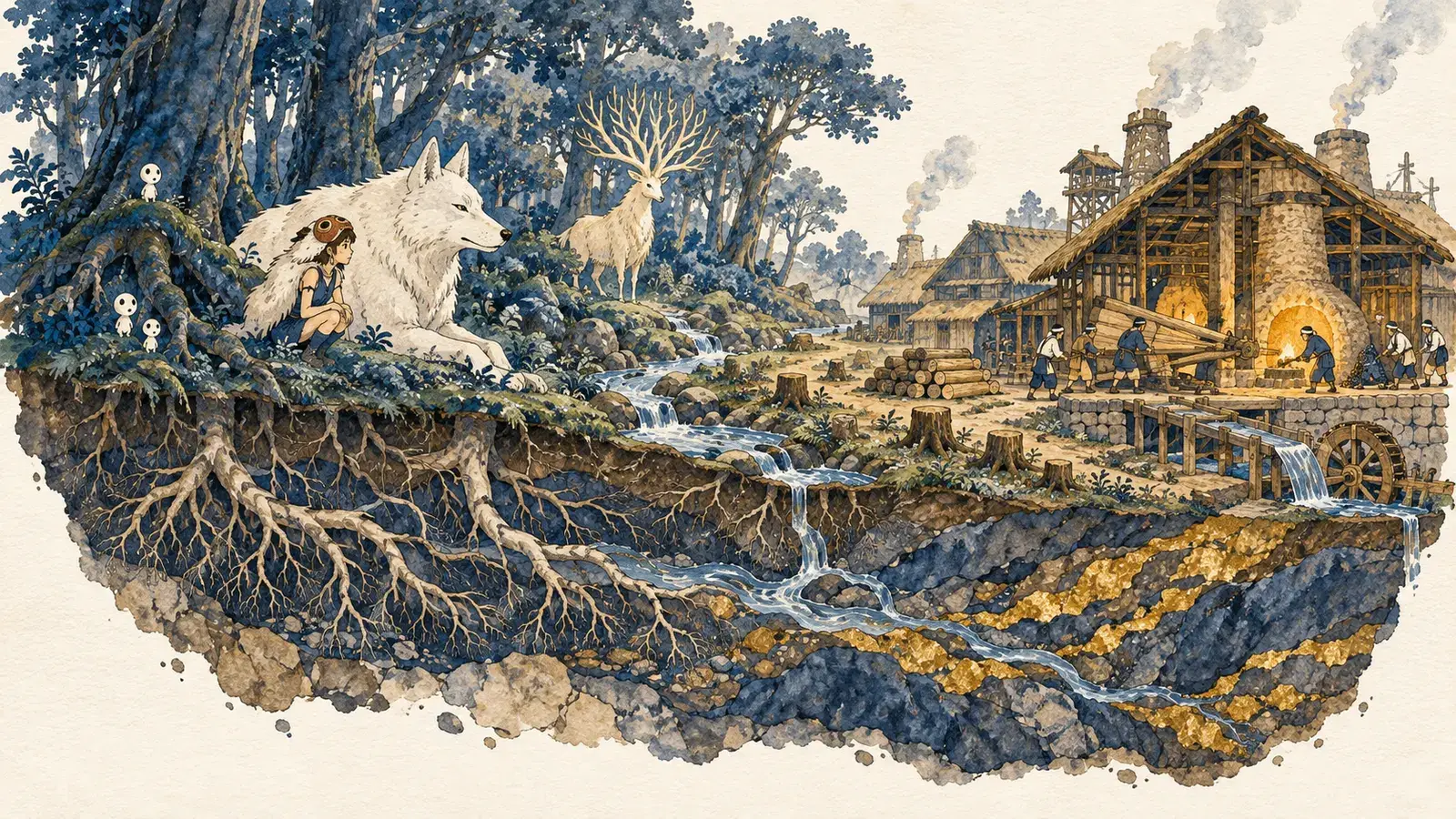
“Princess Mononoke” (1997), written and directed by Hayao Miyazaki, is set in Japan during the Muromachi period. Prince Ashitaka, the last prince of the Emishi, kills a demon-possessed boar threatening his village, but his arm is cursed. Exiled, he heads west in search of a cure and becomes entangled in the conflict between the forest gods and the nearby town, as well as the dispute between Lady Eboshi, the town’s leader, and San, a girl raised by wolves.
The ecological dimension is central to the film, but Miyazaki does not present the conflict as a simple confrontation between good and evil. As animation scholar Susan J. Napier notes, the film “offers a vision of life as a densely interwoven pattern” rather than an allegory of divided opposites. Humanity and nature have equal standing in the film’s world, while internal conflicts exist on both sides: the spirit tribes disagree among themselves, and humans fight for many reasons.
Iron Town clears the forest to mine iron, but it also provides a refuge for former prostitutes and people with leprosy, who find a dignified life there and fair treatment from Eboshi. Miyazaki was inspired to depict people with leprosy after visiting the Tama Zenshoen sanatorium near his home. According to scholars, this complexity marks a shift toward greater intricacy compared with the director’s earlier works, which usually presented a utopian model as an answer to social issues.

The film was the most expensive animated production in Japan up to that point, with a budget of 2.35 billion yen. For the first time in a Miyazaki film, it combined hand-drawn animation with digital techniques—about five minutes were entirely digital—even though he was known for his aversion to digital techniques. The decision was made early in production, starting with the boar demon in the opening scene. Approximately 144,000 cels were used in total, and Miyazaki himself is estimated to have drawn or revised nearly 80,000 frames.
The film has multiple influences. Miyazaki began developing ideas in 1980 and considered basing a film on the Japanese classic “Hōjōki” (1212), which explores the fleeting nature of life. Napier believes the work echoes the “growing sense of vulnerability” in Japanese culture at the time of its production. He was also inspired by the Epic of Gilgamesh and the ecological writings of historian Sasuke Nakao, who offered him an alternative account of Japanese history.
The historical context of the 1990s shaped the film’s tone. Miyazaki was critical of Japan’s decision to provide military assistance in the Gulf War, while the Great Hanshin earthquake and the sarin attack on the Tokyo subway by the Aum Shinrikyo cult in 1995 had a deeply negative impact on Japanese culture. After “Porco Rosso,” the director decided to create a “substantial work” that would not resort to escapism, guided by the philosophy that “however bad things get, we have no choice but to keep living.”
The film’s release in Japan on July 12, 1997, was accompanied by the largest advertising campaign of the time, with a promotional budget of at least 2.6 billion yen. The film broke several box office records and eventually became the country’s highest-grossing film.
Miramax commissioned fantasy author Neil Gaiman to write the English dub, and he made significant changes to the script for American audiences. The film performed poorly at the US box office.
Despite its American failure, the film received widespread positive reviews in Japan and the United States and won leading Japanese awards, including the Mainichi Film Awards and the Japan Academy Film Prize. Its lasting popularity and cultural impact gave it cult status, with total earnings of $231.3 million by 2026.




Comments