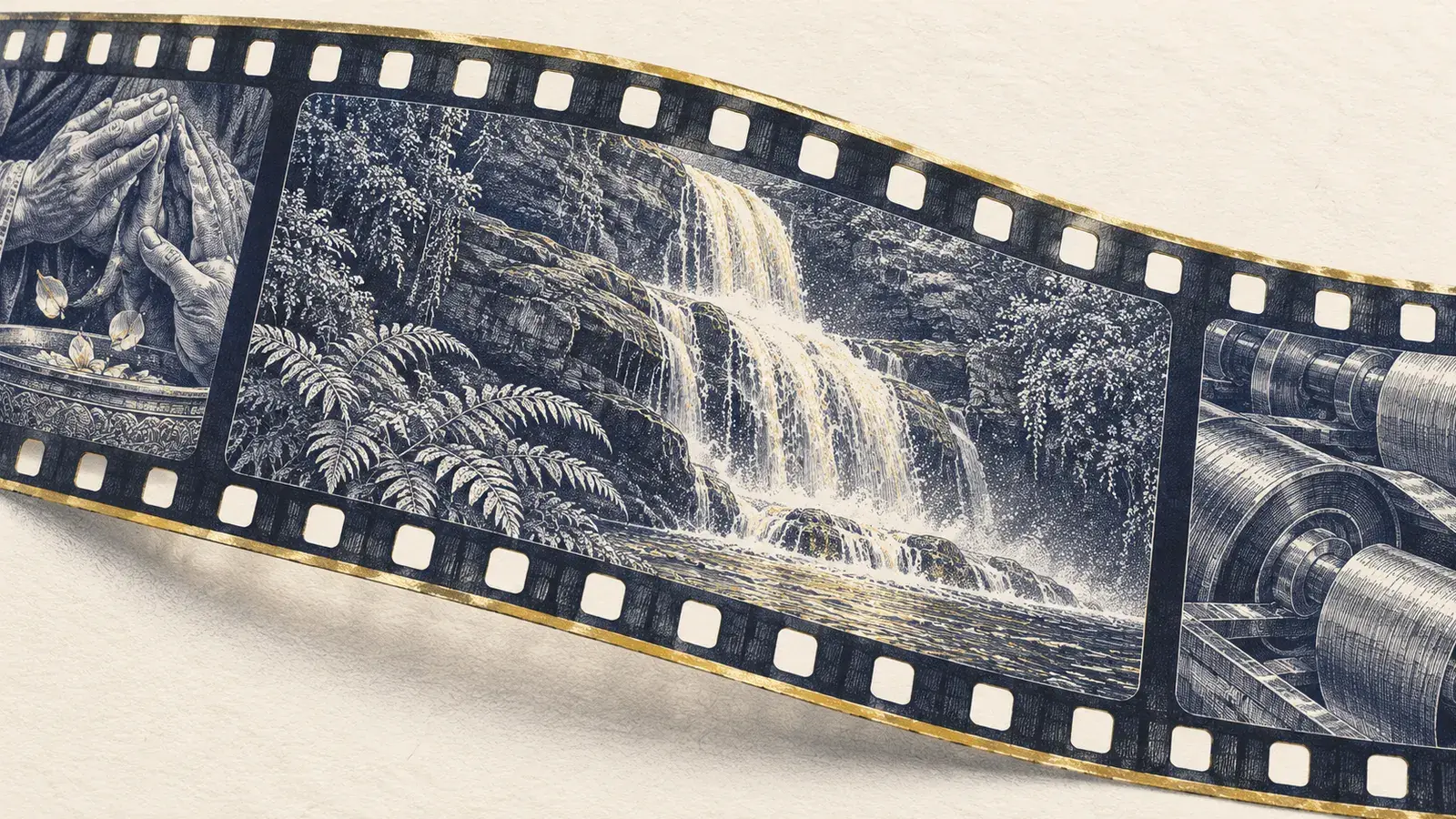
Baraka is a 1992 American non-narrative documentary directed by Ron Fricke. It was shot entirely on 65 mm film using the Todd-AO system and is the first film in history to be restored and digitally scanned at 8K resolution. It has no narration or voice-over; its name comes from the Islamic concept of baraka, meaning blessing.
The film is a later project by Fricke following Godfrey Reggio's similar non-verbal documentary Koyaanisqatsi. Fricke had worked as cinematographer and collaborator on that film, and with Baraka he set out on his own to refine and expand the photographic techniques. The footage combines slow motion and time-lapse. The Todd-AO system was used for conventional shots, while for the time-lapse sequences Fricke built a special camera that combined frame-by-frame photography with precisely controlled movements.
Filming took place at 152 locations in 24 countries on six continents over 14 months. Places shown include the Church of the Holy Sepulchre in Jerusalem, Ryoan-ji Temple in Kyoto, Lake Natron in Tanzania, the burning oil fields in Kuwait, the rim of an active volcano, a busy subway station, the aircraft graveyard at Davis–Monthan Air Force Base, Maasai ceremonies in Kenya and monks chanting at Dip Tse Chok Ling Monastery.
Baraka does not tell a story but explores themes through a collection of natural events, life, human activities and technological phenomena. It includes long tracking shots through Auschwitz and Tuol Sleng, across photographs of people, past skulls piled in a room and on to a spread of bones. The film suggests a universal cultural perspective: a shot of an elaborate tattoo on a bathing Japanese yakuza precedes an image of tribal body paint.
The score is by Michael Stearns, and the film also features pieces by Dead Can Dance, L. Subramaniam, Ciro Hurtado, Inkuyo, Brother, Anugama & Sebastiano and David Hykes. In 2019, German composer Mathias Rehfeldt released the concept album Baraka, inspired by the film.
In 2007, the original 65 mm negative was rescanned at 8K resolution using equipment designed specifically for Baraka at FotoKem's laboratories. The automated 8K scanner ran continuously and took more than three weeks to scan over 150,000 frames, with each frame requiring around twelve to thirteen seconds, producing more than thirty terabytes of image data in total. After 16 months of digital processing, which also included new 96 kHz/24-bit audio processing, the film was re-released on DVD and Blu-ray in October 2008.
Project leader Andrew Oran described the reissue at the time as “possibly the highest-quality DVD ever made,” while critic Roger Ebert wrote that the Blu-ray was “the finest video disc I have ever viewed or ever imagined.” The film has a score of 85% on Rotten Tomatoes based on 26 reviews. Ebert included it in his “Great Movies” list and noted that if humanity sends another Voyager to the distant stars and it can carry only one film, that film could be Baraka. A sequel, Samsara, also shot in 65 mm by the same filmmakers, premiered at the Toronto International Film Festival in 2011 and was released internationally in August 2012.


Comments