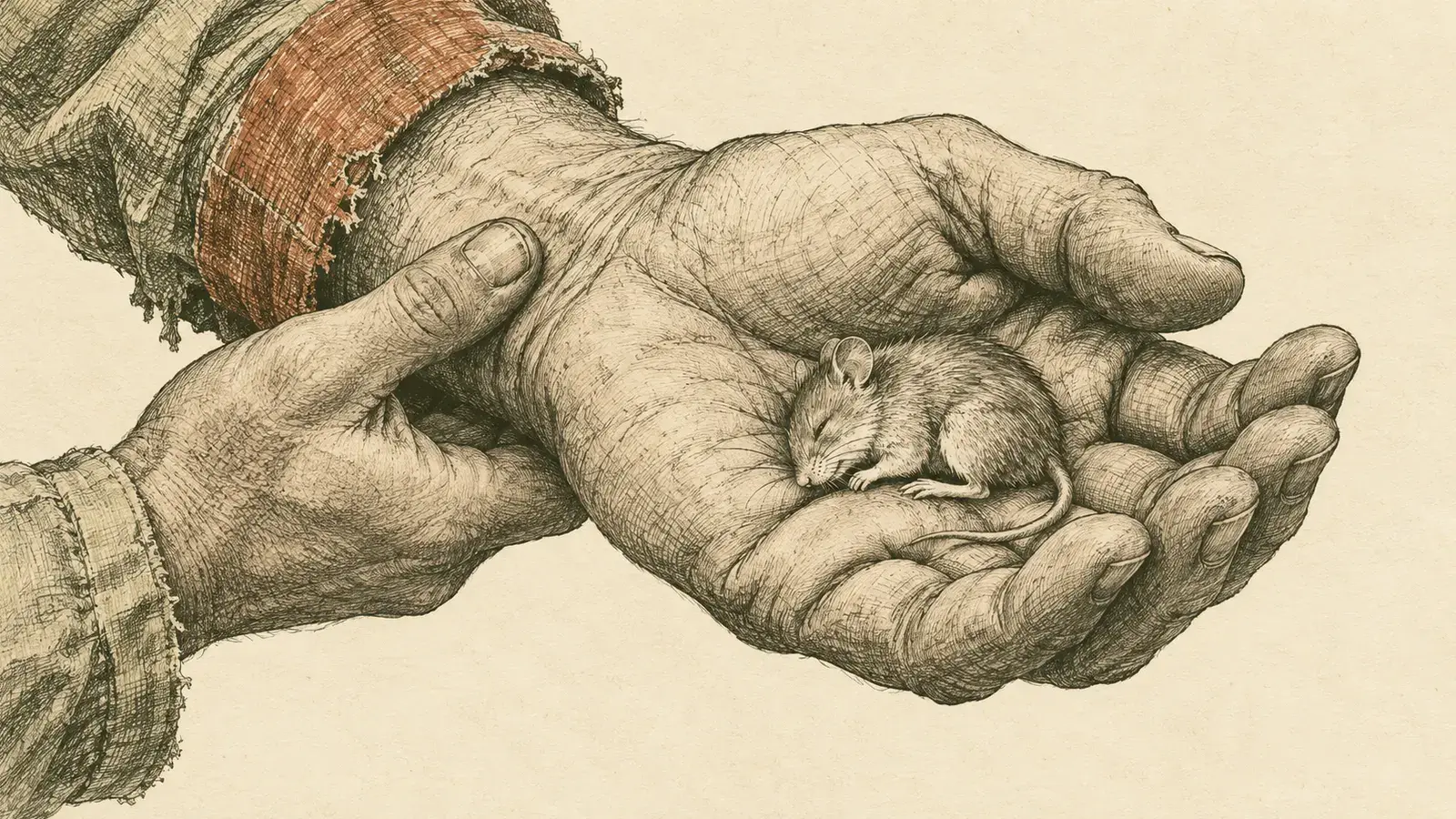
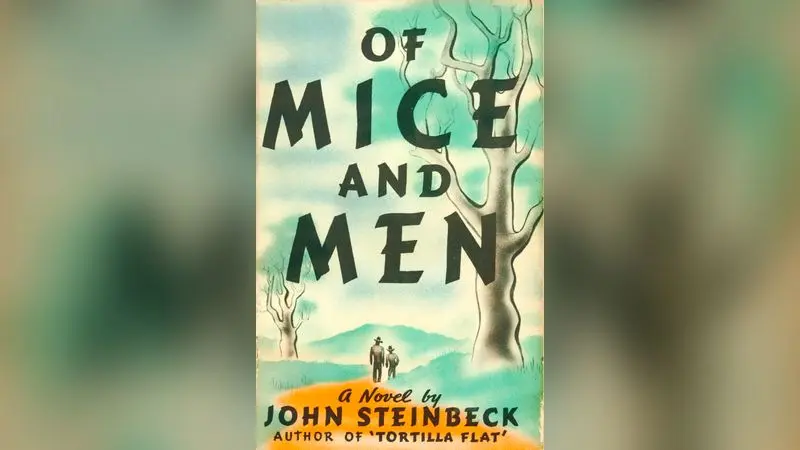
“Of Mice and Men” is a 1937 novella by the American Nobel Prize-winning author John Steinbeck. It recounts the experiences of George Milton and Lennie Small, two migrant farm workers looking for work in California during the Great Depression. Steinbeck based the work on his own experiences as a teenager working alongside migrant workers in the 1910s. The title comes from Robert Burns's poem “To a Mouse”: the best-laid plans of mice and men often go wrong.
George is intelligent but uneducated; Lennie is physically very powerful but has an intellectual disability. Together they share a dream: to own a piece of land. Lennie's part in the dream is simply to tend rabbits, because he loves soft animals—but he always pets them so forcefully that he accidentally kills them. The two men were forced to leave Weed when Lennie grabbed a young woman's skirt because he thought it was pretty, leading to an accusation of rape and a mob intent on lynching him.
At the farm where they are hired, they meet Curley, the foreman's short, aggressive son, who targets Lennie. They also meet Candy, an elderly worker with one hand and a faithful dog—which their fellow worker Carlson kills—and Slim, the intelligent and kind lead mule-team driver, the only person who will fully understand the bond between George and Lennie.
For a while, the dream seems to be drawing closer: Candy offers $350 towards buying the farm, on the condition that he can live with them. But their joy is overshadowed when Curley attacks Lennie, who easily crushes his hand while defending himself. In the stable, Lennie talks to Crooks, the embittered but educated black stable hand, who is isolated from the others because of his skin colour. Curley's wife, lonely and frustrated, threatens Crooks with lynching.
The tragedy reaches its climax when Lennie accidentally kills his puppy while petting it, and then, when Curley's wife lets him stroke her hair, she panics at his strength and he accidentally breaks her neck. The workers form a lynch mob. George realises that the dream is over, finds Lennie at their meeting place and, while once again telling him his favourite story about their dream, shoots him to give him a more humane death than he would suffer at the mob's hands. Only Slim understands what happened.
The main themes are dreams and aspirations, loneliness and powerlessness. Steinbeck sets the story near the town of Soledad, which means “solitude” in Spanish, while Crooks expresses the theme bluntly: “A man goes crazy if he has nobody”. The characters are often powerless because of intellectual, economic and social circumstances: Lennie has the greatest physical strength, but his disability leaves him powerless, while the workers are victims of the Depression. The author presents the tragedy as “something that happened”, taking a non-teleological view without condemnation.
The work was written as a “play-novel”, structured in three acts so that it could also be read as a play script. Its original title was “Something That Happened”. Steinbeck changed the title after reading Burns's poem, which addresses the futility of human plans. An early manuscript was destroyed by the author's dog; in a 1936 letter, he explained that the puppy had turned about half the book into “confetti”. He later told The New York Times that he had worked in the same area and that Lennie was a real person, then confined to a psychiatric hospital.
The novella received an excellent reception: it was selected by the Book of the Month Club before publication and praised by critics. In the United Kingdom, it ranked 52nd on the BBC's “The Big Read” list in 2003. At the same time, it is a frequent target of censorship: it has been excluded from school libraries for “vulgarity”, racist language, allegedly “promoting euthanasia” and “anti-business” content, and appears on the American Library Association's lists of the most challenged books. Scholars such as Thomas Scarseth have nevertheless defended its literary value: “in truly great literature, the pain of life is transformed into the beauty of art”.
The work has seen many adaptations: stage productions since 1937, a 1939 film with Lon Chaney Jr. and Burgess Meredith, a 1992 version directed by Gary Sinise with John Malkovich, an opera by Carlisle Floyd in 1970, a ballet in 2022 and radio productions. Why it still speaks to readers today: it addresses our need to belong somewhere, the right to dream even when circumstances deny it, and the responsibility we have towards one another—especially towards the most vulnerable. Through George and Lennie, Steinbeck asks what it means to be human: to try to understand another person, even when fate is against you.

Comments