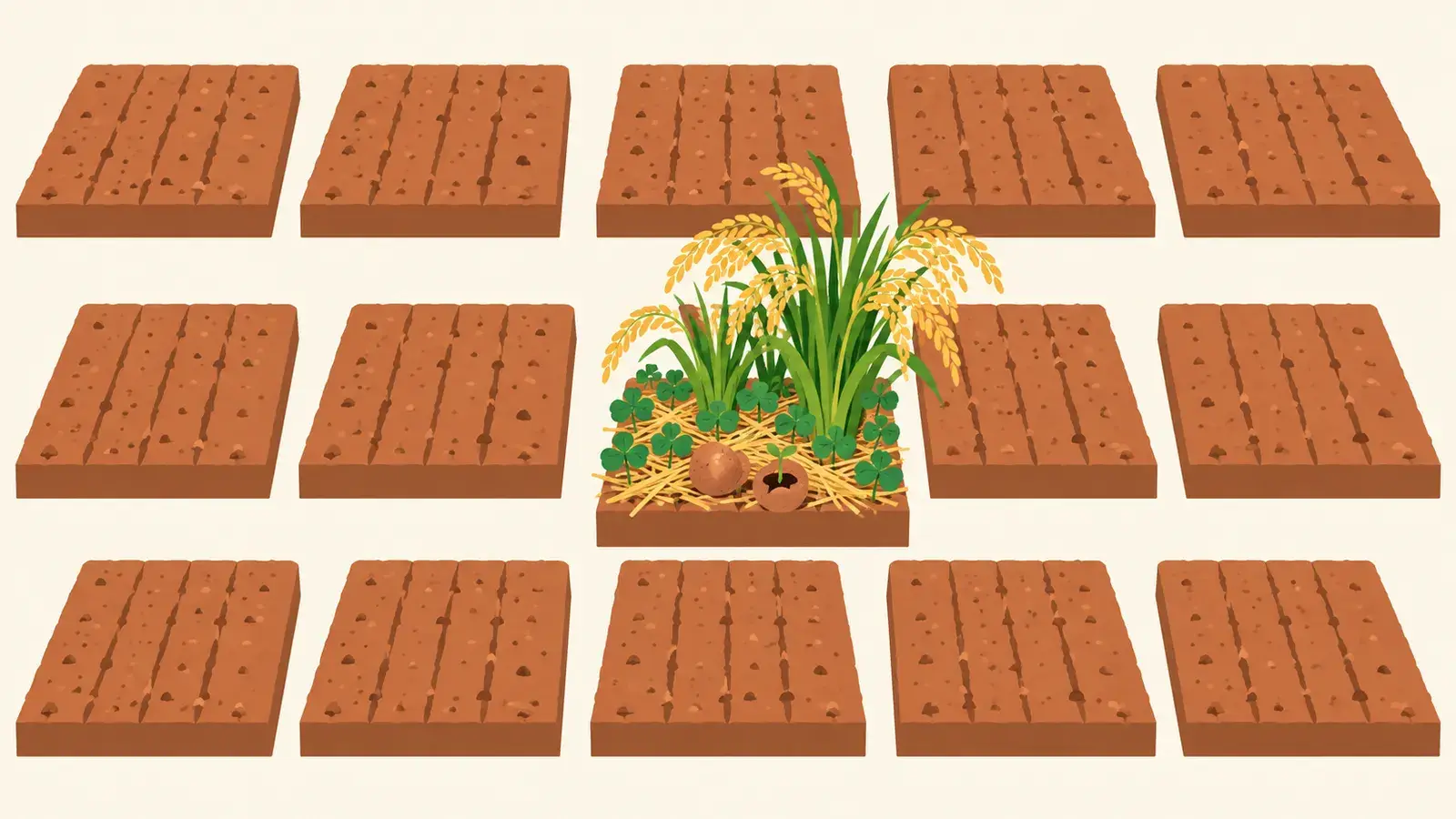
Masanobu Fukuoka was a Japanese farmer and philosopher known for "natural farming" and the revegetation of desertified land. He was born on 2 February 1913 and died on 16 August 2008. He advocated farming methods without tillage, herbicides or pesticides, developing an approach often called "natural farming" or "do-nothing farming".
He was born in Iyo, in Ehime Prefecture, the second son of an educated and wealthy landowner. He studied at an agricultural college in Gifu Prefecture and trained as a microbiologist and agricultural scientist, specialising in plant pathology. In 1934, he worked as an agricultural products inspector at the Yokohama customs office. In 1937, he was hospitalised with pneumonia and, during his recovery, had a profound spiritual experience that led him to question modern "Western" agricultural science. He immediately resigned from his position and returned to the family farm on the island of Shikoku.
In 1938, he began experimenting with organic citrus orchards. Among other things, he stopped pruning one area of citrus trees, which resulted in insect infestations and tangled branches. As he put it, this experience taught him the difference between nature and non-intervention.
His efforts were interrupted by the Second World War, when he worked at an agricultural experimental station in Kochi Prefecture. After the war, his father lost most of his land through post-war land reform and was left with a very small rice field and the hillside citrus orchards. In 1947, Fukuoka successfully resumed natural farming, growing rice and barley without tillage.
His book The One-Straw Revolution was published in 1975, translated into English in 1978 and became his best-known work; it has been translated into more than 20 languages and has sold more than one million copies. From 1979 onwards, he travelled extensively around the world, giving lectures, sowing seeds and helping to revegetate degraded areas. By the 1980s, his family was sending around 6,000 crates of citrus fruit to Tokyo each year, weighing approximately 90 tonnes in total.
His philosophy, known in Japanese as shizen nōhō, is based on recognising the complexity of the living organisms that make up an ecosystem and deliberately drawing on it. Fukuoka saw farming not only as a means of producing food but also as an aesthetic and spiritual approach to life, with the ultimate goal of "the cultivation and perfection of human beings". The four principles of natural farming are that no tillage or machinery is needed, no prepared fertilisers or compost, no weeding through cultivation or herbicides, and no pesticides—only minimal weed suppression with minimal disturbance of the soil.
Fukuoka reinvented and developed the use of clay seed balls, an ancient practice in which seeds are mixed, often with humus or compost, and encased in clay to form small balls. The method is now often used in "guerrilla gardening" to sow seeds quickly on restricted or private land.
He travelled to Somalia, Ethiopia, India, Tanzania, Vietnam and Greece, among other countries, to sow seeds in deserts and on degraded land. In 1998, he visited Greece to help with plans to revegetate 10,000 hectares around Lake Vegoritida in Pella and with the production of a film about the large-scale seed ball effort.
He received major honours, including the Desikottam award from Visva-Bharati University and the Ramon Magsaysay Award for Public Service in the Philippines in 1988, the Earth Council Award in 1997 and a grant from the Rockefeller Brothers Fund in 1998, which he returned because of his advanced age. Within the international organic farming movement, he is regarded as one of the "five towering figures" who inspired it, alongside Rudolf Steiner, Hans Müller, Lady Eve Balfour and J. I. Rodale.
The reception of his work was not without reservations. Wendell Berry wrote in the foreword to the American editions that his techniques were not "directly applicable to most American farms", although he added that it would be a mistake to consider the book's practical passages useless. The techniques proved difficult to apply even on most Japanese farms; the early years of transition from conventional farming bring yield losses, which Fukuoka estimated at 10%, while others, such as Yoshikazu Kawaguchi, found that strict adherence to the methods led to crop failures and required many years of adjustment. In the early 2000s, Theodor Friedrich and Josef Kienzle of the FAO argued that rejecting mechanisation was not justified in modern agricultural production and that the system could not interact effectively with conventional systems. More recently, however, the FAO itself, together with research universities and organisations such as the Union of Concerned Scientists, found that conventional industrial agriculture relies on unsustainable practices that ignore basic biology and the needs of ecosystems.
Many of Fukuoka's principles are now incorporated into modern forms of farming that support more biodiversity, rely less on chemicals and machinery, and achieve similar yields while improving soil health. In Japan, where he had few followers and collaborators, his critics noted that the "inner world and the connection between humans and nature do not encompass all of reality" and that he paid insufficient attention to interpersonal relationships or society. The next generation of natural farmers, led by Yoshikazu Kawaguchi, partly addressed these concerns by establishing free schools and annual conferences; today, there are more than 40 learning sites and over 900 active students in Japan's natural farming network.
Fukuoka died on 16 August 2008 at the age of 95, leaving a legacy that continues to fuel discussions about the relationship between farming, ecosystems and human life.

Comments