Bruce Charles “Bill” Mollison was born in 1928 in the fishing village of Stanley, in northwestern Tasmania, Australia. He left school at 15 to help in the family bakery and spent the next ten years working as a shark fisherman, sailor, forestry worker, mill worker, wildlife trapper, tractor driver and naturalist. In 1954 he joined CSIRO's Wildlife Research Division, later becoming a curator at the Tasmanian Museum and working for the Inland Fisheries Commission. In 1966 he entered the University of Tasmania, earned a degree in biogeography, taught there and developed its Environmental Psychology course, retiring from it in 1979.
As he told his student Toby Hemenway, the initial idea for permaculture came to him in 1959 while he was watching marsupials grazing in Tasmania's rainforests. Struck by the ecosystem's abundance and interconnectedness, he wrote in his diary: “I believe we could build systems that would work just as well as this one.”
Over the following decades, he became deeply concerned about industrial farming methods, believing they degraded the soil, relied on non-renewable resources, poisoned land and water, reduced biodiversity and stripped billions of tonnes of topsoil from fertile landscapes. As he wrote, after years as a scientist at CSIRO and Tasmania's Department of Inland Fisheries, he began protesting against political and industrial systems that, in his view, were killing people and the world around them. But he decided that constant confrontation led nowhere. He withdrew from society for two years because he wanted to return with something very positive that would allow people to exist without biological systems collapsing.
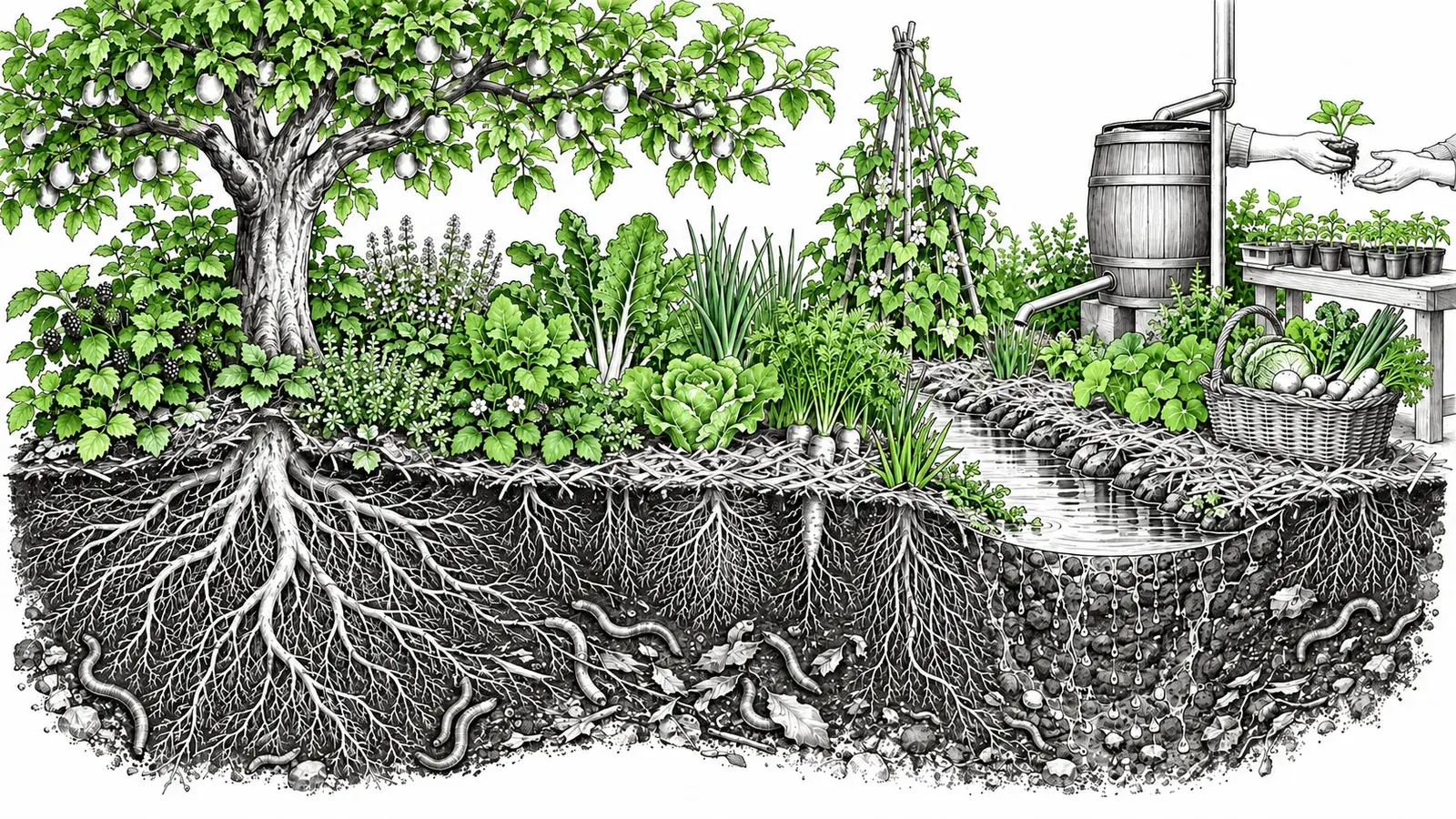
Between 1974 and 1975, Mollison and David Holmgren jointly developed a framework for a sustainable agricultural system based on a polyculture of perennial trees, shrubs, herbs, vegetables and weeds, fungi and root systems. They named it “permaculture”. In 1978 they published Permaculture One, introducing the system to the wider public.
The word originally came from “permanent agriculture”, but Mollison quickly realised that it was a system of permanent culture, since no culture can survive without a productive landscape, healthy ecology and a circular economy. Over time, Mollison broadened the concept: permaculture concerned not only agriculture, gardening, architecture and ecology, but also economic systems, strategies for access to land and legal systems for businesses and communities. As he said, food self-sufficiency is meaningless if people lack access to land, information and financial resources, so permaculture became “an entire human system”.
In 1979 he helped establish the first Permaculture Institute to teach students worldwide the practical design of sustainable soil, water and plant systems, as well as legal and economic systems. Mollison taught the first Permaculture Design Certificate course in Stanley in January 1980 and created a “train the trainers” educational system. In 1987 he taught the first such course in India. By 2011 there were more than 300,000 graduates practising and teaching permaculture around the world.
He is considered the founder and “father” of permaculture. He also developed the “herb spiral”, a structure that allows herbs with different needs to coexist in a small space. He spent his final years in Sisters Beach in northwestern Tasmania and died in Hobart in 2016, aged 88.
The significance of Mollison's work lies in how he turned concern about soil degradation and dependence on non-renewable resources into a positive model that could be taught and put into practice. Permaculture began as a positive idea open to new information and as a practice that could incorporate knowledge of sustainable ecological techniques from all parts of the world.
Comments