The year 2025 begins with grim forecasts for the humanitarian situation: according to OCHA, around 305 million people are expected to need assistance, more than five times the 57.5 million in 2015. At the same time, the gap between needs and available resources is widening: in 2024, the UN raised just 46% of the $49.6 billion required. In this context, the case for innovation is more pressing than ever.
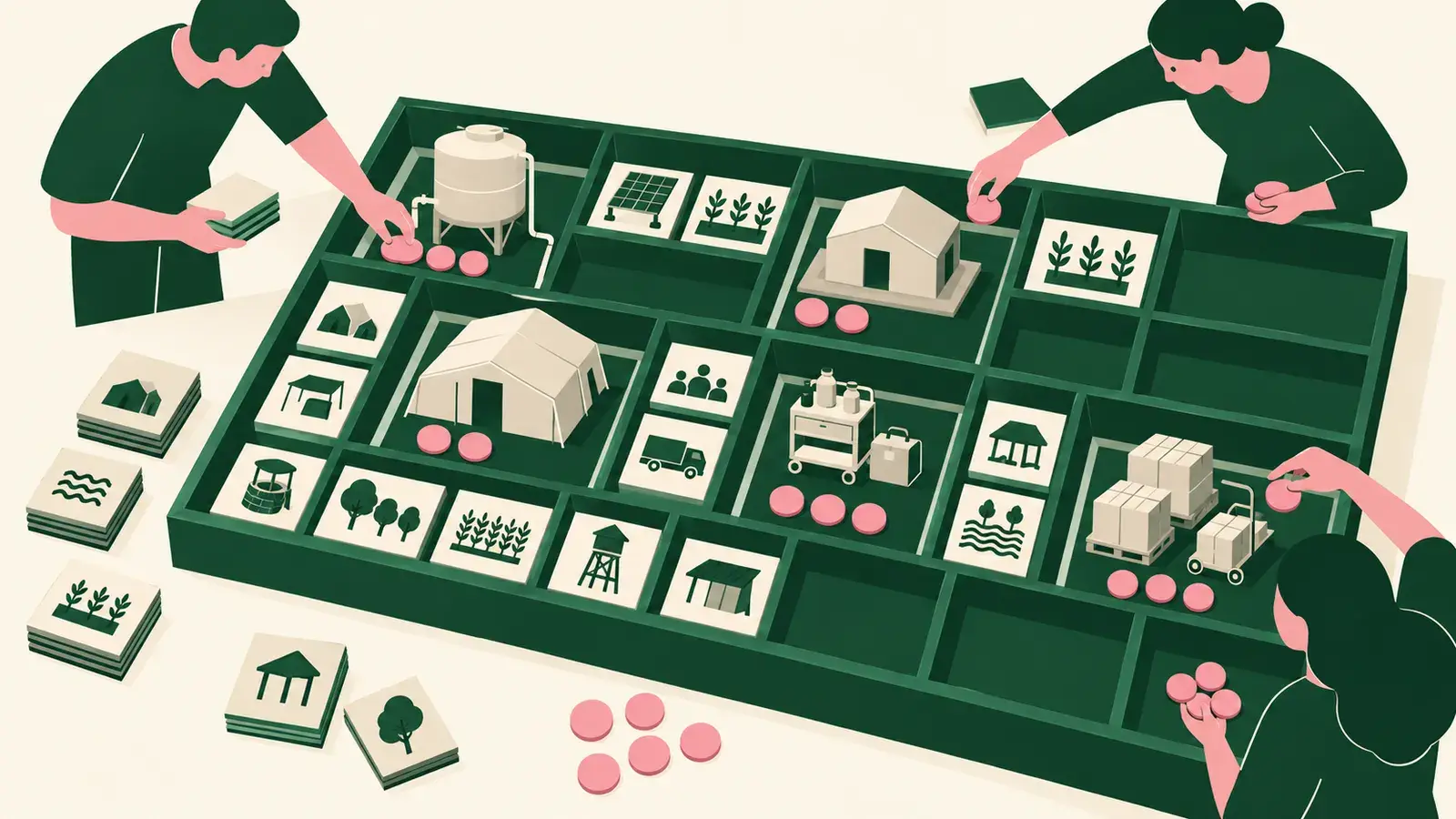
Innovation portfolio management is a systematic approach to aligning processes, resources, partnerships and performance with an organisation’s goals. It is widely used in the private sector and helps identify gaps, make use of synergies and reuse resources, technologies and processes. The OECD has developed a tailored version for international development funders, allowing them to assess the social return of the entire portfolio rather than just individual projects.
In 2024, the OECD and the UK’s Foreign, Commonwealth and Development Office (FCDO) launched a partnership to map and develop the humanitarian research and innovation portfolio. The aim was to improve alignment with strategic goals, better balance risks and benefits, and advance efforts to scale up. A core team set three strategic criteria: how strong the evidence base is for each solution, which populations it aims to reach, and whether it is a distinct, scalable solution or practices seeking to change local systems.
The initiatives funded by the FCDO in 2023–2024 through programmes such as the Humanitarian Innovation Fund, the UK Humanitarian Innovation Hub, the Community Led Innovation Partnership, the Creating Hope in Conflict Humanitarian Grand Challenge, GSMA Mobile for Humanitarian and the Frontier Tech Hub were then mapped. More than 272 research and innovation initiatives were recorded, worth a total of £42.2 million. Data from the main implementing partners enabled the OECD to create visualisations of the distribution of investment by scaling stage, using the International Development Innovation Alliance framework. The distribution showed that the FCDO was investing almost equally in the proof-of-concept (£16 million, 115 initiatives) and transition-to-scale (£17.5 million, 77 initiatives) stages. Relatively less money went to early stages: around £2.5 million to ideas and a similar amount to research and development.
Participants in two workshops jointly mapped the portfolio’s components against the selected criteria, then worked together to interpret the findings and discuss strategy. A key finding was that the portfolio focuses on innovations with an established or developing evidence base, while fewer resources go to solutions with little or no supporting evidence. The assessments also showed that most solutions are adaptations of innovations proven in other contexts, which reduces programme risk. The still limited evidence base for some initiatives at the transition-to-scale stage may reflect either that these are newer initiatives whose evidence is still being strengthened, or difficulties in scaling up or addressing systemic issues. The portfolio shows a balance between deepening impact for populations already served and reaching those not yet reached, but early-stage initiatives targeting unreached groups are limited. Workshop participants reached further conclusions: the portfolio is well aligned with programme goals and the FCDO’s risk appetite, while greater clarity is needed on how to bring about change in the relevant systems.
The exercise revealed that the portfolio was split roughly equally between investments in specific solutions, such as the Safe Water Optimization Tool, and system-level practices, such as setting a global standard for humanitarian surgery — a balance that had not been expected based on the initial business plans. The findings suggest that early-stage investments from 2018 have matured and efforts to scale up have increased, filling an identified funding gap.
At the same time, questions and trade-offs are emerging that will shape the future: should the UK provide more support for early stages or for sustainable scale? What does “sustainable scale” mean in the evolving humanitarian landscape? Should funding instruments be designed to support innovation from end to end, rather than through fragmented project cycles? And should the priority be to reach more unreached people or to improve the quality of the response for those already receiving help?
Answering these questions will require the FCDO team to refine its priorities, taking available resources into account, and to work with other funders to build a coherent ecosystem for supporting innovation. The portfolio approach can continue to be used for strategic analysis of work carried out simultaneously across themes and stages, while clearer boundaries around priorities and guidance for partners will help focus on a distinct set of problems.
In 2025, the OECD will publish a handbook on innovation portfolio management and is inviting development professionals to contribute to the consultation by testing the criteria that matter for investment in innovation.




Comments