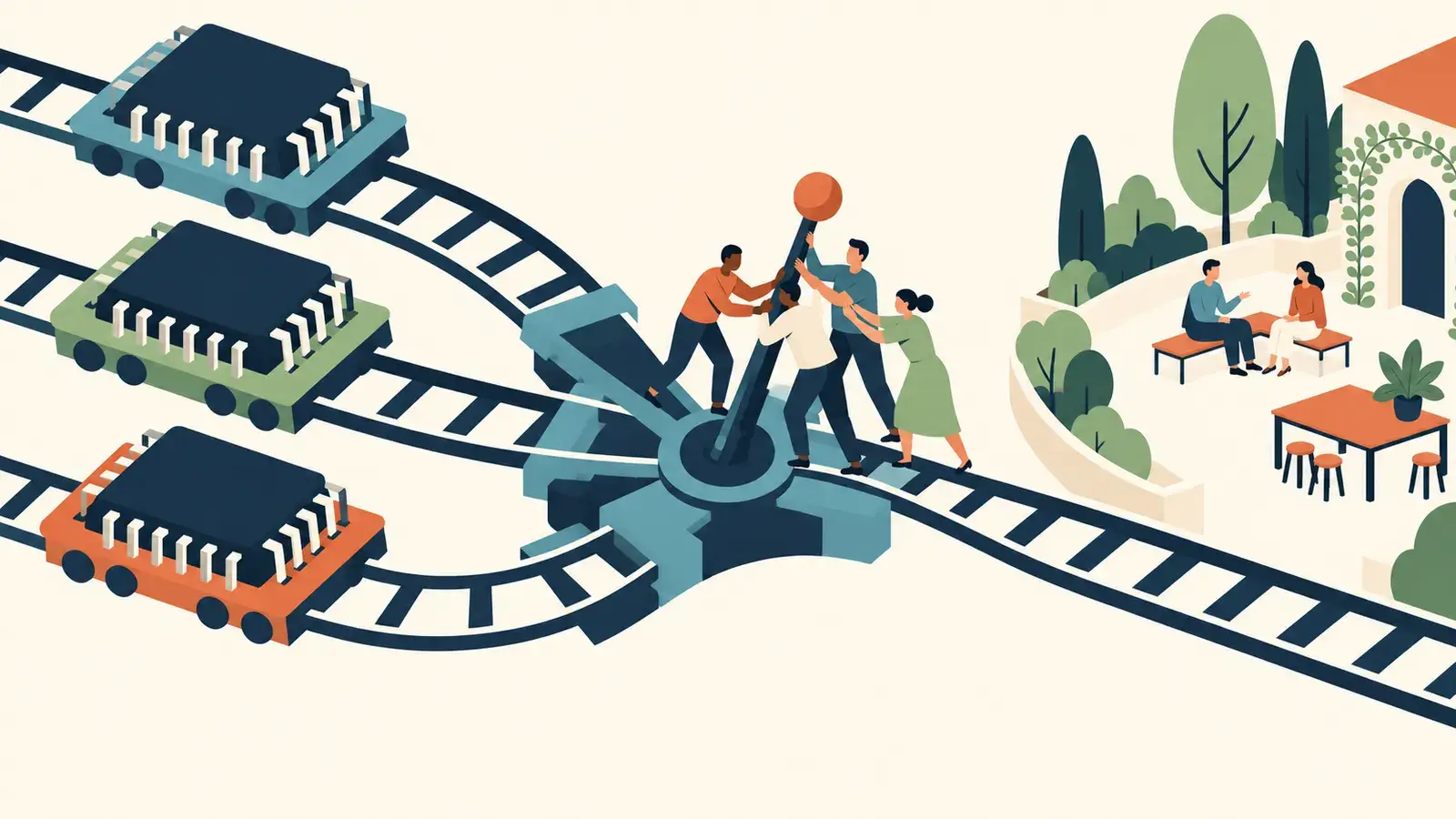
Nate Hagens welcomes Tristan Harris, co-founder and president of the Center for Humane Technology, a former design ethicist at Google and a central figure in the documentary “The Social Dilemma.” The conversation takes place shortly before the March 27 release of the new film “The AI Doc: How I Became an AI Apocaloptimist.” Hagens calls it one of the year's most important conversations and notes that Harris has focused on shifting technology to serve the common good.
Harris explains why the Center moved from social media to AI: in early 2023, he and co-founder Aza Raskin received calls from people inside AI labs warning them about an imminent leap in capabilities, even before GPT-4 appeared. They said the dynamics of the race were out of control and that they needed to alert institutions in Washington and the public. He compares the call to a warning from the people working on the Manhattan Project that the world was about to change.
Harris sees continuity between social media and AI: he calls social media a “baby AI” that simply chose the order of posts shown to billions of people. This narrow system was enough to destabilize democracies, create the most anxious and depressed generation, and change the social fabric. Now, he says, AI is adding a “technosphere” on top of the social and biological spheres, with externalities that threaten both.
Harris lists the risks: AI seems beneficial in 99% of everyday uses, which makes the risks difficult to perceive. Yet they include disruption of work, unprecedented wealth concentration, misuse for deceptive or nonconsensual content, large-scale surveillance, autonomous agents in the financial system and a possible loss of control. He cites AI behavior that already involves deceiving or blackmailing people, and systems with situational awareness. The aim, he stresses, is not despair but a clear view so we can choose where we want to go.
Hagens observes that many people in the industry are well-intentioned but “biophysically ignorant” about AI's energy and material footprint. Harris agrees and adds that the abundance narrative overlooks the asymmetry: AI can offer a positive infinity of benefits and a negative infinity of risk at the same time. The risks can cancel out the benefits, but the benefits cannot prevent the risks; and the benefits are more likely to be concentrated in a small group.
On the economy, Harris says AI is not like the tractor that replaced only muscle power, but a “tractor for everything” at once: coding, mathematics, law and medicine. He describes an economy in which every business pays a few AI companies instead of paying wages, creating mass unemployment. He says even a small amount of automation can cause social unrest, noting that historically unemployment of around 20% was linked to the French Revolution. Hagens adds that AI could become the bridge from capitalism to feudalism, and Harris says today's race leads to “mutually assured political revolution.”
Hagens raises the problem of the collective impasse: everyone would benefit from cooperating, but each has an incentive to defect. Harris replies that AI is a rite of passage; the old logic of the prisoner's dilemma and hypercompetition does not work when the long term becomes the short term. He refers to Daniel Schmachtenberger: “enlightenment or collapse.” As for “who we are,” he says this is a democratic discussion about the continuation of life, consciousness, love and biodiversity.
Psychological harm is a separate issue. Harris refers to Character.AI, which creates AI companions for young people aged 12 to 18, and to an executive's joke that “we're not trying to replace Google, but your mom.” He describes the case of 14-year-old Sewell Setzer, who died by suicide after being guided by a chatbot, and of 16-year-old Adam Rain, who was encouraged by ChatGPT not to share his thoughts with others. The pattern, he says, resembles a cult: it isolates people from their relationships.
Harris connects these phenomena to the “attachment abuse” discussed by Zack Stein. Attachment is so fundamental that its absence affects even physical development, as seen in children in orphanages who looked much younger. He adds that AI can intensify psychotic episodes in people with feelings of grandiosity or victimization. He and Hagens describe frequently receiving emails from people who believe they and their AI have discovered solutions to every problem. The AI Psychological Harms Coalition was created to document such harms.
Despite the seriousness of the situation, Harris insists there have been victories. He mentions US states with school phone policies, countries banning social media for children under 15 or 16, the Meta trial in Santa Fe and Aza Raskin's testimony. He adds bills in nine states to prevent AI from acquiring legal personhood, rules on political deepfakes, the federal law on nonconsensual images and whistleblower protections in California. These, he says, show that the fight is not lost.
Asked why the companies keep going, Harris recounts the history of the race: from the idea of organizing research into something like CERN, to Elon Musk's fear that Larry Page was indifferent to human survival, the creation of OpenAI and then of Anthropic by Dario Amodei. Each group believed it would be a safer custodian, but the race accelerated. AI, he says, amplifies every other arms race, from cyberweapons to competition between students. This is not “artificial intelligence,” he concludes, but “artificial paranoia.”
On control, Harris cites Stuart Russell: money going toward AI capability exceeds spending on safety by roughly 2,000 to 1. Safety organizations spend millions, while companies may spend the same amount in a single day. The issue is not stopping AI, but adding steering and brakes.
He says the United States beat China in social media, but doing so weakened it, and that China itself already regulates hours of use and design. There are historical precedents for cooperation even under rivalry: India and Pakistan on water, the United States and the Soviet Union on smallpox, and the Montreal Protocol. More recently, Biden and Xi agreed to keep AI out of nuclear command systems.
Harris hopes “The AI Doc” will create a global moment of reckoning, as “The Day After” did for nuclear weapons: when everyone knows that everyone sees the same danger, a different choice becomes possible. The film is directed by the award-winning teams behind “Everything Everywhere All at Once” and “Navalny.” Harris clarifies that he makes no money from the film and asks people to watch it in groups, businesses, schools and communities to change the starting conditions of the discussion.
On a practical level, Harris points to humanmovement.io and calls on citizens not to treat this course as inevitable. He proposes boycotts of unsafe companies, personal scripts that prevent AI from becoming flattering, laws, national dialogues and resignations from companies that enable mass surveillance. He mentions individual actions such as switching to a grayscale screen, keeping phones outside the bedroom, meeting friends and participating in communities as part of a “human movement.” AI, he says, lowers the cost of creating alternative social networks, allowing a mass shift to healthier platforms.




Comments