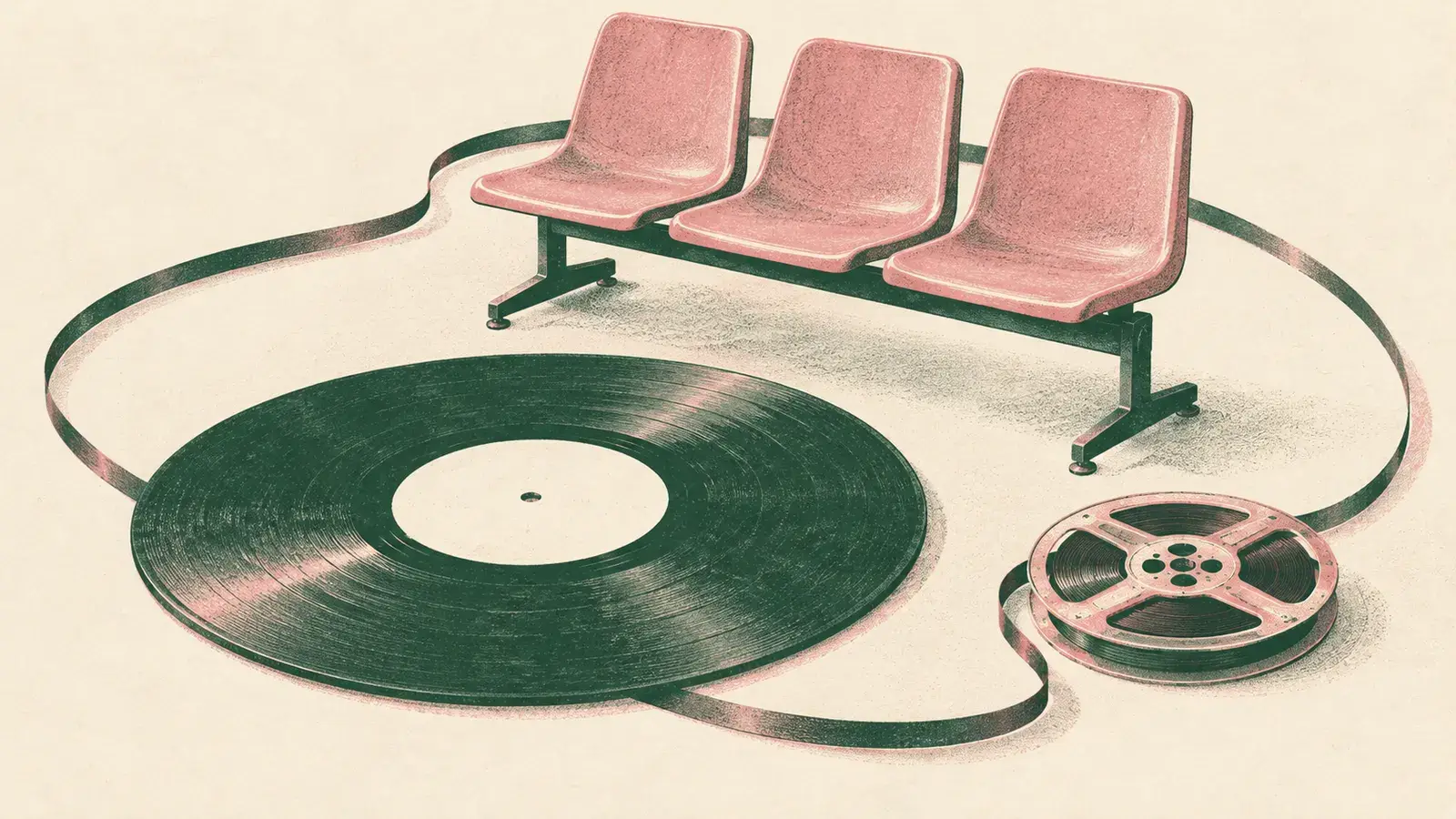
In early 1979, Brian Eno released “Ambient 1: Music for Airports” through E.G. Records and Polydor Records. It was his first record presented under the label of ambient music, a genre he described as music intended to “induce calm and a space to think”, while remaining “as ignorable as it is interesting”. The record consists of four compositions made with overlapping tape loops of different lengths, designed to play continuously as a sound installation to soften the stressful atmosphere of an airport, as an alternative to the “canned” music of Muzak and easy listening. It was the first of Eno’s four Ambient albums, a series that concluded in 1982 with “Ambient 4: On Land”.
The idea had a personal origin. In 1975, Eno was hospitalised after a road accident. While he was recovering at home, a friend put on a record of classical harp music at low volume, its sound blending with the rain hitting the window. Unable to get up to adjust the volume, he let the sound create an atmosphere that followed his attention. This experience was joined by Erik Satie’s idea of “furniture music”: music that becomes part of a room’s atmosphere and “mingles with the sound of knives and forks at dinner” instead of demanding concentration. Eno himself considered 1975’s “Discreet Music” his first venture into ambient music.
The specific concept emerged when Eno spent hours waiting for a flight at Cologne Bonn Airport in Germany and became irritated by its lifeless atmosphere. In the album’s liner notes, he explained how it differed from conventional elevator music: “canned” music companies standardise spaces by covering up their acoustic characteristics, whereas ambient music enhances them. Its purpose is not to “brighten” the environment by adding stimulation, but to induce calm and space for thought without imposing a particular way of listening.
Eno began work on “Music for Airports” while producing David Bowie’s “Low” in Berlin. At German producer Conny Plank’s studio, he recorded individual notes sung by three German women, and later, in England, recorded Fred Frith on guitar and Robert Wyatt on piano. He turned the recordings into tape loops. He said the album was “deliberately spare and unemotional” and that it was “essentially made by machines”. The compositions use a limited range of pitches, gestures and motifs, with no underlying rhythm and irregular repetition, while their timbres differ: the warm “1/1” contrasts with the cold, dark “1/2”.
“1/1” is based on piano tape loops played without a steady rhythm and was the only track with a melody. It emerged from two pianists improvising without being able to hear each other clearly, producing separate but complementary melodies. Philosopher of art John Lysaker observed that “1/1” “holds together no better or worse than a cloud”. “2/1” and “1/2” use vocal tape loops. Musicologist Victor Szabo described “2/1” as “haunted” and its vibrato-free vocal loops as “uncannily lifeless”, suggesting human absence. “2/2” was recorded with the ARP 2600 synthesiser, slowed down and given three types of echo; Eno considered it a beautiful sound he could not get from another synthesiser.
Eno also linked the record to death. As an anxious air passenger, he did not want the result to be “all bright and cheerful”; he considered the feelings an airport evokes, including an awareness of mortality, and hoped the album would offer comfort. As he put it, “really, it’s music to reconcile you with the possibility of death”.
Although it was the first ambient record to become popular and was later recognised as the first “deliberately ambient” recording, it was initially rejected by critics, audiences and some of Eno’s peers. In 1979, Michael Bloom in Rolling Stone found it self-indulgent and unfocused, writing that to appreciate its craftsmanship, “you must thwart the music’s intent by concentrating on it”. Robert Christgau in The Village Voice later called it “boring”, while Alan Niester in The Globe and Mail described it as “background grunge”. By contrast, Lester Bangs described a “crystalline” quality and recounted how the record led him into a dreamlike state in which Charles Mingus appeared.
Its reputation changed radically. By the 1990s, the record had entered the modern musical canon. In 2004, Rolling Stone credited it with defining the ambient genre, while in 2016 Pitchfork ranked it as the greatest ambient album of all time. Later reviews described it as a masterpiece, “sheer weightlessness” and music “too beautiful to ignore”. The album has sold more than 200,000 copies, making it one of Eno’s most successful solo albums.
Its influence was wide-ranging: it was included in the book “1001 Albums You Must Hear Before You Die” and, according to Chris Richards of The Washington Post, “taught an entire generation of musicians to treat music as texture”. Through the record, Eno’s place in music history became linked to minimalists such as Steve Reich, Philip Glass, Terry Riley and La Monte Young. Artists including Pauline Oliveros, Riley and Harold Budd expanded on its style, while the Ambient series served as a starting point for further exploration of it.
The record has also been installed and performed live at at least five airports, although some travellers and staff found it irritating, while clinics and hospitals have used it to calm patients. In 1998, the ensemble Bang on a Can performed it live; Eno said the human performance moved him to tears, a response shared by critics. In 2010, Black Dog released “Music for Real Airports” as a musical response, criticising the dehumanisation of airports, while in 2023 and 2024 Bruce Brubaker recorded piano transcriptions of the work.


Comments