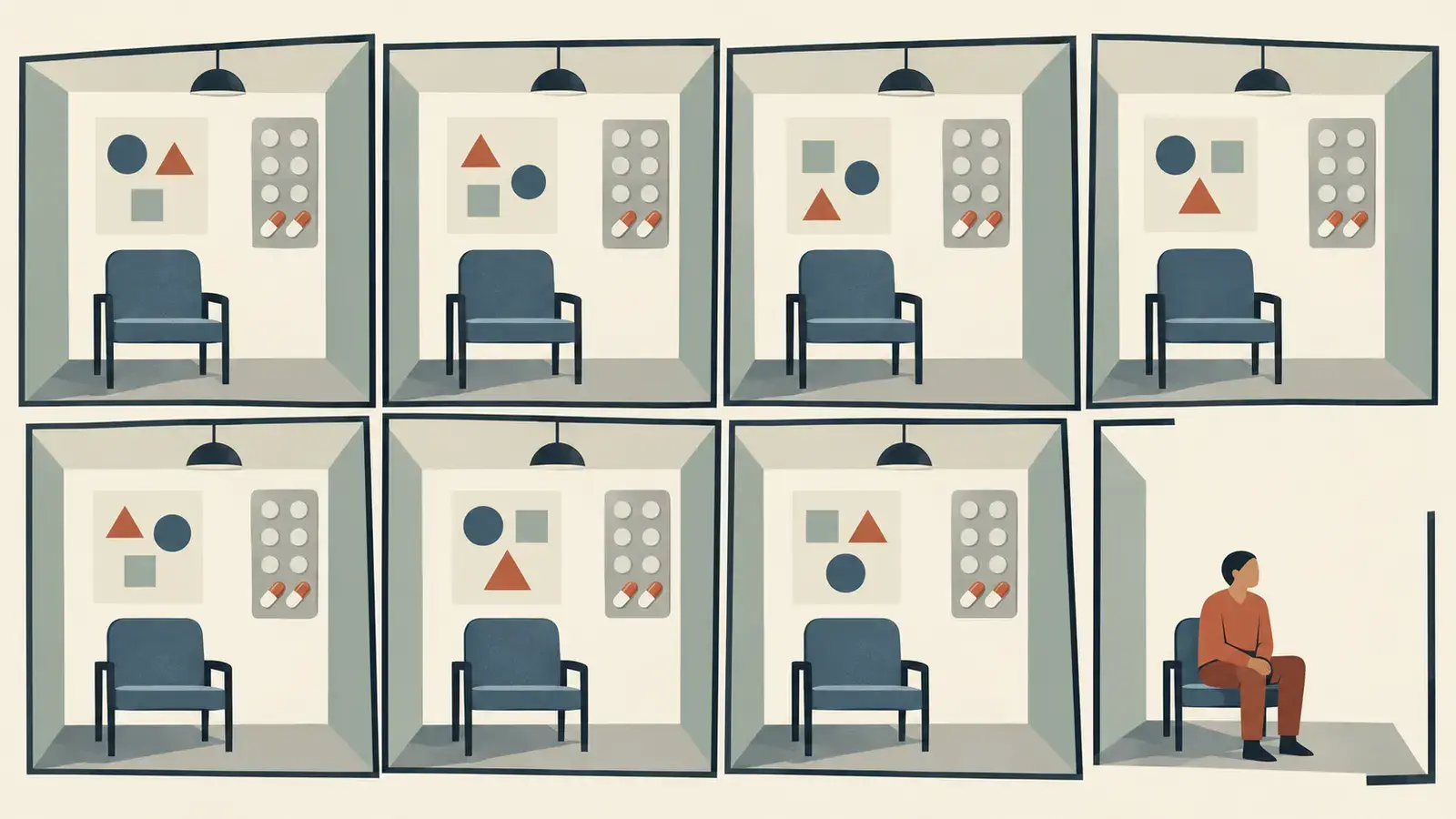
Andrew Scull, a historian of psychiatry, sees the field as facing a real crisis. The human mind and emotions are enormously complex, and psychiatry deals with people whose sense of reality, relationships and emotional control break down. He says the past three-quarters of a century have brought only limited progress, mainly in milder forms of distress. The available treatments are symptomatic rather than curative: 'We don't have a psychiatric penicillin for any of the conditions.' Both psychotherapy and drugs can help, but they can also create iatrogenic harm. For example, confronting trauma in PTSD treatment can make some patients worse, and psychiatrists cannot know in advance who will respond well to antipsychotics or antidepressants, who will suffer bad side effects, and for whom risks and benefits are finely balanced.
The diagnostic system is one source of crisis. DSM-III from 1980 created symptom checklists to make diagnosis reliable across clinicians after embarrassing disagreement and the Rosenhan pseudopatient scandal. Scull says reliability is not validity: labels like schizophrenia, bipolar disorder and major depression are based on symptoms, similar to 18th-century disease labels. Categories multiplied with each DSM edition. When leaders at NIMH spent more than $20 billion on genetics and neuroscience expecting brain pathology to recast diagnosis, it did not happen. Thomas Insel, its former director, admitted the lot of the mentally ill improved 'not one bit.' Insel and Steven Hyman denounced DSM-5 as unscientific. Scull says genetic findings also overlap across diagnoses, undermining distinct categories.
The asylum era began with genuine optimism. Early alienists expected to cure 60-80% of patients in therapeutic environments, rescuing them from jails and attics. But actual discharge rates were far lower, chronic patients accumulated, institutions became overcrowded and abusive. A new narrative blamed patients as 'degenerates' with inferior biology; it justified incarceration and then sterilization. Scull notes that by the 1960s more than 60,000 sterilizations had been performed in the US, with California doing a disproportionate share. German psychiatry borrowed these ideas. Under the Nazis, the T4 program killed as many as a quarter million mental patients, and gas-chamber technology was tested on them.
American philanthropy was entangled with that history. The Rockefeller Foundation chose psychiatry as a priority partly because of trustees' family experiences, but also because the field was backward and pressing. It spread money widely and supported genetic research, including the work of Ernst Rüdin in Germany. Rüdin absorbed California's sterilization lessons and became an enthusiastic advocate of sterilization and later of killing mental patients. Scull uses this as an example of how scientific research can be captured by dangerous ideology, with catastrophic consequences.
Desperate biological remedies followed from the belief that mental illness was a brain disease. One apparent model was general paralysis of the insane (GPI), tertiary syphilis. Wagner-Jauregg's malarial fever therapy won a 1937 Nobel Prize but was used heavily before penicillin made it obsolete. Henry Cotton at Trenton State Hospital promoted 'surgical bacteriology,' removing teeth, tonsils, stomachs, spleens and colons to eliminate hidden focal infections; he claimed around 80% cure rates, but about 45% of patients receiving abdominal surgery died within a year. The practice continued, with tonsils and teeth removed for decades.
Insulin coma therapy from 1933 induced deep hypoglycemic comas for schizophrenia; it carried a 1-5% mortality rate and caused brain damage and obesity, yet was hailed as a miracle cure. John Nash received it at Trenton, and was at risk of lobotomy. Metrazol convulsive therapy produced violent seizures and fractures. Lobotomy, introduced by Egas Moniz, who won the 1949 Nobel Prize, was popularized by Walter Freeman. Freeman's ice-pick lobotomy could be performed in minutes; he travelled in the 'Lobotomobile,' taught any 'damn fool' to do it, and performed many in an afternoon. Women bore the brunt of these experiments.
Electroconvulsive therapy also arose from a crude search for seizures: Cerletti and Bini learned from a slaughterhouse that current through the head of pigs caused convulsions. Early unmodified ECT caused spinal and hip fractures and memory loss, and in the 1940s-50s it was often used as discipline and control. Scull says the film One Flew Over the Cuckoo's Nest fixed a powerful public image of psychiatry. But modern ECT with muscle relaxants has evidence for severe, sometimes suicidal depression, and some patients call it lifesaving. It remains controversial because of memory problems, continuing concerns about brain damage, and the fact that nobody knows exactly why it works.
Psychoanalysis began with Freud's distance from Charcot and collaboration with Breuer on hysteria, including the famous Anna O. case. Freud developed ideas of the unconscious, repressed childhood trauma, free association and the id, ego and superego. At the 1909 Clark University conference, psychoanalysis met a relatively small American audience; Freud himself disliked America, but his ideas later spread among writers, artists and intellectuals. After World War II, psychiatrists influenced by psychoanalysis moved into office practice, but analysts resisted demands to prove outcomes. Scull says classical analysis remained too expensive, too long and too hard to measure for the mass of patients.
A rival emerged from clinical psychology during and after World War II. Psychologists were drafted in to treat soldiers and developed a training model that combined research methods with clinical work. Instead of reconstructing personality, they aimed to treat symptoms with shorter, reproducible therapies, especially cognitive behavioral therapy. Aaron Beck, originally trained in psychoanalysis, became disillusioned and joined this movement; he also helped expose unreliable diagnosis. Scull says evidence for CBT is of low-to-medium confidence, but for milder depression it can work better than drugs and without drug side effects, and NICE recommends it as a first line.
Psychopharmacology began accidentally. Chlorpromazine, an antihistamine first synthesized in the 1880s, was passed around for possible uses. Henri Laborit noticed it made surgical patients indifferent, like a 'chemical lobotomy,' and psychiatrists Delay and Deniker tried it in Paris. SmithKline & French bought the rights and turned it into Thorazine; within two years millions were taking it. Major tranquilizers became antipsychotics, and minor tranquilizers such as Miltown and later Valium followed. This shifted psychiatry toward drug treatment and transformed the industry.
The limits of antipsychotics became clearer over time. They can reduce positive symptoms such as hallucinations and delusions for many people, but do much less for negative symptoms like apathy, poverty of speech and loss of initiative. Side effects include restlessness, Parkinsonian symptoms and tardive dyskinesia. The 2005 CATIE study found newer second-generation drugs were not more effective than older ones and that between 67% and 82% of patients dropped out due to lack of effect or intolerable side effects; the newer drugs brought weight gain, diabetes and heart problems.
Antidepressants have a similarly mixed story. The first ones emerged from an accidental observation in tuberculosis patients, and SSRIs such as Prozac later dominated. Scull says they beat placebo statistically but often not by a clinically meaningful margin; much of the effect is placebo. Side effects include emotional numbing, sexual dysfunction and difficult withdrawal. Around 40% of depressed patients do not respond. At the same time, public policy has abandoned serious mental illness: people with serious mental illness die 15-25 years earlier, and the Los Angeles County Jail, Cook County Jail and Rikers Island function as the largest psychiatric inpatient facilities.
Scull's path forward is not nihilism. He wants more humility from psychiatry, less hype about breakthroughs such as psychedelics and ketamine, and more research on psychosocial supports, housing, families and social connection. He worries about loss of trust in science and medical institutions, but still believes biological components are part of the story and better drugs may emerge. The episode ends with his argument that progress has happened in small steps, that many clinicians genuinely want to help, and that giving up hope would be a mistake.




Comments