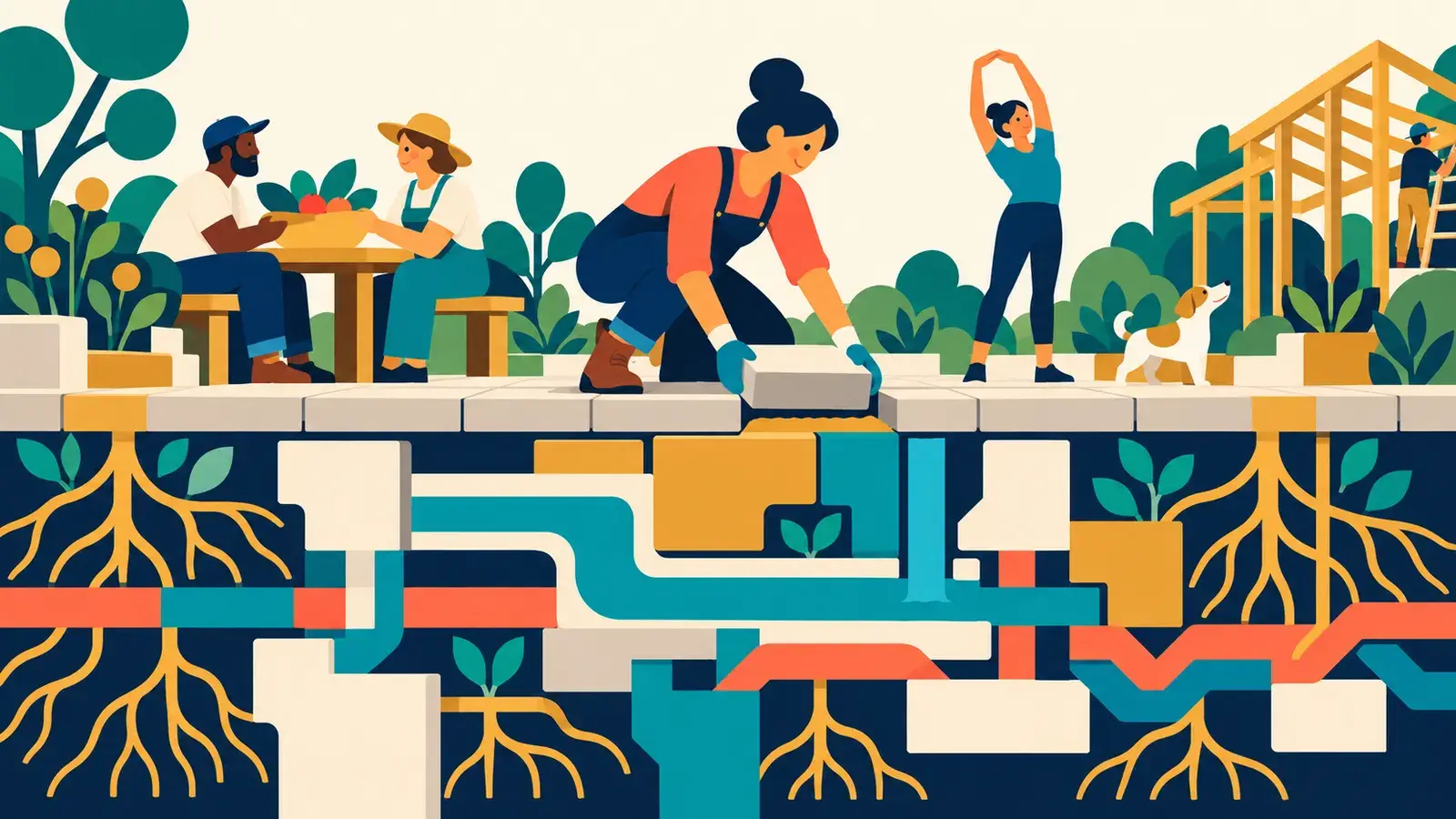
In this solo episode of the series, Nate Hagens explains that he originally planned the fifth part as a discussion of “no-regrets responses” to the composite future scenarios he presented in the previous parts. But during a bike ride, he says, he realized that the broad analysis of civilizational future landscapes has a personal echo that deserved to be explored first. So he moves that topic to the sixth part and turns the lens inward: how the same landscapes map onto the scale of a human life, and how we can move toward the better “valleys” of the future for ourselves.
The series had built four grids: economic, power, geopolitical and Earth system, which were combined into four composite worlds. Hagens argues that the same dynamics have parallels in individual lives. He proposes examining two things we direct—material flow and agency—and two foundations beneath them that limit what is possible. Throughout the analysis, he insists that the picture looks similar at the civilizational and personal levels: what appears to be success may be depleting reserves, while what looks like decline may be a slow return to life.
The first area is material flow. At the macro level, the question is whether the economy is growing or shrinking, and whether that is regenerative or extractive. At the personal level, he says, the question is whether the material flow and complexity of life are expanding or becoming simpler, and whether that builds us up or wears us down. Expansion can be regenerative when it is connected to health, skills, relationships and meaning. But it can be extractive when a growing career eats into time with children, animals or nature, when income rises but health deteriorates, or when social presence expands while relationships lose depth.
Likewise, simplification is not always the same. Hagens makes clear that you can simplify selectively: let go of obligations that exhaust you, sleep better and think more clearly because your body has time to recover. But contraction can also be outright decline when you did not choose it and it comes from exhaustion or giving up.
At this point, he introduces the distinction between “personal Mordor” and the “personal long repair.” The first looks successful on the civilizational scorecard—income, career, productivity, social status—but beneath the surface it consumes capital: health, close relationships, creative capacity and presence in the moment. The second looks like failure by the same measures, but feels like a return to life: less prestige, fewer possessions, less busyness, more rest, home-cooked meals, connection with the natural world and real conversations.
The second area is agency. At the macro level, the question was who holds power and who benefits; at the personal level, it is who actually controls time, attention and daily decisions, and who reaps the value of our efforts. The four sources of power—military, political, economic and technological—translate roughly into biology, social expectations, financial obligations and technology platforms. Hagens asks whether our time is truly our own, or whether an employer owns the daytime hours, a mortgage owns the nighttime worries, social obligations own the weekends, and the phone owns every gap in between.
He describes the personal version of “captured democracy” as a life full of freedoms that works like a trap: you make many choices each day, but they are predetermined by debts, obligations, habits and your phone. It looks like freedom without functioning as freedom. Broad agency, by contrast, belongs to someone whose time reflects their values. They are not free of obligations, but the commitments they make are mostly chosen, and the benefits return to them and to what they care about.
Beneath these two lie two foundations, slower and deeper, less responsive to conscious decisions because they are built from years of choices, childhood, genetics, trauma, experiences and luck. The first foundation is the body and nervous system, our personal “Earth,” which moves last. Hagens asks how much sleep debt we carry, how regulated our nervous system is, and whether our baseline state is calm and capacity or caffeine, cortisol and compulsions. As with the Earth system, we can ignore the signs for years, but by the time they become obvious, the damage is already advanced and recovery is slow. A body with intact foundations provides reserves and room for choice; a depleted foundation leaves no margin, allowing a setback to escalate.
The second foundation is the web of relationships, our personal geopolitics. This is not about networks or social media followers, but about the people who would show up at two in the morning if you were in trouble, who know what you are going through and stay beside you because they care. A strong web of relationships makes the personal long repair possible, because you have people to simplify with, share burdens with, hold you accountable and remind you who you really are. If that circle does not exist or is full of drama, stress leads to isolation, rigidity or complete breakdown. Even if we manage flow and agency perfectly, doing it alone means building on sand.
The four personal composite worlds emerge from combining these elements.
The personal long repair combines deliberate simplification, real agency, an intact body and a strong web of relationships. It is difficult, requires constant honesty with yourself, and can easily be lost through a stressful month or an enticing job offer, but it is the only truly regenerative path.
Personal Mordor has expanding flow, captured agency, a declining body and relationships maintained on the surface. The civilizational scorecard says everything is fine, but the danger is that you are consuming the very resources you would need for a graceful transition. Hagens himself acknowledges that he spent much of the first half of the year on this path, when recovery from knee surgery coincided with the situation in Hormuz.
The personal fortress is a simplified life with some agency, but mainly through an illusion of control. You are rich in financial capital and poor in everything else, able to survive but not thriving, and the fortress is expensive in both energy and money.
Finally, personal unraveling is when several areas collapse at once: health worsens while flow grows to pay medical bills, relationships deteriorate, and days become nothing more than reactions to whatever comes along.
The feedback loops resemble those in the civilizational scenarios. When the body is exhausted and there is no one beside us, but we must keep paying for the mortgage, food and lifestyle, agency shrinks and flow becomes extractive because there is no room for anything else. Stress and a shortage of personal energy or money pull us toward the fortress, just as scarcity and fear pull toward authoritarian concentration at the civilizational level.
Hagens notes an asymmetry: it is easier to slip from the long repair into the fortress under pressure than to climb from Mordor to the long repair, because that climb requires questioning the measures that civilization says mean everything is fine.
The conclusion is that most people, when they want to change their lives, focus on the more striking actions: what to do differently, how to spend their time, what to consume or cut out. These are questions of flow and agency. But bypassing the foundations is like building economic policy on a deteriorating biosphere.
The real questions are whether we get enough sleep, whether we rest, whether we feel calm in our bodies and can return to calm after stress, whether there are people who know us and care, and whether we spend time in green, wild places.
Foundational work is not glamorous: it is more sleep, walks, cooking, sitting with another person without an agenda, taking potatoes to a neighbor, putting the phone down at seven in the evening.
Hagens closes by saying that this personal maneuver is not visible week by week, but it is visible month by month and year by year. When the ground beneath civilization shifts, this progress is what will keep us steady.
The questions he leaves us with are which personal composite world we inhabit now, whether we are building foundations or eroding them, and whether we are building things that will last.
The good news, as he puts it, is that personal maneuvers are available to everyone here and now, without permission or institutional reform. They require honesty and small actions in the right direction that create positive feedback. He says he is not going to become a self-help guru, but acknowledges that people who change their own initial conditions are more likely to help society respond better to what is coming.


Comments