David Kirtley, a nuclear engineer and CEO of Helion Energy, spoke to Lex Fridman about nuclear fusion and his company's efforts to turn it into a commercial source of electricity.
He began with the basics: fusion is the process that powers stars, in which light hydrogen nuclei combine into heavier ones. Because the resulting nucleus has slightly less mass than its components, this mass difference is converted into energy according to the equation E=mc². Fission, by contrast, splits heavy nuclei such as uranium and plutonium, which are already unstable, and also releases energy through the same equation.
Kirtley explained that fission fuels are mined from the ground, while fusion fuels are found everywhere. Deuterium, a heavier isotope of hydrogen, exists in all the water on Earth—even in our bodies or in Coca-Cola. According to him, if humanity used fusion to meet today's electricity consumption, the deuterium in seawater would last for 100 million to 1 billion years. The fuel is stored mainly as heavy water or mixtures of hydrogen and deuterium, without requiring any rare raw material.
One key difference Kirtley highlighted is that fission occurs at room temperature and can become a self-sustaining chain reaction, while fusion requires temperatures above 100 million degrees and stops as soon as the fuel supply stops. That is why, he said, fusion is fundamentally safe: there is no chain reaction that can run out of control.
He considers modern fission reactors safe from an engineering standpoint, but says the problems at Chernobyl and Fukushima arose mainly from human factors, such as operating beyond design limits. He added that concerns about fission are also linked to uranium enrichment, which can be used for weapons.
According to Kirtley, fusion cannot be used to build nuclear weapons. Even the so-called hydrogen bomb is actually mainly a fission bomb, since most of its energy comes from uranium.
He said nuclear nonproliferation experts had urged him to develop fusion power plants as quickly as possible, because otherwise the world would turn to enriched uranium for clean baseload power, increasing the risk of weapons proliferation. In addition, because deuterium exists everywhere in the sea, no country can monopolize the fuel or cut off a pipeline, which could decouple energy from geopolitical tensions.
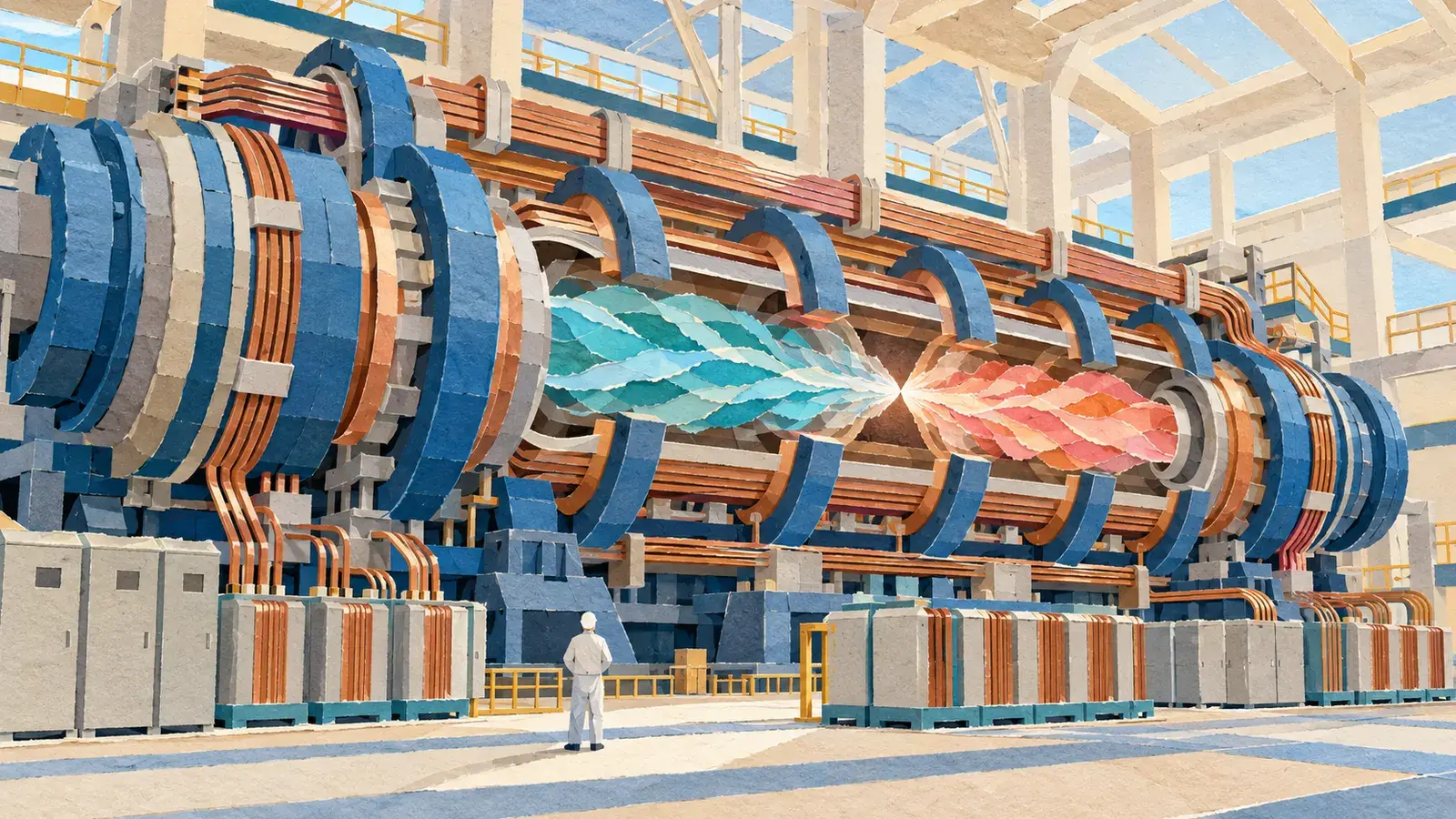
Kirtley described the main approaches to fusion. Inertial fusion, as used at the National Ignition Facility, compresses fuel with lasers for billionths of a second. Magnetic fusion, as used in tokamaks and stellarators, tries to confine plasma for a long time using magnetic fields. Helion uses a third approach, magneto-inertial fusion, which combines compression and magnetic confinement. It is based on “theta-pinch” experiments from the 1950s that achieved high performance but were limited by the technology of the time.
At the heart of Helion's method is the field-reversed configuration (FRC). Kirtley explained that if the magnetic field is reversed within a millionth of a second, the plasma does not have time to move and reorganizes itself. This creates an electric current within the plasma itself, which produces its own magnetic field and becomes trapped in it. The phenomenon resembles a transformer or solar flares, where similar self-organized plasmas, known as plasmoids, are observed in nature.
The problem is that these high-beta plasmas are inherently unstable. Kirtley used the analogy of a spinning top: a top falls over if it does not spin fast enough, but with enough kinetic energy and elongation, it can remain stable. This is described by the parameter S*/E, which links stability to the plasma's temperature and shape. The challenge is to heat the plasma quickly enough that it does not tip over before reaching fusion conditions.
That is why, he said, Helion is often more of an electrical engineering company than a fusion company.
One distinctive feature of Helion's approach is direct electricity recovery. In a tokamak, fusion heats water, produces steam and drives turbines with an efficiency of around 30–35%. In pulsed magnetic fusion, the expanding plasma pushes against the magnetic field, induces current in the coils and recharges the capacitors that started the process. Kirtley cited theoretical studies showing 80–85% efficiency for fusion energy, while recovery of the initial magnetic energy can exceed 95%. This, he said, changes the economics of fusion and allows smaller systems.
The choice of fuel is also critical. Deuterium–tritium, which dominates traditional designs, produces neutrons that leave the system and are used to boil water. But in a high-beta system, the neutron does not push against the magnetic field, so it is not ideal.
Helion prefers deuterium and helium-3, a reaction that produces charged particles capable of delivering electricity directly. The trade-off is that temperatures of 200–300 million degrees and larger systems are required, since increasing the temperature in a fixed magnetic field reduces the density. Helium-3 is also rare on Earth and must be produced or sought elsewhere.
Kirtley stressed that the goal is not simply fusion, but cheap electricity. The cost of a power plant approaches the cost of its materials asymptotically—concrete, steel, copper and aluminum. That is why the company designs smaller, mass-produced components instead of one huge, difficult magnet.
He argued that rapid construction and iteration also accelerate science because they allow you to learn quickly from each prototype. This philosophy, he said, was the opposite of what he believed at the beginning of his career, when he imagined that one large scientific experiment was the best path.
Helion has built seven prototype systems. The first were named after Starbucks coffee sizes, from Tall to Trenta. Trenta, which began operating in 2020, reached temperatures of 100 million degrees and, according to Kirtley, achieved the first known bulk deuterium–helium-3 fusion.
Technicians now make up around 50% of the team, which includes more than just scientists, with an emphasis on vertical integration and rapid construction. Kirtley noted that they buy used vacuum pumps on eBay, not to save money, but to receive them in weeks rather than nine months, provided they meet the specifications.
In 2023, Helion signed an agreement with Microsoft to build a fusion power plant that will supply the grid serving a data center, with the aim of generating its first electricity in 2028. Kirtley said he thinks about this deadline every day.
On the technical side, the pulsed operation allows power to be adjusted one to ten times a second, while the DC voltage from the capacitors can be converted into alternating current using established converters. The team is also exploring whether it could supply data centers directly with DC power, avoiding conversion losses, while semiconductor cooling has elements in common with cooling a data center.
Kirtley sees fusion as a way to replace around 4,000 gigawatts of installed fossil fuel capacity. He envisions a factory turning out 50-megawatt generators every day, on a scale similar to what has been achieved with rockets and electric vehicles.
He estimates that a 50-megawatt power plant could fit in a building of around 27,000 square feet, or about one stremma, compared with around 2,000 stremmas for solar power. This energy density, he said, could enable desalination, vertical food production in multistory buildings, and even microwave rocket propulsion without fuel.
At the end of the discussion, Kirtley reflected on the Fermi paradox and the Kardashev scale. He said a technologically advanced society might increase its intelligence rather than physically expand into space, as in the idea of Matrioshka brains. Fusion and artificial intelligence, according to him, could accelerate this path. He concluded that what impresses him most about physics is that all the pieces—from the forces of nature to the conditions for life—work together in a way that hardly seems accidental, and that humanity finds solutions even at the last moment.


Comments