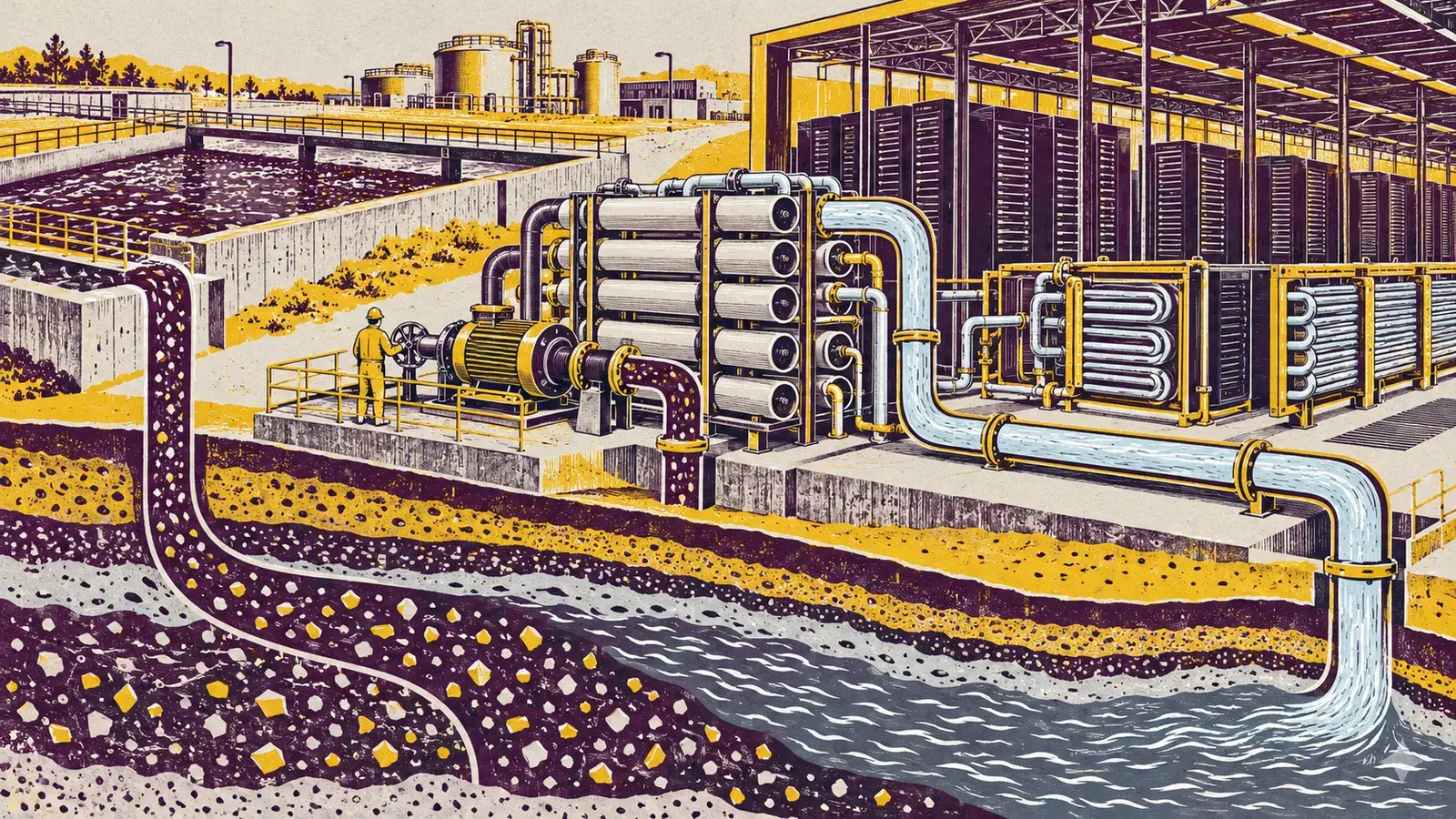
Treating salty water could meet some of data centers' cooling needs while reducing pressure on local freshwater supplies, according to new research from the University of Texas at Austin. The study, published in Water Research, examined different water supply and desalination scenarios, comparing their costs and environmental impacts. The aim is to connect two needs: securing water for data centers and managing water produced by industrial activities, such as oil and gas extraction.
The researchers argue that part of the problem can be addressed with technologies that are already available. Vaibhav Bahadur, a mechanical engineering professor and one of the research leaders, emphasizes that there is no need to wait for some future invention, but implementing today's solutions comes at a cost. The team examined how the choice of treatment method affects both expenses and the environmental footprint. The results concern planning and analysis scenarios, rather than widespread implementation of the approach.
The main desalination options presented are reverse osmosis membranes and thermal treatment. Membranes use less energy but struggle when the water's salt content exceeds that of seawater. The thermal method turns water into steam and then condenses it to produce fresh water, and is suitable for very high salinity. However, it requires more energy and faces problems with salt deposits on equipment.
According to the research team, even the most energy-intensive water treatment accounts for a small share of a data center's total energy consumption. The researchers therefore estimate that pressure on local water resources can be reduced without a drastic increase in overall costs or energy demand. Comparing the methods remains essential, since membranes' lower energy consumption comes with limitations on salinity. The study examines these options in relation to the needs of individual projects.
In Texas, the oil and gas industry is presented as a potential supplier of water for treatment. Bahadur says the Permian Basin produces a volume of water equivalent to 1,200 Olympic-sized swimming pools every day, which is currently transported over long distances and injected underground. He says this practice is linked to problems, including the risk of seismic activity, while available capacity for underground disposal could run out as early as 2030. Treating this water for use in cooling is proposed as a way to put it to use.
To assess local pressure on water resources, the researchers developed a new index, Saline Water Utilization Intensity, or SWUI. Of the three data center scenarios studied, the one for a project in Longview, Texas, showed the lowest pressure according to this index. That scenario involves using brackish groundwater and treating it with two-stage reverse osmosis. According to the analysis, this combination would allow high freshwater recovery, low costs and relatively limited energy consumption.
The research comes at a time of increased scrutiny of data centers' environmental impacts. The accompanying release says that in September, Texas Governor Greg Abbott ordered a halt to the issuing of new permits so that the consequences for local communities could be assessed further. It also says the state attorney general's office announced an investigation into water use by existing data centers. Permitting decisions thus provide an immediate opportunity to use the team's analyses.
Bahadur and his colleagues in the COMPASS consortium are also developing software to assess individual projects and inform residents, elected officials and companies. He and economist Ning Lin recently presented their research to the Texas Senate committee responsible for water, agriculture and rural affairs. Lin points out that local officials are often asked to make decisions without an objective analysis of water and electricity consumption. The aim of the effort, she explains, is to give them tools to help protect their communities and secure benefits for them.




Comments