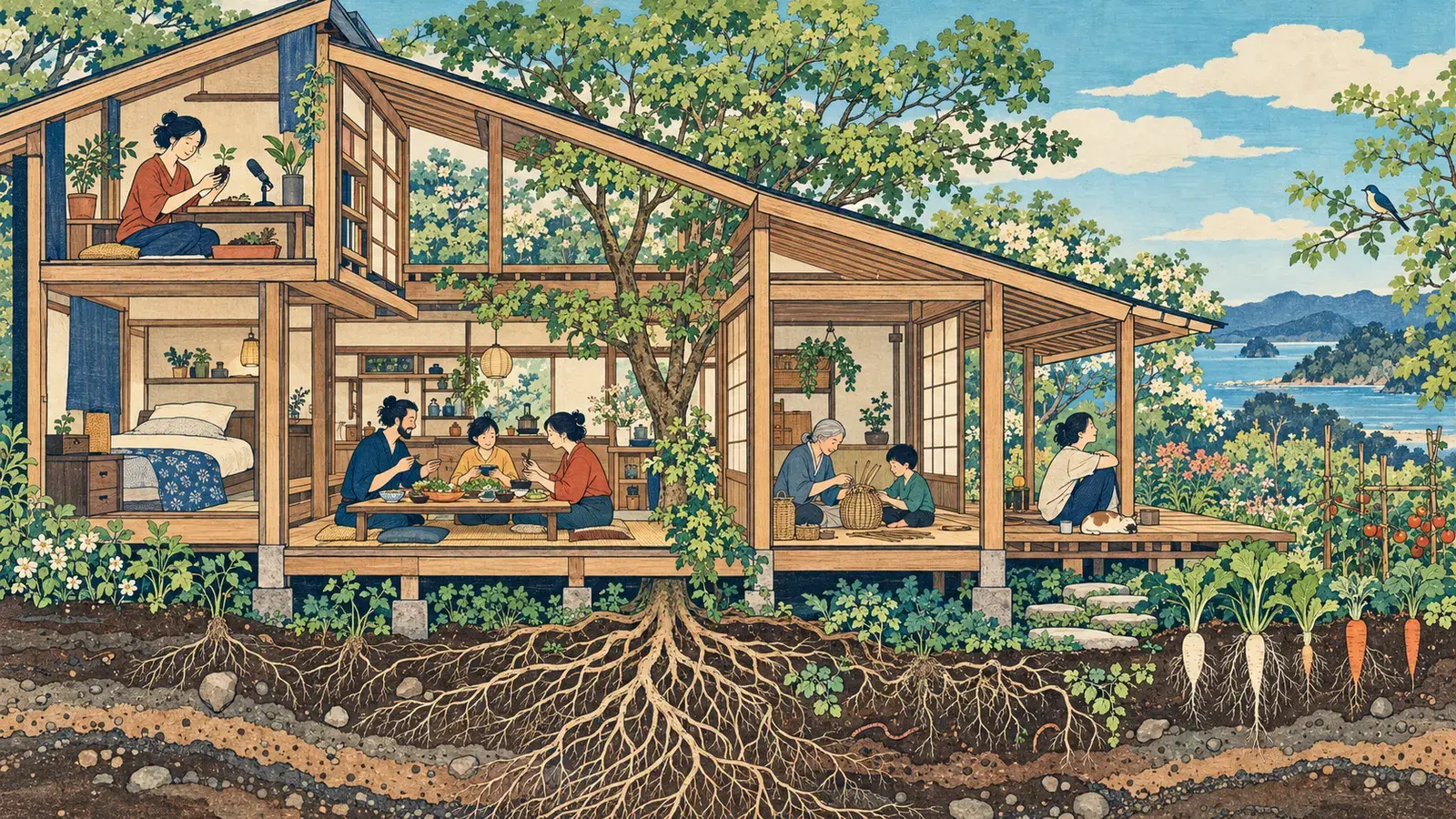
Nate Hagens opens the episode with a listener's comment: after everything he has learned through the podcast, what does he want? He says he thought about it for several days and initially had dozens of answers, until he realised that a bigger question was hidden within it: what do I want to want? He clarifies that he does not mean what he wanted when he was younger, or what culture, advertising, the pursuit of dopamine or status games tell him to want.
The question, as he frames it, is what he would like to have lived through and experienced in a human lifetime, looking back from some future point, possibly even beyond his own lifetime. He asks listeners to pause and think of around ten things they themselves want to want for the future. He stresses that these are not goals, but his personal version of humanity's foundations, whether we are talking about fifty or five hundred years from now.
First on his list are basic needs: food, water, shelter, heating and cooling when needed. He adds that we do not need all the heating and cooling that modern civilisation demands, and mentions that he has a sleeping bag that keeps him warm down to zero. For him, basic needs are essential because without enough of them nothing else matters, while having enough makes many things possible.
Second comes stability. Hagens says this may be a result of living in this era and knowing how unique the positive side of the carbon pulse has been. The negative side, he explains, puts many of the biosphere's ecological foundations of stability at risk, while social and geopolitical instabilities also exist. He believes having a stable sense of what to expect from the future is very important for a person to flourish.
Next is agency, freedom or volition: the ability to act, shape one's day and choose how to respond to things. Hagens describes it as a quiet confidence that he can respond rather than simply react. Related to this is self-restraint, because he does not want unbridled freedom, but limits that bind us as people living together, not because they are oppressive, but because they protect what we have collectively decided matters.
At this point, he talks about guardrails for the commons, ethics and laws that keep the tragedy of the commons at bay and remind us of something larger. He argues that a degree of self-restraint is linked to wisdom. He then turns to love across its full spectrum: romantic, sexual, sensual, psychological, spiritual and intellectual. He adds that beyond a relationship with one person, friendship and networks may be the best part of being human: interacting with small groups of others.
He describes three types of friendship in his life: people he enjoys spending time with, doing things such as fishing or playing games; intellectual friends with whom he learns and works through ideas; and friends with whom he collaborates towards a purpose. He says that, after basic needs, friendship is a foundation of a good human life. He builds community on that too: a sense of belonging and interaction beyond close friends, with shared rituals, mutual support and neighbours who help one another.
He also wants to have a craft or skill, something he can get better at and practise, whether writing, gardening, teaching or building things. He describes it as the joy of sharpening one's samurai sword by working on something one values, creates and cares for. He does not leave out fun, novelty and play: music, games, stories. He notes that we are not only thinkers and doers but also players, and that a beautiful song, a joke or a game can keep us going.
He then turns to curiosity, wonder and awe. He likes learning, seeing things and understanding how they work and how they connect. He gives the example of a century-old tree in a meadow and the entire succession of life that follows it. From there, he moves on to access to the natural world, to have daily reminders that he is not separate from nature but part of it, and to see the beautiful complexity of the web of life, something many people today do not have.
He also includes a non-human companion in his life: a dog, though, as he says, it could be a goat, a bird or a duck, a creature with non-human eyes. He comments that some of his best experiences have been with his non-human friends, because with his dog he can truly be himself. He reminds listeners that we co-evolved with wolves and ended up with dogs, something that serves as a non-human reminder of our connection to the natural world.
Last on his list is a purpose larger than life's superficial details: to be useful, to contribute, not for praise, likes or status, but to matter, to leave a mark on something greater than himself. After finishing the list, he asks listeners to notice what is missing: there are no yachts, skyscrapers, designer brands or ultra-fast forms of transport, because once basic needs are met, most of the best things in life are free or nearly free.
He observes that many of the things he wants come from within and relate to the human condition, can exist in good times or bad, with or without money, and are timeless human desires. Some, however, depend on society, ecosystems, the level of technology, energy, material flows and cohesion. He points out that culturally, economically and psychologically, we are tied to what we have already invested in and to the stories we tell about success, and if we could start over, many of us would want different, more sustainable things.
That is why he concludes that any real discussion about the future must begin with what we desire, what we truly want or what we want to want. If we do not ask this question, he says, we will keep building futures that serve desires tied to an exceptionally unsustainable period in human history. He closes by suggesting that listeners ask themselves how much the sunk costs of past investments in their lives and in culture influence their answers.
Comments